Income Tax : Learn how different types of income tax assessments are conducted under the Income-tax Act. The FAQs explain assessment procedures...
Income Tax : This guide explains who is required to maintain books of account under Section 44AA based on business, profession, turnover, and i...
Income Tax : This guide explains the various assessments under the Income-tax Act, including summary assessment, scrutiny assessment, best judg...
Income Tax : ITAT Mumbai held that an addition under Section 69A cannot be sustained when the assessee is denied the opportunity to cross-exami...
Income Tax : The Tribunal held that CIT(A) cannot enhance income under Section 251 on matters not considered by the Assessing Officer during as...
Income Tax : Learn about the new block assessment provisions for cases involving searches under section 132 and requisitions under section 132A...
Income Tax : Discover how Finance Act 2021 revamped assessment and reassessment procedures under Income-tax Act, impacting notices, time limits...
Income Tax : Income Tax Gazetted Officers’ Association requested CBDT to issue Clarification in respect of the judgement of Hon’ble Supreme...
Income Tax : In view of Indiscriminate notices by income Tax Department without allowing reasonable time it is requested to Finance Ministry an...
Income Tax : Lucknow CA Tax Practicioners Association has made a Representation to FM for Extension of Time Limit for Assessment cases time bar...
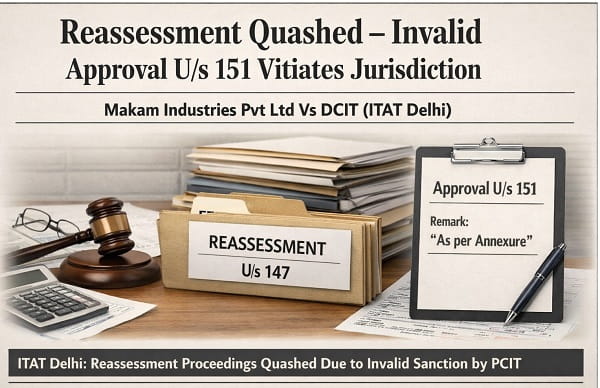
Income Tax : ITAT Pune held that the reassessment proceedings were invalid because the notice under Section 148 was approved by the Principal C...
Income Tax : ITAT held that interest earned by a co-operative credit society from deposits with a co-operative bank remained attributable to it...
Income Tax : ITAT Pune held that reassessment proceedings were invalid because the approval under Section 151 was granted by the Principal Comm...
Income Tax : The Supreme Court set aside High Court judgments quashing reassessment notices after noting that the Finance Act, 2026 introduced ...
Income Tax : The ITAT held that Section 68 could not be applied to sale proceeds received from investments already recorded in the books in an ...
Income Tax : ITAT Chandigarh held that ITO Ward-3(1), Chandigarh had no jurisdiction to issue notice to an NRI and hence consequently the asses...
Excise Duty : Notification No. 29/2024-Central Excise rescinds six 2022 excise notifications in the public interest, effective immediately. Deta...
Income Tax : Learn how to initiate proceedings under section 147 of the IT Act in e-Verification cases. Detailed instructions for Assessing Off...
Income Tax : Explore e-Verification Instruction No. 2 of 2024 from the Directorate of Income Tax (Systems). Detailed guidelines for AOs under I...
Income Tax : Supreme Court in the matter of Shri Ashish Agarwal, several representations were received asking for time-barring date of such cas...
The ITAT ruled that section 69A cannot be invoked unless ownership of cash is established. Mere third-party seized ledgers without recovery of money are insufficient to sustain an addition.
The ITAT emphasised that dismissal of appeals without dealing with substantive grounds is legally untenable. NFAC was directed to rehear the reassessment appeals after granting reasonable opportunity.
The Tribunal held that once the Assessing Officer has examined and accepted the source of property investment, the Commissioner of Income Tax (Exemption) cannot reopen the issue under section 263. The ruling emphasizes finality of AO’s findings.
The appeal was filed late due to ongoing police proceedings against the assessee. The Tribunal held this to be sufficient cause and restored the appeal for fresh consideration.
The appeals were dismissed solely due to delay without examining merits. The Tribunal held that substantive justice requires condonation, though costs may be imposed for repeated defaults.
The issue was whether entire cash deposits could be added as unexplained despite income being declared under section 44AD. The Tribunal held that presumptive taxation shields routine business deposits, though a reasonable lump-sum addition was justified where receipts were partly unsubstantiated.
The ITAT held that reassessment was invalid where notices and orders showed shifting facts and no independent reasoning. Changing bases across stages reflected a casual approach that vitiated jurisdiction.
The issue was whether reassessment and LTCG addition could rest solely on INSIGHT portal information. The ITAT held that without independent enquiry or corroborative material, such inputs cannot sustain reopening or additions. The key takeaway is that suspicion can-not substitute evidence.
The Tribunal examined whether an addition under section 153C could survive without seized material. It held that in an unabated year, additions are impermissible without incriminating evidence found during search, leading to deletion of the addition.
The Tribunal ruled that a creditor’s write-off alone cannot trigger section 41(1) taxation. The assessee’s liability persisted in its books, and the ₹10.23 crore addition was deleted.