Income Tax : Income may become tax-free under the new tax regime because of the standard deduction and Section 87A rebate, but ITR filing may s...
Income Tax : This guide compares the Old and New Tax Regimes, explaining differences in deductions, exemptions, home loan benefits, and standar...
Income Tax : Old Regime vs New Regime for Salaried Employees in FY 2026-27: A CA’s Optimisation Checklist The article explains that no ch...
Income Tax : Despite withdrawal of many tax benefits under Section 115BAC, official duty-related allowances remain exempt to the extent of actu...
Income Tax : The article explains that HRA exemption is unavailable under the new tax regime, which is why the HRA field may not appear in the ...
Income Tax : The Government confirms a higher rebate under the new tax regime, ensuring no tax up to ₹12 lakh and outlining revised slabs eff...
Income Tax : Union Budget 2025-26 introduces tax relief with no income tax up to Rs. 12 lakh, benefiting middle-class taxpayers and boosting co...
Income Tax : The ITAT Pune held that the option exercised under Section 115BAC continues for subsequent years unless it is withdrawn or becomes...
Income Tax : ITAT held that once Form 10IE is validly exercised and not withdrawn, it continues for later years. AO was directed to grant Secti...
Income Tax : The Tribunal held that a one-day delay in filing Form 10IE for an earlier year cannot defeat the assessee’s right to be taxed un...
Income Tax : Read the full text of the ITAT Pune order in Akshay Devendra Birari Vs DCIT regarding the allowance of benefits under the new inco...
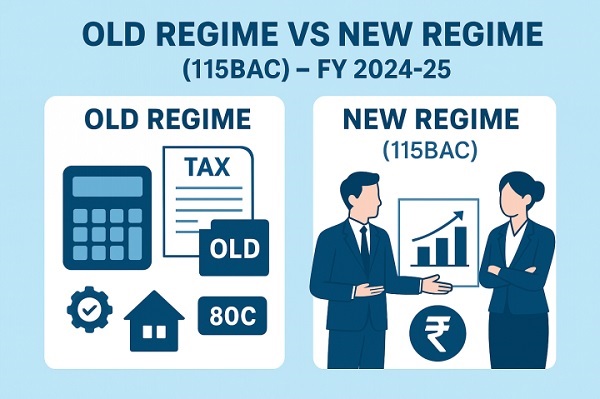
This title highlights that the correct tax regime depends on your real deductions, not assumptions. The comparison shows how your financial profile—not salary—determines which option saves more tax.
Two CIT(A) rulings confirm the Section 87A tax rebate applies to total income up to Rs.7 lakh, even with Short-Term Capital Gains (STCG) u/s 111A, for taxpayers under the new 115BAC(1A) regime.
Missing the ITR due date u/s 139(1) mandates the use of the new tax regime, as the option to choose the old regime or file Form 10−IEA is lost.
Compare deductions under India’s old and new tax regimes. Learn which tax-saving options, including Standard Deduction and Gratuity, are available in each.
Effective A.Y. 2024-25, the new tax regime is the default. Taxpayers with business or professional income must file Form 10-IEA to opt for the old regime.
Learn about India’s optional tax regime under Section 115BAC, which offers lower tax rates in exchange for giving up various exemptions and deductions.
Understand the key deductions for AY 2025-26 under the new tax regime, including standard deduction, NPS, and the ₹7 lakh tax rebate.
Understand the 2025-26 salary tax implications in India. Compare old vs. new tax regimes, tax slabs, deductions (80C, 80D, HRA), and choose the best option for your income.
The new tax regime simplifies taxes with lower rates but fewer deductions. Learn which key deductions, like standard deduction and gratuity, are still available in both the new and old tax regimes.
India’s Equalisation Levy is phased out and replaced by the Significant Economic Presence (SEP) regime. This shifts the tax from a gross revenue basis to a net income basis.