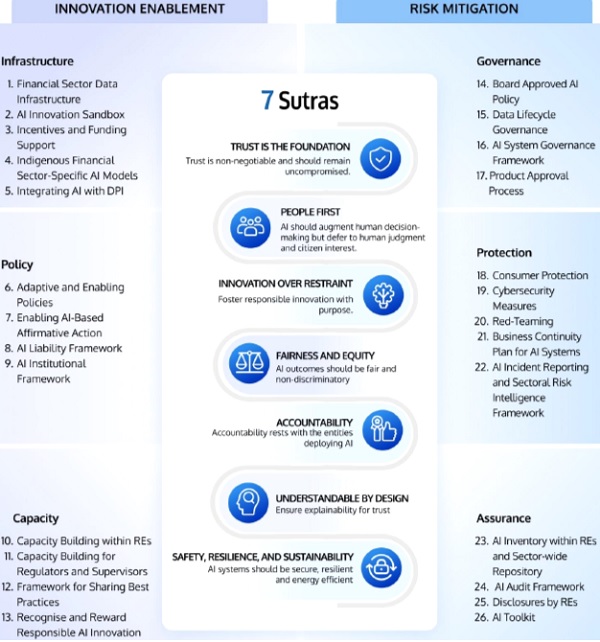
The Reserve Bank of India (RBI) has published the report from its Committee to develop a Framework for Responsible and Ethical Enablement of Artificial Intelligence (FREE-AI) in the Financial Sector. Formed on December 26, 2024, the committee’s report provides a strategic framework to guide the use of AI in finance. The framework is built on seven core principles, or “sutras,” which include Trust, People First, Innovation over Restraint, and Fairness. Based on these principles, the committee has provided 26 recommendations organized under six pillars: Infrastructure, Policy, Capacity, Governance, Protection, and Assurance. Recommendations for innovation enablement include establishing a shared data infrastructure, creating an AI Innovation Sandbox, and developing indigenous financial sector-specific AI models. For risk mitigation, the committee recommends that regulated entities (REs) create board-approved AI policies, enhance cybersecurity, and ensure robust governance frameworks throughout the AI lifecycle. The report aims to balance the tremendous potential of AI to promote financial inclusion and efficiency with the need to mitigate risks like bias, lack of explainability, and data protection issues.
Reserve Bank of India
August 13, 2025
Report of the Committee to develop a Framework for Responsible and Ethical Enablement of Artificial Intelligence (FREE-AI) in the Financial Sector
In pursuance to the announcement made in the Statement on Developmental and Regulatory Policies released along with the Monetary Policy Statement dated December 06, 2024, the Reserve Bank of India had set up the committee to develop a Framework for Responsible and Ethical Enablement of Artificial Intelligence (FREE-AI) in the Financial Sector on December 26, 2024.
2. The Committee, after extensive deliberations with diverse stakeholders, has since submitted its report and the same is being placed on the RBI website.
3. The report sets out a framework to guide the use of AI in the financial sector, aiming to harness its potential while safeguarding against associated risks. The Committee has developed 7 Sutras to serve as the foundational principles for AI adoption. Guided by the 7 Sutras, the Committee has recommended a forward-looking approach, containing 26 actionable recommendations under six strategic pillars. The report envisions a financial ecosystem where encouraging innovation is in harmony, and not at odds, with mitigation of risk.
Press Release: 2025-2026/902
(Puneet Pancholy)
Chief General Manager
Executive Summary
Artificial Intelligence (AI) is the transformative general-purpose technology of the modern age. Over the years, the simple rule-based models have evolved into complex systems capable of operating with limited human intervention. More recently, it has started to reshape how we work, how businesses operate and engage with their customers. In the process, it has forced us to question some of our most fundamental assumptions about human creativity, intelligence and autonomy.
For an emerging economy like India, AI presents new ways to address developmental challenges. Multi-modal, multi-lingual AI can enable the delivery of financial services to millions who have been excluded. When used right, AI offers tremendous benefits. If used without guardrails, it can exacerbate the existing risks and introduce new forms of harm.
The challenge with regulating AI is in striking the right balance, making sure that society stands to gain from what this technology has to offer, while mitigating its risks. Jurisdictions have adopted different approaches to AI policy and regulation based on their national priorities and institutional readiness.
In the financial sector, AI has the potential to unlock new forms of customer engagement, enable alternate approaches to credit assessment, risk monitoring, fraud detection, and offer new supervisory tools. At the same time, increased adoption of AI could lead to new risks like bias and lack of explainability, as well as amplifying existing challenges to data protection, cybersecurity, among others.
In order to encourage the responsible and ethical adoption of AI in the financial sector, the FREE-AI Committee was constituted by the Reserve Bank of India. The RBI conducted two surveys to understand current AI adoption and challenges in the financial sector. The Committee referenced these surveys and, in addition, undertook extensive stakeholder consultations to gain further insights.
After extensive deliberations, the Committee formulated 7 Sutras that represent the core principles to guide AI adoption in the financial sector. These are:
(i) Trust is the Foundation
(ii) People First
(iii) Innovation over Restraint
(iv) Fairness and Equity
(v) Accountability
(vi) Understandable by Design
(vii) Safety, Resilience and Sustainability
Using the Sutras as guidance, the Committee recommends an approach that fosters innovation and mitigates risks, treating these two seemingly competing objectives as complementary forces that must be pursued in tandem. This is achieved through a unified vision spread across 6 strategic Pillars that address the dimensions of innovation enablement as well as risk mitigation. Under innovation enablement, the focus is on Infrastructure, Policy and Capacity and for risk mitigation, the focus is on Governance, Protection and Assurance. Under these six pillars, the report outlines 26 Recommendations for AI adoption in the financial sector.
To foster innovation, it recommends:
- the establishment of shared infrastructure to democratize access to data and compute; the creation of an AI Innovation Sandbox
- the development of indigenous financial sector-specific AI models
- the formulation of an AI policy to provide necessary regulatory guidance
- institutional capacity building at all levels, including the board and the workforce of REs and other stakeholders,
- the sharing of best practices and learnings across the financial sector
- a more tolerant approach to compliance for low-risk AI solutions to facilitate inclusion and other priorities
To mitigate AI risks, it recommends:
- the formulation of a board-approved AI policy by REs
- the expansion of product approval processes, consumer protection frameworks and audits to include AI related aspects
- the augmentation of cybersecurity practices and incident reporting frameworks
- the establishment of robust governance frameworks across the AI lifecycle
- making consumers aware when they are dealing with AI
This is the FREE-AI vision: a financial ecosystem where the encouragement of innovation is in harmony with the mitigation of risk.
FREE AI Framework