In re Kapil Sons (Rajendra Kumar Baheti) (GST AAR Maharashtra)
From the submissions made by the applicant we observe that the main contractor has been given a contract by MSRDC to construct tunnels for Mumbai Pune Expressway and accordingly, the main contractor has subcontracted the tunneling work to the applicant by way of drill and blast technique of tunneling. In the subject case, the work is for construction of tunnels which can be considered as immovable properties belonging to the Government of Maharashtra. Further as per the work order submitted by the applicant, it clearly appears that the impugned activity carried out by the applicant can classified as composite supply of works contract for construction of tunnel. This would answer the first question raised by the applicant.
It is further noticed that similar view has been taken by the Advance Ruling Authority of Gujarat in case of M/s KHEDUT HAT [2018-TIOL-173-AAR-GST] that blasting work with use of explosives is a composite supply.
In respect of the second question asked by the applicant, we hold that the impugned activity carried out by the applicant is a composite supply of works contract for construction of tunnel and is covered under Entry 3(iv) of Notification No. 11/2017-CT (Rate) dated 28.06.2017.
FULL TEXT OF THE ORDER OF AUTHORITY FOR ADVANCE RULING, MAHARASHTRA
The present application has been filed Under Section 97 of the Central Goods and Services Tax Act, 2017 and the Maharashtra Goods and Services Tax Act, 2017 [hereinafter referred to as “the CGST Act and MGST Act” respectively] by M/s. KAPIL SONS, the applicant, seeking an advance ruling in respect of the following question.
1. Whether the activity to be carried by the applicant shall be classified as supply of goods or services or a composite supply of ‘works’ contract’?
2. Whether the activity should be classified as Composite Supply of works contract for Construction of tunnel under Entry 3(iv) of Notification No. 11/2017-CT (Rate) dated 28.06.2017 taxable at the rate of 12%?
At the outset, we would like to make it clear that the provisions of both the CGST Act and the MGST Act are the same except for certain provisions. Therefore, unless a mention is specifically made to any dissimilar provisions, a reference to the CGST Act would also mean a reference to the same provision under the MGST Act. Further to the earlier, henceforth for the purposes of this Advance Ruling, the expression ‘GST Act’ would mean CGST Act and MGST Act.
2. FACTS AND CONTENTION – AS PER THE APPLICANT
The submissions made by M/s Kapil Sons are as under:-
2.1 M/s Kapil Sons, the applicant is registered under GST and engaged in drilling and blasting works at various sites using Industrial explosives and other materials.
2.2 Government of Maharashtra entrusted Maharashtra State Road Development Corporation Limited (MSRDC), a corporation fully owned by Government of Maharashtra, the development, operation and maintenance of Two Tunnel (Two Tubes of four lane each) for Missing Link under Capacity Augmentation Of Mumbai to pune Expressway in Mumbai.
2.3 MSRDC resolved to construct the same, invited proposals for short listing of bidders for EPC and accepted the bid of a company M/s Navyauga Engineering Company Limited (Main Contractor) and issued its letter of Acceptance. MSRDC entered into an Engineering, Procurement and Construction Agreement on 11th of October 2018 with M/s Navyauga Engineering Company Limited for the following work:
Construction of Two Tunnel (Two tubes of four lane each) for Missing Link under Capacity Augmentation of Mumbai Pune Expressway in the state of Maharashtra under EPC mode.
2.4 In relation to the work awarded under above EPC Agreement, the main contractor engaged the applicant for a sub-contracting arrangement for the construction of tunnel by drilling and blasting method and issued a work order for subject work titled as under:
Work Order for Drilling & Blasting Charges for Missing Link Project, Maharashtra – reg.
The description of supply to be made by the applicant was “Drilling and Blasting including all tools, materials, explosive vans etc complete for approach roads and tunnel works.
B. STATEMENT CONTAINING APPLICANT’S INTERPRETATION OF LAW AND/OR FACTS
Legal Provisions as applicable
2.5 The charging section for GST is Section 9 of the Central Goods and Services Tax Act 2017. The term “goods” has been defined under section 2(52) of the CGST Act, 2017. The term “services” has been defined under section 2(102) of the CGST Act, 2017. Section 2(30) defines a composite supply and the term works contract has been defined under Section 2(119) of the CGST Act, 2017. Further, clause 6 of the Schedule II states that works contract as defined in clause (119) of section 2 shall be treated as a supply of services.
2.6 The GST rates on services have been notified by the Government in Notification No. 11/2017-CT (Rate) dated 28.06.2017. which has been amended by various notifications and Sr.No 3 (iv) of the said notification (as amended up to date) states that Composite supply of works contract as defined in clause (119) of section 2 of the Central Goods and Services Tax Act, 2017, [other than that covered by items (i), (ia), (ib), (ic), (id), (ie) and (if) supplied by way of construction, erection, commissioning, installation, completion, fitting out, repair, maintenance, renovation, or alteration of a road, bridge, tunnel, or terminal for road transportation for use by general public attract 12% GST.
Interpretation of provisions and applicable concepts
2.7 The nature of work awarded by MSRDC needs to be understood. Construction of tunnel involves a series of steps including planning for various factors including, route studies, Tunnel type studies, geotechnical, investigations, operational and financial planning, risk management etc.
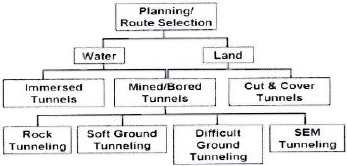
2.8 There are various methods of construction of tunnel also known as tunneling methods, as depicted in above chart and the main contractor has to undertake rock tunneling for the awarded work.
The rock tunneling methods generally prevalent in use are:-