
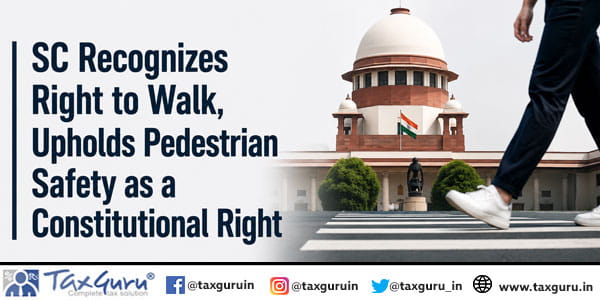
The Supreme Court’s decision in Maniyar Iliyaz @ Shaik Riyaz & Anr. v. P. Ayyappan & Ors. marks a watershed moment in Indian constitutional law by recognizing the fundamental right to walk and the right to use safe, demarcated footpaths as integral to Articles 19(1)(d) and 21 of the Constitution. The case arose from the tragic death of a five-year-old child who was struck by a tanker while walking to school with his father on a road without a footpath or pedestrian crossing. While enhancing compensation, the Court went beyond motor accident jurisprudence by holding that pedestrian rights take precedence over motor vehicle movement. It converted the matter into an Article 32 petition titled Re: Fundamental Right to Walk and Footpath, directed the Union Government’s participation, sought Law Commission review of the statutory framework, and emphasized that authorities must provide safe, uninterrupted footpaths, making pedestrian safety a constitutional obligation rather than merely a policy objective.
THE RIGHT TO WALK THROUGH A NATION BUILT TO DRIVE
“A man on foot, on horseback or on a bicycle will see more, feel more, enjoy more in one mile than the motorized tourists can in a hundred miles”. — Edward Abbey, American author and philosopher
This reflection by this famous writer and wilderness philosopher cuts to the heart of what India’s road planners forgot: that walking is not a deficiency of transport, but the most human form of movement there is. The Supreme Court, in Maniyar Iliyaz @ Shaik Riyaz and Anr. V. P. Ayyappan and Ors. (2026 INSC 647)[1], has finally said the same thing in the language of constitutional law.
A Morning Walk That Never Came Home
Like any young father, the appellant lovingly readied his five-year-old son and left home at 9 am to drop him at the neighbourhood school. How would anyone even think that it would become the last stroll for his son? Father and son were strolling down to the school when suddenly a tank came from the rear side and hit the child, breaking his waist and below part of the body.
Take it for granted, there was neither a footpath nor a pedestrian crossing.
That one line — spare, almost clinical — contains within it the weight of every pedestrian death in this country. It is not a freak accident. It is a structural failure, one that the Indian state has tolerated for decades by treating pedestrians as inconvenient afterthoughts to a road-use regime designed almost entirely around the motorised vehicle.
On June 19, 2026, a Bench of Justice Pamidighantam Sri Narasimha and Justice Atul S. Chandurkar of the Supreme Court of India chose not to let this particular death be reduced to one more Motor Accident Claims Tribunal number. It was established in Maniyar Iliyaz @ Shaik Riyaz & Anr. v. P. Ayyappan & Ors. (2026 INSC 647) that the right to walk along footpaths, which have been marked out and designed for walking, is a fundamental right guaranteed by the Indian Constitution and is superior to the rights of vehicles.
The Judgement Day
The facts were tragically ordinary. A father was walking his child to school. There was no footpath. A boy was killed by a tanker. The Motor Accidents Claims Tribunal awarded Rs. 782,000; the Supreme Court. The Supreme Court did two things simultaneously: it corrected the compensation, and it corrected the constitutional imagination of the country.
In this regard, the court ruled that the foremost right of movement under Article 19(1)(d) is the “Fundamental Right to Walk,” a right that comes before the right to move about using wheels and therefore must apply to ensure that the right is upheld by providing access to safe and clearly defined footpaths. However, the basic right of the citizen to traverse through these marked pathways shall be prior to the right of the movement by mechanical modes.
This freedom is very crucial for the exercise of rights guaranteed under Articles 19(1)(d), 19(1)(a), 19(1)(b), 19(1)(c), and 21 of the Indian Constitution. This is so because it was necessary to create a connection between the right to move, the right to express, the right to associate, and the right to live.
The Court observed that the Motor Vehicles Act, 1988, is not and has never been the statute that recognises the fundamental right to walk. In fact, it has in many ways been an impediment, undermining the precious rights of walkers[2]. The Motor Vehicles (Driving) Regulations, 2017, which recognises pedestrians as road users, do not recognise the basic right of walking on demarcated footpaths or give priority to this right over motorised roads; thus, they are nothing but guidelines for motorists[3].
By way of judgement, it was held that the right to walk and the right to walk on footpaths are fundamental rights and can be availed of under Article 19(1)(d) along with Articles 19(1)(a), (b), (c), and 21 and are of greater significance than motor vehicles[4].
The court asked the registry to rename the case as a petition under Article 32 of the Constitution and cause it to be titled “Re: Fundamental Right to Walk and Footpath.” The Union of India, represented by the Ministries of Housing and Urban Affairs, Rural Development, and Road Transport and Highways, was the other party. The court also asked the Additional Solicitor General, Mr. K.M. Nataraj, to help.
The court additionally said that it was necessary to have an available remedy of restitution for citizens whose fundamental right to walk on footpaths marked out for walking was being violated; that is what makes this right distinct from normal tort under the Motor Vehicle Act.
The court also stated that a copy of this judgment be provided to the Law Commission of India for the purpose of analysing the statutory scheme for the protection of this right, identifying duty holders and remedies for the same.
S. Rajaseekaran v. Union of India, W.P. (C) No. 295/2012[5]
Before the Maniyar Iliyaz judgment, the biggest attempt by the judiciary to ensure safety of pedestrians could be seen in the case filed by Dr. S. Rajaseekaran, an orthopaedic doctor, in public interest litigation, as he was shocked at the level of destruction caused by road accidents to human lives in India. The Bench pointed out with great alarm that according to official records, no less than 35,000 pedestrians lost their lives due to road accidents in 2023.
It was in May 2025 that a Bench comprising Justices A.S. Oka and Ujjal Bhuyan observed that “the right to use footpaths or footways by pedestrians is protected under Article 21 of the Constitution of India” and directed all states/UTs to file reports regarding their progress on the provision of pedestrian facilities.
In October 2025, the bench comprising Justices J.B. Pardiwala and K.V. Viswanathan laid down directions to be followed while implementing road safety measures such as pedestrian crossings, auditing of footpaths in 50 cities with the most pedestrian deaths, use of bollards and guardrails to safeguard pedestrians and camera-based surveillance of encroachments.
The verdict in S. Rajaseekaran marked a shift in paradigm from an approach to road usage that is grounded on rights, including safety, inclusion, and responsibility on every tier of governance.
Collectively, the above cases have constructed the framework within which Maniyar Iliyaz operates.
The Structural Critique: Wheels Over Feet
What makes Maniyar Iliyaz remarkable is not just what it decides but what it diagnoses.
As per the court, “It is quite bizarre that we did not recognize and secure this right of walking.” Perhaps it is due to the dominance of wheels and the fact that municipal administration was concerned with constructing roads that would cater to the needs of wheeled vehicles. Alternatively, it can be said to be a case of elitism where the wheels of the machine were enjoyed by the elite alone.
For years, India’s roads were designed keeping motor vehicles in mind, and pedestrians came second in importance in this regard. More than half of deaths from road accidents in Bihar and West Bengal involved pedestrians. Pedestrians are the second biggest group among the victims of road accidents in the country after two-wheelers, and that too comprises people who have no vehicle at all, that is, the poor.
It was not idle rhetoric on the part of the court when they referenced the Dandi March and padayatra of Vinoba Bhave in the verdict. Walking has been an arena of protest in India since time immemorial—be it religious processions reclaiming the space of the public for their purpose, the 241-mile march by Mahatma Gandhi that elevated a mundane act to a means of fighting colonial rule, or the padayatra of Vinoba Bhave covering 70,000 kilometers for land distribution.
The Duty-Bearers: Who Must Now Act
The Maniyar Iliyaz judgment is not merely declaratory. It is directional.
Construction and maintenance of footpaths are some of the responsibilities that fall on the shoulders of the urban development authority, municipality corporation, municipality, and panchayat. What the Court has done by making the civil appeal an Article 32 petition clearly means that any breach of this right would directly be enforced through the constitutional courts and not hidden under tort law or motor accident claims jurisdiction.
It became very necessary for the Court to create a legal regime not only for the recognition of this right but also for the recognition of the duty bearers in terms of laws that can safeguard this right.
The Court directed that the right to walk demands, at minimum, a comfortable space for an easy and carefree walk, and noted that a wide, well-demarcated, uninterrupted footpath could transform the beauty of and equitable access to cities and towns in ways that would be truly civilisational in their impact
What Remains Undone
The judgment is landmark. The gap between the landmark and lived reality in India is where people continue to die.
There is no Right to Walk Act. There is no dedicated pedestrian rights legislation. The Motor Vehicles Act remains, in the court’s own words, an impediment. The National Road Safety Board—mandated by the Motor Vehicles (Amendment) Act, 2019—had, as of mid-2025, still not been constituted, drawing the Supreme Court’s public expression of dissatisfaction in S. Rajaseekaran[6].
It is the role of the Law Commission to investigate the statutory architecture. It is still unknown whether the process would result in a bill passing through the process of political bargaining. The Ministry of Road Transport and Highways has been treating pedestrian safety as an afterthought in a car-dominated policy architecture for decades.
The court has provided an opportunity through constitutional means. It is now up to the legislature and the executive to walk through it.
Conclusion
According to the Supreme Court, the fundamental right to walk is such that walking is now accorded the status of a constitutional right that is not only not some sort of neglected need but rather is one of the issues of long-term bias against pedestrians and favouritism toward the automobile that needs to be addressed with clear footpaths.
The views expressed are personal.
[2] The Motor Vehicles Act, No. 59 of 1988 (India)
[3] The Motor Vehicles (Driving) Regulations, 2017, G.S.R. 933(E) (India)
[4] INDIA CONST. art. 19, cl. 1(a), (b), (c), (d); art. 21
[5] S. Rajaseekaran v. Union of India, W.P. (C) No. 295/2012 (Supreme Court of India)
[6] The Motor Vehicles (Amendment) Act, No. 32 of 2019 (India) (mandating constitution of the National Road Safety Board)









we need right to shelter act,declare shelter as basic fundamental birth right under art 14 15 19 1e and 21 32 38 39 and 254. land is 2 dimension but shelter is 3 dimension. present colonial land valuations or utility value of land valuations as suggested by prof brahmananda semibombla, indifference curve and prof Samuelson revealed preference theory. art 21 is upheld both by justice Surya kanth bench and justice Mahadevan bench. but as authors of one nation one housing policy we have added art 14, 15 19 1e. supreme court should first take and declare shelter as basic fundamental birth right for 20cr homeless and 25 cr houseless households,invisible litigants or even after 75 years of independence ,why we should follow outdated colonial land valuations. justice delayed is justice denied. supreme court should find answers for ever rent payers, first shelter seekers, marginal titled,,living in pavements,thatched , phagadi,slums,..every body should have 4 walls and roof. if pedestrians have a right,why not shelter be declared as fundamental right.