GST Summons, late‑Night Enquiries & Arrest Threats: Legal Limits, BNSS Changes and Practical Strategy for Bona Fide Taxpayers
1. Introduction: Old Excise Mindset in a New GST World
Even after almost nine years of GST, many bona fide taxpayers still feel that “old‑style” Central Excise and Customs investigation tactics have simply migrated into GST.
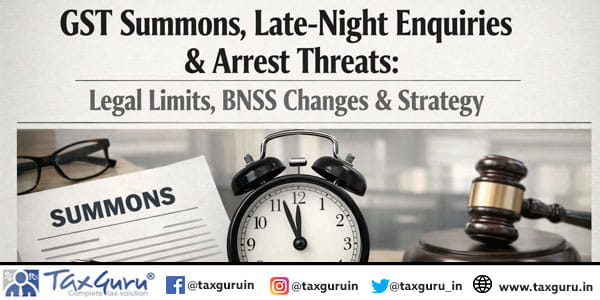
Summons under section 70 are used to call taxpayers at odd hours, video‑record long statements, and threaten arrest under sections 69 and 132 if “confession” is not given on the spot.
This fear is particularly strong among small and medium businesses who are willing to comply but are not prepared for marathon enquiries after 6.00 p.m. or even late in the night.
At the same time, demands for initial years of GST are being raised with huge tax, interest and penalty, often based on retrospective interpretations, mismatch reports and portal glitches.
The objective of these writes‑up is to give a practical toolkit to taxpayers and professionals: what the law actually permits, how courts have reacted to misuse, how BNSS/BNS have changed the criminal law backdrop, and how to respond calmly and effectively to a summons.
2. Section 70 vs Section 69: Two Different Worlds
2.1 Section 70 – power to summon and judicial proceeding
Section 70 of the CGST Act empowers the “proper officer” to summon any person whose attendance he considers necessary either to give evidence or to produce a document or any other thing in any inquiry.
Proceedings under section 70 are deemed to be judicial proceedings for the limited purpose of offences like giving false evidence or insulting the officer (earlier under IPC, now corresponding provisions under BNS).
Key points:
- Proper officer (not below Superintendent) may issue summons in the same manner as a civil court issues summons under the Code of Civil Procedure.
- Person summoned is legally bound to appear and to state the truth, and can be prosecuted for false evidence or intentional insult in such proceedings under the relevant BNS sections.
- CBIC instructions emphasise that summons should not be issued mechanically; they are a serious step and must be used only when necessary.
2.2 Section 69 – power to arrest in serious cases
Section 69 empowers the Commissioner to order the arrest of a person where he has reasons to believe that the person has committed specified offences under section 132, such as fraudulent ITC, fake invoices or deliberate tax evasion above prescribed thresholds.
Arrest is thus an extraordinary step, intended for serious fraud, and is not part of routine assessment or minor disputes.
Important safeguards:
- Only the Commissioner can authorise arrest; mere summons by Superintendent or Assistant Commissioner is not an arrest by itself.
- The arrested person must be informed of the grounds of arrest and produced before a Magistrate within 24 hours.
- Courts have repeatedly said that such powers must be exercised cautiously and not as a tool of harassment.
2.3 The practical misuse: mixing section 70 enquiry with arrest threats
In practice, the real mischief happens when an officer calls a person under section 70 “just for enquiry”, but then:
- Keeps him till late evening or night.
- Records long video‑statements, often dictated by the department.
- Pressurises him to accept liability, surrender ITC or sign pre‑drafted statements.
- Threatens immediate arrest under section 69 if he does not “cooperate”.
Courts have disapproved this approach, treating such conduct as contrary to Articles 14 and 21 and to the spirit of CBIC’s own guidelines.
3. Timing of Summons: “Reasonable Hours” and Late‑Night Enquiry
3.1 No rigid statutory “6 p.m. bar”, but clear administrative discipline
The CGST Act does not specify a clock‑based limit such as “only up to 5.30 p.m.” for recording statements under section 70.
However, CBIC instructions, GST investigation guidelines and general principles of fairness together require that summons proceedings be conducted during normal working hours, except in rare emergencies.
From administrative and professional literature:
- Summons should require appearance during “reasonable hours such as regular business hours”.
- Statements should be recorded during work time and not at odd hours; older CBEC circulars under Excise have been consistently followed in GST also.
- Instructions stress that summons is a last resort, not a routine method of calling every dealer for every minor discrepancy.
Recent High Court orders (e.g. in writs reported in GST portals and commentaries) have relied on these instructions to insist that officers do not detain persons beyond reasonable hours without justification.
3.2 What taxpayers can practically do
If, during a summons appearance, it is already late evening (say after 6.00 p.m.) and the officer wishes to continue for many more hours without any emergency:
- The taxpayer can politely record that he is fully willing to cooperate but requests that the enquiry may continue on the next working day during regular office hours, citing CBIC guidelines and fairness.
- This request should ideally be put in writing – either on the statement itself (“I request that further recording may be done tomorrow during office hours”) or by a short letter submitted immediately.
- If the officer refuses and continues with coercive questioning, the taxpayer may need to send an immediate email/letter after leaving, documenting the events and reserving the right to challenge any statement obtained under pressure.
If harassment persists, approaching the jurisdictional High Court under Article 226 for protection against coercive methods during summons has been recognised and used effectively in several cases.
4. Nine‑Year‑Old Demands and Limitation: Sections 73 and 74
With the passage of time, cases for 2017‑18 and 2018‑19 are now approaching or crossing limitation boundaries, yet notices and orders are still being issued, sometimes with huge retroactive demands.
Understanding the limitation scheme is critical to challenge such demands.
4.1 Basic framework
- Section 73 (no fraud/suppression): Order must be issued within three years from the due date for furnishing annual return for the relevant year.
- Section 74 (fraud, wilful misstatement, suppression): Order must be issued within five years from the due date of annual return.
Because the Act requires a minimum gap between show cause notice (SCN) and order, the effective last date for issuing SCN is typically:
- Around 2 years 9 months (for section 73).
- Around 4 years 6 months (for section 74).
COVID‑19 related notifications extended these periods for specified financial years and phases, leading to complex computations that must be checked carefully for each case.
4.2 Practical implication for present demands
When a taxpayer receives a fresh notice or adjudication order now:
- Check whether the proper section (73 or 74) has been invoked.
- Note the due date of GSTR‑9 for that year.
- Apply the relevant extension notifications to see the outer date by which SCN and order should have been issued.
If the notice or order is issued beyond the extended limitation, it is time‑barred and can be challenged in appeal or writ.
High Courts have consistently quashed such time‑barred proceedings, especially where the department has tried to reopen issues after several years based on new interpretations.
5. Misuse of Summons and Coercion: Judicial Trends
Judicial trends across GST and earlier service tax/excise show a clear pattern: summons are necessary for investigation, but misuse and harassment are not tolerated.
Important principles emerging from court observations and commentaries:
- Summons under section 70 are for inquiry, not adjudication; repeated summons on the same issue without justification can be treated as oppressive.
- CBIC instructions say senior management (CMD/MD/CEO/CFO) should be called only when there is clear evidence of their involvement and not in the first instance.
- Courts have held that mere appearance pursuant to summons does not amount to detention or arrest, and there is no statutory requirement of “minimum 7 days’ notice” for issuing summons, provided constitutional safeguards are respected.
- High Courts have criticised the practice of obtaining “voluntary” confessions and payment undertakings during late‑night interrogations and have allowed retraction or protection where statements were clearly involuntary.
For bona fide taxpayers, this jurisprudence is a strong shield: they can insist that any enquiry be conducted fairly, within reasonable hours, and without threats of arrest or coercion to pay disputed amounts on the spot.
6. BNSS/BNS: New Criminal Law Backdrop for GST
From 2024–25 onwards, India’s criminal law framework is transitioning from the old IPC/CrPC/Evidence Act to the new BNS/BNSS/BSA.
- Bharatiya Nyaya Sanhita (BNS) replaces the Indian Penal Code for substantive offences.
- Bharatiya Nagarik Suraksha Sanhita (BNSS) replaces the Code of Criminal Procedure and governs arrest, bail, anticipatory bail, etc.
- Bharatiya Sakshya Adhiniyam (BSA) replaces the Indian Evidence Act.
For GST:
- Wherever section 70 refers to “judicial proceeding” for offences like false evidence or insult to public servant, the relevant sections will now be the corresponding provisions under BNS instead of IPC sections 193, 228, 172, 174, etc., for offences committed after the new law comes into force.
- Arrest, remand, bail and anticipatory bail procedure for GST offences committed after that date will be governed by BNSS provisions; older offences remain under CrPC by virtue of saving clauses.
- BNSS emphasises recording reasons for arrest, proportionality, and discourages unnecessary arrest in economic offences where custodial interrogation is not essential.
A GST‑related decision under the new regime has granted anticipatory‑type protection where the court felt that custody was not required and that arrest would unnecessarily cripple business operations, reinforcing the principle that “bail is the rule, jail is the exception” in tax matters without clear fraud.
7. Anticipatory Bail and Summons: Present Position
7.1 Supreme Court’s restrictive view on anticipatory bail based only on summons
In Bharat Bhushan v. DGGI, the Supreme Court held that a person who is merely summoned for enquiry under GST cannot, on that sole basis, invoke section 438 CrPC for anticipatory bail.
The Court approved the High Court’s cancellation of anticipatory bail that had been granted simply because of summons, emphasising that investigative agencies must be allowed to conduct enquiry in accordance with law, subject to safeguards.
However:
- The Court did not rule out all protection; it recognised that a person may approach the High Court under Article 226 if there is concrete apprehension of illegal arrest or harassment.
- Various High Courts, including Allahabad and others, have granted anticipatory bail or similar relief in GST cases where tax was already paid, no embezzlement or fraud was alleged, and custodial interrogation was unnecessary.
7.2 Practical takeaway
- Mere receipt of summons under section 70 does not automatically entitle a person to anticipatory bail.
- If there are strong indicators of impending arrest (e.g., prior arrests in linked cases, seizure of alleged bogus invoices, clear threats by officers), the person can still seek protection, either through writ petition or under the appropriate BNSS provision, by demonstrating cooperation and absence of flight risk.
- Courts have shown willingness to grant protection where the taxpayer is compliant, has paid or is willing to secure the allegedly due tax, and where the dispute is essentially interpretational.
8. How to Attend an Enquiry Under Section 70
8.1 Before the date of appearance
1. Read the summons carefully
-
- Check that it is issued by a proper officer (usually not below Superintendent).
- Verify that it clearly mentions section 70, the F. No., date, time, and place of appearance, and has a valid DIN (where applicable).
2. Clarify the subject of enquiry
-
- Look for the period and issue (e.g., ITC availed from certain suppliers, e‑way bill mismatch, etc.).
- If the summons is extremely vague, you may write a short letter asking for basic clarity to enable meaningful preparation.
3. Prepare documents and a brief note
-
- Collect all documents called for: invoices, purchase register, sales register, GSTR‑1/3B/9, reconciliation statements, e‑way bills, bank statements as relevant.
- Prepare a brief written note about the business, nature of transactions and compliance history; this helps set the context and shows cooperative attitude.
8.2 During appearance
1. Presence and representation
-
- The person specifically summoned should appear in person unless exemption is granted.
- A professional (CA/advocate) may accompany, though the officer may insist that answers come from the person summoned, not the representative.
2. Recording of statement
-
- Request that your statement be recorded in question‑answer form, in your own words.
- Read each page carefully before signing; correct any mistakes or unclear language before you sign.
- Avoid broad legal admissions like “I accept liability of ₹X and will pay with interest and penalty” unless you are absolutely sure and have independent advice.
3. Resisting coercion and late‑night interrogation
-
- If you feel pressure (“sign or we will arrest you”), stay calm and politely say that you will fully cooperate but cannot sign anything that is not true, and that you may need time to check your records or seek advice.
- If it is getting late, request that further recording be continued the next day during normal office hours, referring to CBIC guidelines.
- Where you feel your health or safety is at risk, clearly state that you are unwell or exhausted and cannot continue further, and record this in writing.
8.3 After the enquiry
1. Prepare an internal file note: Record date, time, names of officers present, main questions asked, answers given, documents taken, and copies handed over.
2. Retraction where needed: If any part of the statement was given under pressure or is factually wrong, send a retraction letter at the earliest to the same officer and to higher authorities, explaining the circumstances and correcting the record.
3. Ongoing cooperation: Continue to supply documents and clarifications within reasonable time, so that your stand as a bona fide and cooperative taxpayer is beyond doubt.
9. Specimen Letter: Initial Reply to Summons Under Section 70
You can adapt the following specimen for practical use and publication.
Specimen – Initial Written Response to Summons
To
The Superintendent / Deputy / Assistant Commissioner
[Division / Range / Commissionerate]
[Address]
Date: ……………
Subject: Response to Summons under Section 70 of the CGST Act, 2017 – F. No. ………… dated ………… – reg.
Sir / Madam,
I, [Name], [Designation] of [Legal Name of Registered Person] (GSTIN: ……………), acknowledge receipt of the summons issued under section 70 of the Central Goods and Services Tax Act, 2017, bearing F. No. ………… dated ………… requiring my appearance on ………… at ………… hours in connection with enquiry relating to [brief description of subject/period as mentioned in the summons].
I respectfully submit that I am a bona fide taxpayer, regularly filing GST returns and maintaining proper books of account. I am fully willing to cooperate with the ongoing enquiry and to furnish all records and information as may be lawfully required.
In compliance with the summons, I shall appear before you on the scheduled date and time and shall bring the following documents as indicated in the summons:
(a) ……………
(b) ……………
(c) ……………
(Or, “A detailed list of documents proposed to be produced is annexed herewith.”)
I humbly request that the recording of my statement, if any, may kindly be conducted during normal office hours in accordance with CBIC’s guidelines on issuance of summons and the instructions that statements should ordinarily be recorded during working hours, except in exceptional circumstances.
I further request that the proceedings may kindly be conducted in a fair and non‑coercive manner and that I may be given reasonable opportunity to verify my records and, where necessary, obtain professional advice before making any substantive statement regarding tax liability.
This letter may kindly be taken on record as proof of my intention to cooperate fully with the enquiry and to comply with all lawful directions issued by your goodself.
Thanking you,
Yours faithfully,
[Signature]
[Name]
[Designation]
[Legal Name of Taxpayer]
[GSTIN]
[Mobile] / [Email]
For repeated summons on the same issue, you can modify this draft to mention earlier appearances, documents already furnished, and a request that further summons be avoided unless specifically justified, citing CBIC instructions against repetitive harassment.
10. Key Reassurance for Bona Fide Taxpayers
Despite the aggressive posture sometimes adopted at field level, the legal position gives significant comfort to genuine taxpayers:
- CBIC’s own instructions say that summons should be used sparingly, during reasonable hours, and with respect for taxpayer’s dignity.
- Courts have frowned upon late‑night interrogations, forced confessions and misuse of arrest powers in bona fide recipient cases.
- BNSS/BNS reforms stress proportionate use of arrest and recorded reasons, especially in economic offences where documents speak louder than custodial interrogation.
- Several High Courts have granted anticipatory bail or writ protection where investigation can continue without arrest, and where tax is paid or secured and there is no allegation of embezzlement.
For professionals and taxpayers, the way forward is a balanced strategy: cooperate fully, prepare thoroughly, assert rights politely, document everything, and, when necessary, use writ jurisdiction and BNSS‑based safeguards to resist harassment.