GST Enforcement, DGGI, CAG and the Honest Taxpayer: A Practitioner’s Appeal for Balance, Ground Verification and Natural Justice
GST has undoubtedly changed Indian indirect taxation in a fundamental way. It has widened the tax base, improved invoice matching, increased monthly revenue visibility, and created a common national framework that is, in principle, better than the fragmented Sales Tax and VAT regime that existed earlier. At the same time, the lived experience of many genuine taxpayers, especially small and medium businesses, has been very different: portal-based compliance, mismatch-driven notices, retrospective cancellation of registration, ITC blocking under Rule 86A, attachment under section 83, and a growing tendency to invoke section 74 even where the facts suggest error, confusion, or supplier default rather than fraud.
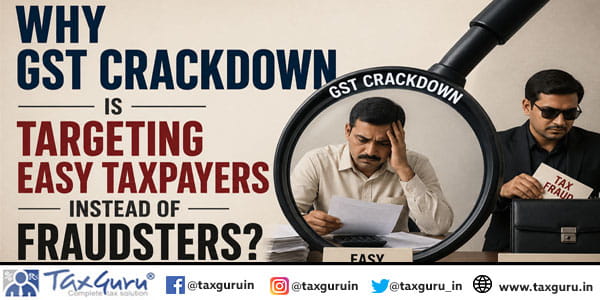
This article is written from the standpoint of long practical experience. It does not deny that fake ITC frauds, shell firms, and bogus export refund scams are real. DGGI and CAG have, in fact, exposed very large frauds involving non-existent entities and wrongful ITC running into hundreds and thousands of crores. But the central question is this: if frauds of such magnitude are being detected, how much money is actually coming back to the exchequer from the real fraudsters? And if recovery is small, why is the burden so often shifted to visible recipients, small businesses, and professionals who are easiest to locate and pressurise?
A fair GST system must distinguish between three separate categories:
the mastermind fraudster, the defaulting supplier, and the bona fide recipient who has maintained books and acted on genuine business records. When these three are mixed together, enforcement becomes arbitrary and natural justice suffers.
DGGI and CAG have exposed large frauds
There can be no serious dispute that DGGI and CAG have revealed major weaknesses in GST administration and major fraud patterns. DGGI has repeatedly uncovered fake invoice networks, shell firms, fraudulent ITC chains, and bogus export refund claims across India. Recent public reporting on the Kapil Chugh matter describes a ₹1,825 crore refund fraud involving dummy firms, high-value tobacco invoices, layered transactions, fake exports and circular movement of funds. Other DGGI operations in different zones have similarly reported fake ITC frauds of hundreds of crores involving dozens of shell firms and centralised control by a few key operators.
The CAG has also pointed out systemic weaknesses in GST registration, refund scrutiny and compliance controls. Audit observations have highlighted that newly registered entities with little track record were able to obtain refunds without deep verification, that risk filters were weak, and that supervisory review of suspicious claims was not always effective. This is important because it shows that large frauds do not arise only because of clever criminals; they also arise because the control system fails to react early.
So, the first part of the story is clear: fraud exists, DGGI has detected it, and CAG has repeatedly highlighted structural weaknesses. But that is only half the story.
The second half is recovery.
Detection is large, recovery is small
One of the most striking official data points available in the public domain is that in FY 2023-24, DGGI detected fake ITC and tax evasion of about ₹21,089 crore, but recovered about ₹2,577 crore, roughly 12 percent of the detected amount. Reports on the same data also noted that this was actually an improvement over earlier years, when recoveries in such fraud matters were often only 2 to 3 percent.
This gap between detection and actual recovery is the practical heart of the problem. The law provides powerful machinery for recovery:
section 74 for fraud-based determination of tax, section 79 for recovery proceedings, and section 83 for provisional attachment of property and bank accounts during pendency of proceedings.
In large fraud cases, other agencies may also become involved, including CBI for bank fraud and ED under the PMLA for tracing and attaching proceeds of crime.
Yet actual recovery remains limited for obvious reasons. By the time the fraud is fully detected, many shell firms have no stock, no real premises, and no attachable assets in their own names. The real controllers have often layered money through multiple accounts, moved funds to relatives or associates, invested in benami properties, or transferred value outside the country. Even when attachment orders are passed, sale and realisation may be delayed by litigation, competing claims, or lack of sufficient asset value.
Therefore, if one asks a simple question — excluding amounts still locked in appeals and court cases, how much money has actually come back to the department from the real fraudsters? — the available public data suggests:
only a small fraction. That reality is what pushes the administration, rightly or wrongly, toward a second strategy: turning to the recipient side of the chain.
Why retrospective cancellation creates wider suffering
One of the most damaging enforcement trends in GST has been cancellation of registration with retrospective effect. On paper, section 29 and the Rules allow cancellation where the registrant has defaulted or where registration has been obtained by fraud or misstatement. In a genuine fake-firm case, cancellation may be justified. But retrospective cancellation from the beginning of registration has severe consequences that go far beyond the supplier itself.
When registration is cancelled retrospectively, the practical effect is that the supplier is treated as if it should never have been allowed to issue valid tax invoices for the relevant past period. Once that happens, recipients who purchased from that supplier are suddenly told that the ITC taken by them is doubtful or ineligible, even if goods were received, payments were made, tax was charged on invoice, and the transactions were recorded in books. This is how the department often breaks the chain and spreads liability downstream.
Courts have repeatedly warned that retrospective cancellation cannot be ordered mechanically. The Delhi and Allahabad line of cases on cancellation has stressed that such action has serious civil consequences, including denial of ITC to recipients, and therefore requires recorded reasons, fair hearing, and a conscious decision as to why retrospective effect is really warranted. If the supplier is still traceable and operating, one may legitimately ask whether immediate cancellation is always the best option. If the registration remains active, the department can still use the law to demand tax, interest and penalty from the supplier directly, monitor compliance, and insist on payment. Once registration is cancelled and the person disappears from the tax system, direct leverage may actually reduce, while pressure on recipients increases.
This is why many practitioners feel that retrospective cancellation is sometimes being used not as a carefully calibrated legal tool, but as an administrative shortcut that converts one defaulting supplier into many notices against many buyers. That approach creates huge hardship and often punishes the easier party rather than the real wrongdoer.
Section 74 is being invoked in too many cases
Section 74 is a serious provision. It applies where non-payment, short payment, wrongful refund, or wrongful ITC is by reason of fraud, wilful misstatement or suppression of facts to evade tax. In theory, it should be reserved for cases where the material genuinely supports a fraud-based conclusion. In practice, a large number of show cause notices and adjudication orders appear to invoke section 74 almost as a default position, even in cases that arise from portal mismatches, supplier-side default, timing differences, classification confusion, or inadequate verification.
High Courts have repeatedly interfered where GST adjudication has ignored documents, gone beyond the show cause notice, used the wrong GSTIN, failed to serve notices properly, or denied meaningful opportunity of hearing. These cases matter because they show that the judiciary is not objecting to tax enforcement as such; it is objecting to enforcement without discipline, without application of mind, and without regard to natural justice.
A taxpayer who maintains books, purchase records, bank statements, transport records, stock records and tax invoices is entitled to have those materials examined. GST law does not authorise a purely mechanical adjudication based only on higher-level reports or portal differences. Yet on the ground, many taxpayers are told that since the DGGI report says “non-existent” or the audit report flags a mismatch, the officer cannot take a different view. That is not adjudication; it is administrative surrender.
Rule 86A and section 83 are extraordinary powers
The same concern arises with Rule 86A and section 83. Rule 86A permits blocking of ITC in the electronic credit ledger on “reason to believe” that the credit is fraudulently availed or ineligible. Section 83 permits provisional attachment of bank accounts and property during pendency of certain proceedings in order to protect revenue.
The Supreme Court and High Courts have repeatedly described provisional attachment as a serious and drastic power that must be exercised with care, proportionality, and recorded reasons. These powers are intended for protecting revenue in genuine high-risk situations, not for routine pressure in ordinary disputes. Yet many small taxpayers experience exactly that: credit blocked first, bank attached first, registration suspended first, and hearing only later. By that stage, business is already paralysed.
The financial impact is severe. Working capital gets locked, bank operations stop, vendors and customers lose confidence, and the taxpayer must immediately spend substantial sums on consultants, advocates and court proceedings just to restore a basic ability to do business. Even if relief is eventually obtained, the damage to business continuity may already have been done.
The practitioner has become the real field educator under GST
One truth that deserves to be openly acknowledged is the role of practitioners. Chartered accountants, advocates, GST practitioners, accountants and tax consultants have carried a very large part of the practical education burden under GST. They have gone to rural areas, taluk headquarters, district centres and cities, explaining registration, invoicing, return filing, e-way bills, reconciliation, and notices to taxpayers and entrepreneurs who would otherwise have found the system impossible to understand.
Monthly GST revenue has stabilised and improved over time, but this has not happened only because of portal architecture or enforcement. It has also happened because professionals and accountants have spent years translating the law into practical compliance for traders, small manufacturers, service providers and new entrepreneurs. In that sense, practitioners are not external to the compliance system; they are one of its main pillars.
Yet, under GST, the same professionals are often treated with suspicion. Summons under section 70, threats of arrest under section 69, and allegations of fake ITC conspiracy are increasingly used even where the person’s role is limited to filing returns or maintaining records. The Gujarat High Court in Rohitkumar Parsotambhai Sanghani v. State of Gujarat & Anr. made an important distinction: a person whose role is mainly compliance-oriented cannot be casually equated with a major conspirator in a fake ITC racket unless there is clear material showing active and central participation.
That judgment matters far beyond one bail application. It is a reminder that professionals are not automatic conspirators, and that role, benefit, control, and mens rea still matter in law. A healthy tax administration should treat genuine practitioners as allies in compliance, not as routine suspects.
A fair GST system must distinguish between three separate categories:
One of the biggest cultural changes from the Sales Tax/VAT era to GST is the loss of field-level understanding. Under the old regime, there were certainly disputes and excesses, but in many cases the local officer would at least ask for books, purchase registers, sales registers, stock records and supporting declarations, and would often have some understanding of the trade pattern of that dealer. Personal hearing and books-based verification played a visible role in assessment culture.
In GST, many officers now spend most of their time in front of the computer, examining dashboards, return variances and auto-generated reports. Differences between GSTR-1 and GSTR-3B, GSTR-2A/2B and 3B, GSTR-9 and annual summary figures, non-existent dealer lists, DGGI alerts and audit flags dominate the administrative workflow. Officers above and below the rank of Superintendent are often pushed into clerical, system-driven tasks rather than substantive field verification and trade understanding.
This matters because the ground reality of business cannot always be understood through portal data. A trader in a rural or semi-urban market may have irregular connectivity, delayed vendor compliance, industry-specific billing patterns, freight and stock timing issues, and informal commercial practices that do not sit neatly inside the GST dashboard. If officers never go to the field and never examine business records properly, the system becomes detached from actual commerce.
Why many genuine taxpayers feel more fear under GST than under VAT
For many new entrepreneurs, GST does not feel like a facilitative tax. It feels like a high-surveillance system in which one technical default can trigger suspension, cancellation, ITC blocking, attachment, and fraud allegations. That fear has practical consequences:
some small businesses remain below the threshold by design, some avoid formalisation, and others register only when forced by customers or market pressure.
This is unfortunate because the GST law, as a structure, has many strengths. It reduces cascading, encourages documentation, allows credit flow, and creates a unified market. But when implementation is seen as harsh, mismatch-driven and insensitive to genuine difficulties, the law loses moral legitimacy among those who are otherwise willing to comply.
The comparison with Sales Tax and VAT is not nostalgia for the old system. It is a reminder that procedural culture matters. Respectful hearing, books verification, a working relationship between practitioner and officer, and reasoned adjudication gave taxpayers confidence even where they did not agree with the outcome. GST needs to recover that culture.
The government’s revenue logic and the overstatement of loss
There is also an economic point often missed in enforcement rhetoric. In a GST chain, once tax has been properly paid at one stage, downstream tax is generally on the value added at later stages, with credit adjustment ensuring that the cascading burden is removed. This means that not every mismatch automatically means full revenue loss on the entire transaction value. Some differences are timing related, some are reporting issues, and some involve only the margin component at later stages.
This is not an argument for leniency in fraud. It is an argument for correct quantification. If officers treat every discrepancy as if the whole tax on the full turnover is lost, demands become artificially inflated, and section 74 notices lose credibility. Correct quantification is a legal obligation, not a concession.
What should change now
A more balanced GST administration is possible, but it requires concrete changes.
Use retrospective cancellation sparingly
Retrospective cancellation should be reserved for cases where the facts clearly show that the registration itself was fraudulent from inception and where the consequences for recipients have been consciously evaluated. In many cases, prospective cancellation or monitored compliance may better protect revenue than simply breaking the chain and forcing litigation across multiple recipient cases.
Distinguish masterminds from ordinary recipients and professionals
Large organised frauds like the Kapil Chugh network show what a real mastermind case looks like:
central control, dummy firms, layered funds, fake exports, multiple agencies, flight risk and deliberate evasion of summons.
That is very different from a trader who bought goods in the ordinary course or a practitioner who filed returns on the basis of documents provided by the client. Enforcement should reflect that distinction.
Restore field verification and books-based adjudication
Before invoking section 74, blocking ITC or attaching bank accounts, officers should insist on books, verify documents, inspect the place of business where necessary, and record what is actually found. Portal data is a starting point, not a substitute for adjudication.
Respect the role of professionals
Professionals should be treated as compliance partners unless there is real evidence of collusion. The Sanghani line of reasoning should be internalised administratively, not only applied after arrest in court.
Reduce coercive action in genuine small business cases
For small and medium taxpayers, the first administrative response should often be correction, reconciliation and guidance, not immediate penal escalation. Blocking credit, attaching accounts and issuing fraud notices should remain exceptional, not routine.
Train officers to apply the Act with judgment, not merely data
DGGI and CAG reports are important, but they are inputs. They cannot replace the officer’s own duty to apply the law fairly. AI tools, analytics and mismatch reports may help in detection, but they cannot replace human judgment, trade understanding and constitutional fairness.
A call to taxpayers and practitioners
Bona fide taxpayers and professionals should not accept mechanical action as inevitable. The law does protect them, but those protections have to be asserted. High Courts across India have shown willingness to interfere where registration is cancelled without reasons, where SCNs are defective, where opportunity is denied, where adjudication is mechanical, and where drastic powers are used without valid material.
That means taxpayers and practitioners must document everything:
purchase records, transport proof, payment trails, books of account, reconciliation statements, communication with suppliers, and replies to notices. It also means challenging arbitrary actions rather than treating them as final. A constitutional democracy does not expect the honest taxpayer to surrender because the officer says, “Go to appeal if you want relief.” Judicial review exists precisely because administrative excess exists.
Conclusion
GST is a good law in concept and, in many ways, better than the old indirect tax structure. But a good law can still produce injustice when implemented without balance. DGGI and CAG have undoubtedly exposed very large frauds and non-existent entities under GST. At the same time, the publicly available recovery data shows that only a small fraction of detected fraud value comes back from real fraudsters. The result is that pressure often shifts to the easiest targets: the visible recipient, the working small businessman, and sometimes even the professional who kept the books.
Retrospective cancellation, routine invocation of section 74, mechanical reliance on portal differences, aggressive use of Rule 86A and section 83, and refusal to meaningfully examine documents have created fear and financial hardship for many genuine taxpayers. This is not healthy for tax administration, business confidence, or constitutional governance.
What is needed now is not weaker enforcement, but better enforcement:
strong action against real masterminds, stronger early detection, more actual recovery from principal wrongdoers, and far greater protection for bona fide taxpayers who maintain records and act in good faith. Officers must return to ground verification, careful adjudication and reasoned orders. Practitioners must continue to educate and defend taxpayers. And taxpayers must be prepared to stand up against arbitrary action, because the rights of the individual under the Constitution do not disappear merely because the case carries the label “GST fraud.”