The : A Blueprint for Modern Business
On March 18, 2026, the Ministry of Corporate Affairs tabled the Corporate Laws (Amendment) Bill, 2026 (Bill No. 85), in the Lok Sabha. Far from just a routine legal update, this legislation—shaped by years of expert consultations and the 2022 Company Law Committee report—promises a sweeping overhaul of both the Companies Act, 2013, and the Limited Liability Partnership (LLP) Act, 2008. The overarching mission is clear: to strike a pragmatic balance between making business easier to conduct and tightening the screws on true corporate governance.
The Core Philosophy: Decriminalization & Compliance
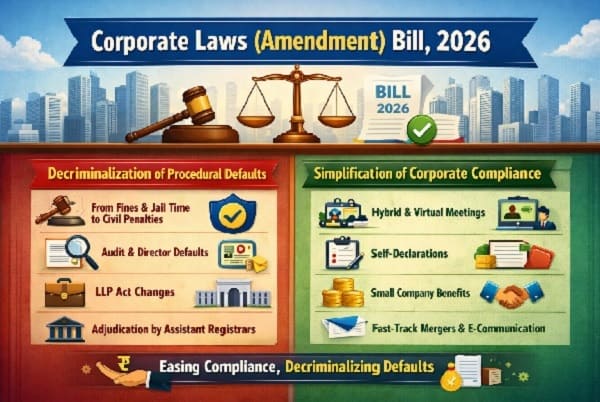
At the heart of this legislative makeover is a massive push toward decriminalizing procedural defaults. Recognizing that threatening executives with jail time for minor paperwork errors stifles business growth, the Bill systematically replaces criminal prosecution with civil penalties for technical infractions. However, lest anyone think the government is going soft, criminal sanctions remain firmly in place for serious offences involving fraud, which has seen its financial thresholds updated to account for inflation. Alongside these tweaks, the Bill empowers the government to exempt certain classes of small companies and start-ups from mandatory auditor appointments entirely, acknowledging that a one-size-fits-all regulatory approach often harms smaller players.
Some of the proposed amendments includes:
- Adjudication Framework (Section 454): Companies can now apply suo moto to settle penalties, encouraging voluntary compliance.
- Small Business Relief: One Person Companies (OPCs) and Start-ups receive significant exemptions, including a move toward exempting small companies from mandatory auditor appointments under Section 139(12).
- CSR Rationalization (Section 135): The net profit threshold for CSR is doubled to ₹10 crore, and the requirement for a CSR Committee is waived for obligations under ₹1 crore, significantly easing the burden on mid-sized firms.
Modernizing the Boardroom and Talent Retention
While life gets easier for administrative slip-ups, the boardroom is facing much stricter scrutiny. The Bill recognizes that in 2026, corporate value is driven by human capital and transparency. Two areas see the most significant “modernization”:
Stricter Governance Standards
While paperwork errors are decriminalized, “fit and proper” standards for directors are tightened. Under Section 164, new disqualification triggers include:
- Professional Cooling-off: Auditors or Valuers must wait three years before joining the board of a client company.
- DIN Validity: A Director’s Identification Number must remain active and valid throughout their tenure, not just at the start (Section 152).
New Executive Compensation (Section 42)
In a heavy nod to modern start-up culture and global talent retention, the Bill amends Section 42 to officially recognize Restricted Stock Units (RSUs) and Stock Appreciation Rights (SARs), placing them right alongside traditional ESOPs. Perhaps the most “startup-friendly” update is the formal recognition of Restricted Stock Units (RSUs) and Stock Appreciation Rights (SARs) alongside traditional ESOPs. The law now treats these as “securities” rather than just “shares,” providing a clear legal framework for high-growth companies to attract talent.
| Instrument | Mechanism | Legal Status (2026 Bill) |
|---|---|---|
| ESOPs | Option to buy shares at a discount. | Long-standing recognition. |
| RSUs | Grant of full-value shares after a vesting period. | Formally recognized under Section 42. |
| SARs | Bonus based on the increase in stock value. | Authorized as “Securities” in Section 42. |
III. Global Alignment: IFSCs and LLPs
Finally, the legislation lays down a red carpet for entities operating in International Financial Services Centres (IFSCs). The Bill prepares India for global competition by creating a specialized “red carpet” for International Financial Services Centres (IFSCs).
- Foreign Currency Operations: Under the new Section 43A, IFSC companies can maintain books, issue capital, and file documents in foreign currencies (e.g., USD), only paying statutory fees in INR.
- LLP Evolution: The Bill introduces a dedicated framework for IFSC LLPs and a new Fifth Schedule, allowing SEBI-regulated trusts to convert directly into Limited Liability Partnerships—a move that provides massive flexibility for investment funds.
Enforcement and Efficiency
To ensure these reforms aren’t just “paper tigers,” the enforcement architecture is being upgraded:
- Fast-Track Mergers: Approval thresholds are rationalized, and applications are now routed to a single NCLT bench to prevent jurisdictional delays.
- Recovery Procedures (Section 454B): New “Recovery Officers” are empowered to collect unpaid penalties, ensuring that the shift to civil penalties actually results in accountability.
- Revised Fraud Thresholds (Section 447): Monetary triggers for fraud are adjusted for inflation, moving from ₹10 lakh to ₹25 lakh for lower-tier offenses, and up to ₹1 crore for serious misconduct.
Conclusion
The 2026 Bill marks a transition toward a more mature corporate ecosystem. It acknowledges that while small businesses need less “red tape,” large corporations and financial entities require higher standards of independence and transparency. For the first time, Indian law fully aligns with global practices regarding how founders can reward their teams and how international hubs like Gift City can operate.