The issue was whether rental income from land qualified as agricultural income without supporting evidence. The Tribunal held that inadequate proof justified remanding the matter to the Assessing Officer for fresh verification.
Karnataka High Court held that request for waiver of pre-deposit amount under Section 129E(ii) of the Customs Act, 1962 is not acceptable since petitioner is an established business and there is no financial distress. Accordingly, writ dismissed.
The issue was whether a reassessment notice issued after the surviving limitation period was valid. The Tribunal held the notice time-barred in light of the Supreme Court ruling, rendering the entire reassessment invalid.
The issue was whether a delayed Form 10AB filing justified denial of charitable registration. The Tribunal held that bona fide delay due to transitional confusion and CBDT clarifications warranted condonation and fresh adjudication.
Delhi High Court held that retrospective applicability of Transport and Marketing Assistance Scheme is impermissible in law. Thus, notification of foreclosure of the Scheme dated 25.03.2022 shall have no application for exports effected between 01.04.2021 and 08.09.2021.
The registrar imposed penalties for a 212-day delay in filing Form MGT-14. Subsequent compliance did not absolve liability under Section 117(2).
The Tribunal ruled that appellate authorities must adjudicate each legal and factual ground raised in appeal. A mere remand to the AO without deciding jurisdictional issues violates statutory requirements.
The Tribunal held that Section 68 cannot be invoked unless a sum is found credited in the assessees books. In the absence of any such entry, the addition based on an alleged cash loan was deleted.
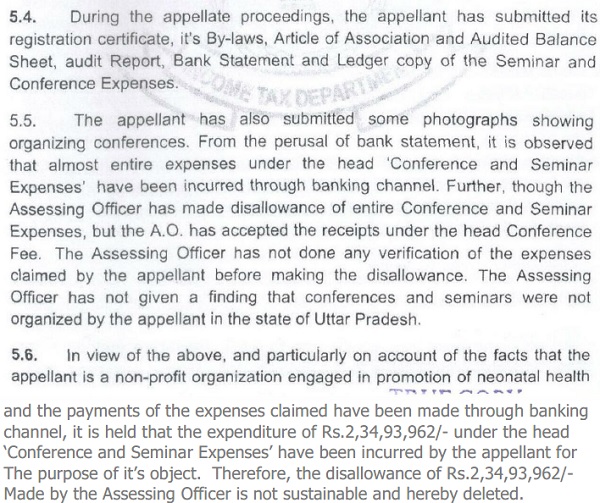
The Tribunal held that additional evidence accepted by the appellate authority must be examined by the Assessing Officer. Allowance based only on banking payments and charitable status was found inadequate.
The order deals with failure to submit complete allottee particulars in statutory filings. It reinforces that incomplete disclosures under allotment rules attract penalties under the residuary provision.