In its February 2026 monetary policy, the RBI maintained a status quo on interest rates, keeping the repo rate unchanged at 5.25% and continuing with a neutral policy stance. The decision reflects confidence in macroeconomic stability, with real GDP growth for FY 2025–26 projected at 7.4% and CPI inflation at a benign 2.1%. Alongside rate decisions, the RBI announced an expansive set of developmental and regulatory measures. Key initiatives include proposed norms for fair marketing of financial products, harmonised recovery agent guidelines, enhanced customer protection in digital transactions, and permission for banks to lend to REITs. Significant steps were also announced for financial inclusion, such as doubling collateral-free loan limits for MSMEs to ₹20 lakh, revising KCC guidelines, and strengthening the Lead Bank Scheme. Market reforms include enabling corporate bond derivatives and easing FPI debt investment rules. Overall, the policy balances growth support with consumer protection, financial inclusion, and market development.
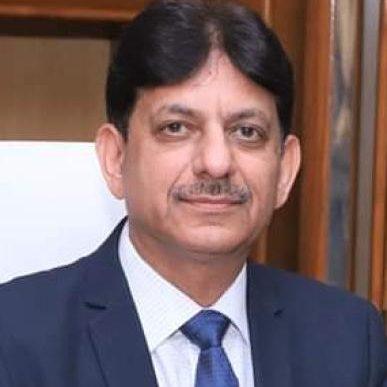
RBI Governor Sh. Sanjay Malhotra announced RBI monetary policy on 6th February 2026:
A. Resolution of Monetary Policy Committee
The various decisions taken in the meeting of Monetary Policy Committee are as follows.
(Link: RBI Monetary Policy- Resolution, Governor Statement Dated 06/02/2026)
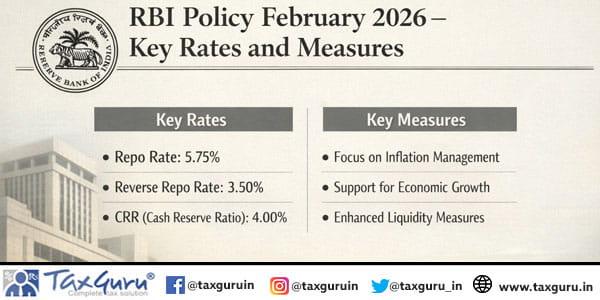
- To keep the policy repo rate under the liquidity adjustment facility (LAF) unchanged at 5.25 per cent. Consequently, the standing deposit facility (SDF) rate remains at 5.00 per cent and the marginal standing facility (MSF) rate and the Bank Rate remains at 5.50 per cent.
- The MPC also decided to continue with the neutral stance.
- The real GDP growth for 2025-26 as per First Advance Estimates is 7.4%. (RBI previous estimate at 7.3%)
- The CPI Inflation projected for 2025-26 at 2.1%. (previous estimate 2.0%)
- The updated policy rates are Repo- 5.25%, SDF- 5.00%, MSF and Bank Rate- 5.50%, CRR– 0%, SLR- 18.0%, Fixed Reverse Repo- 3.35%.
B. Statement on Development and Regulatory Policies
The various measures set out are as follows.
(Link: RBI Monetary Policy- Development & Regulatory Policies Dated 06/02/2026)
I. Regulations
Advertising, Marketing and Sales of Financial Products and Services by Regulated Entities (REs): There is a felt need to ensure that third party products and services that are being sold at the bank counters are suitable to customer needs and are commensurate with the risk appetite of individual clients. It has been decided to issue comprehensive instructions to REs on advertising, marketing and sales of financial products and services. The draft instructions shall be issued shortly.
Conduct of Regulated Entities in Recovery of Loans and Engagement of Recovery Agents: Currently, different sets of instructions are applicable to different categories of Regulated Entities (REs) with respect to the engagement of recovery agents and conduct related aspects of loan recovery. It has been decided to review and harmonise all the extant conduct related instructions on engagement of recovery agents and other aspects related to recovery of loans. The draft instructions shall be issued shortly.
Review of framework of Limiting Customer Liability in digital transactions: The extant instructions on limiting the liability of customers in unauthorised electronic banking transactions were issued in 2017, which deal with scenarios and timelines for zero / limited liability of a customer. In view of the rapid adoption of technology in the banking sector and payments systems, the existing instructions have been reviewed. The draft shall be issued shortly.
Bank Lending to Real Estate Investment Trusts (REITs): Real Estate Investment Trusts (REITs) and Infrastructure Investment Trusts (InvITs) were conceptualised in India with a view to free up banks’ funds in completed and operational real estate and infrastructure projects. While bank lending to InvITs is currently allowed, lending to REITs is not permitted hitherto. Upon review, it is proposed to permit commercial banks to extend finance to REITs. The draft directions shall be issued shortly.
Review of Lending norms for UCBs: It is proposed to rationalise the extant regulatory norms applicable for unsecured loans by UCBs; limits for lending to nominal members; and the tenor and moratorium requirements for housing loans. The proposed review shall adopt a tiered and simplified approach while maintaining prudential discipline. The draft directions shall be issued shortly.
Exemption from registration to eligible NBFCs not availing public funds and not having customer interface (including ‘Type I NBFCs’): The Scale-Based Regulatory Framework for NBFCs envisages differential regulatory treatment for NBFCs that do not avail public funds and do not have any customer interface. It is proposed that such Type-I NBFCs with asset size not exceeding Rs 1,000 crore, may be exempted from registration requirement with the Reserve Bank subject to certain specified conditions. The draft directions shall be issued shortly.
Amendment of NBFC Branch Authorisation Directions-2025: At per extant regulatory requirement, NBFC- Investment and Credit Companies (ICCs) engaged in the business of lending against gold collateral with over 1,000 branches are required to obtain prior RBI approval for opening new branches. It is proposed to dispense with the requirement of prior approval for opening branches by such NBFCs. The draft instruction shall be issued shortly.
II. Payments System
Discussion Paper on “Exploring safeguards in digital payments to curb frauds”: In order to mitigate frauds and strengthen customer protection, it is proposed to issue a Discussion Paper exploring the introduction of calibrated safeguards in digital payments such as introduction of lagged credits, additional authentication for specific class of users like senior citizens, etc.
III. Financial Inclusion
Revision in Lead Bank Scheme: The Reserve Bank has undertaken a detailed review of the existing guidelines on Lead Bank Scheme (LBS). It is now proposed to issue a comprehensive set of instructions on the Scheme with a view to streamline the operational aspects. The draft circular will be issued shortly.
Revision in the Guidelines of Kisan Credit Card (KCC): The Reserve Bank has comprehensively reviewed the KCC Scheme with a view to expand coverage, streamline operational aspects and address emerging requirements. It is proposed to issue a revised set of instructions to banks on the scheme, consolidating those on agriculture and allied activities. The draft guidelines will be issued shortly.
Review of guidelines relating to use of Business Correspondents (BCs) by banks: Business Correspondents have been functioning as critical enablers of last mile access to financial services, particularly in respect of underserved, rural, and remote locations. Reserve Bank had set up a committee, consisting of officials from Reserve Bank, DFS, IBA and NABARD, to comprehensively examine their operations and make suitable recommendations for enhancing their efficiency. The draft amendment directions will be issued shortly.
Enhancement in Collateral free loan limit from Rs 10 lakh to Rs 20 lakh: With a view to facilitate improved access to formal credit, support entrepreneurial activity and strengthen last mile credit delivery for Micro and Small Enterprises (MSEs) with limited collateral, it has been decided to enhance the limit of collateral free loans to MSEs from Rs 10 lakh to Rs 20 lakh. The instructions will be issued shortly.
IV. Financial Markets
Development of corporate bond market: An announcement was made in the Union Budget speech, that total return swaps on corporate bonds and derivatives on corporate bond indices will be introduced. Accordingly, a draft regulatory framework to enable the introduction of derivatives on credit indices and total return swaps on corporate bonds will be issued shortly.
Foreign Exchange Dealings of Authorised Dealers: The regulatory framework governing the facilities for such Authorised Dealers (ADs) has been reviewed, rationalised and refined in view of the current market practices and requirements, domestically and globally. The draft directions will be issued shortly.
Review of the Voluntary Retention Route for FPI investment in debt instruments: The Voluntary Retention Route (VRR) was introduced, to provide an additional channel for investments by Foreign Portfolio Investors (FPIs) with long-term investment interest in the Indian debt markets. The VRR has been witnessing active investment by FPIs, and over 80 per cent of the current investment limit of Rs 2.5 lakh crore has been utilised. With a view to ensuring predictability about the availability of investment limits under the VRR and to further increase ease of doing business, it has been decided that (a) investments under the VRR shall now be reckoned under the limit for FPI investments under the General Route and (b) certain additional operational flexibilities will be provided to FPIs investing under the VRR. The directions will be separately issued.
V. Capacity Building
Mission Saksham – Capacity Building for the UCB Sector: Primary (Urban) Co-operative Banks (UCBs) are vital institutions for promoting financial inclusion and serving the unbanked. RBI will soon be launching Mission SAKSHAM (Sahakari Bank Kshamta Nirman)- a sector-wide capacity-building and certification framework. The Mission will be pursued in partnership with the Umbrella Organisation of UCBs and National / State Federations.
C. Related Notifications issued by RBI
Voluntary Retention Route – Imparting predictability and increasing ease of doing business: RBI has revised the Voluntary Retention Route (VRR) framework for foreign portfolio investments in debt. Under the new directions, VRR investment limits are subsumed within the overall limits applicable to FPI investments under the General Route. Consequently, all existing VRR investments in Central and State Government securities and corporate bonds will be counted against the respective General Route limits. Further, FPIs that opted for retention periods longer than the prescribed minimum will have flexibility to partially or fully liquidate their holdings and exit VRR after completing the minimum retention period.
(Link: RBI Notification 205/2026 dated 06/02/2026)
*****
Disclaimer: The contents of this article are for informational purposes only. The user may refer to the relevant notification/ circular/ decisions issued by the respective authorities for specific interpretation and compliances related to a particular subject matter)