

Judicial Rebuke of CBDT’s Delay Culture: A Multi-High Court Chronicle on ITR Extensions
The Central Board of Direct Taxes (CBDT) has faced mounting judicial scrutiny for its habitual last-minute announcements of Income Tax Return (ITR) deadline extensions. In a rare convergence, five High Courts—Punjab & Haryana, Gujarat, Rajasthan, Karnataka, and Bombay—have issued stern directives and observations, exposing the administrative inertia and stakeholder distress caused by CBDT’s delay tactics. This article synthesizes the legal developments, case details, and broader implications for tax governance.
Punjab & Haryana High Court: Contempt Warning for Inaction
In Tax Bar Association v. Union of India & Ors. [CWP No. 21125 of 2025], the Punjab & Haryana High Court issued a sharp rebuke to the CBDT on October 29, 2025, for failing to act on the Gujarat High Court’s directive to extend the ITR deadline. The Court observed:
“The continued inaction of the CBDT, despite judicial directions and stakeholder appeals, may invite contempt proceedings. The Board cannot remain inert while taxpayers and professionals face chaos.”
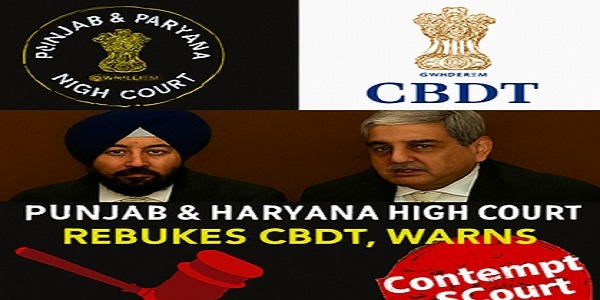
The Court emphasized that last-minute extensions cause panic, disrupt compliance planning, and undermine the credibility of the tax administration. It recorded the Department’s assurance that necessary orders would be issued, but warned that failure to comply would be treated seriously.
Just when the author was about to close the article, an updated message is coming in the websites.
The Court noted that CBDT’s counsel failed to produce any instructions, despite prior judicial nudges and stakeholder appeals. The Bench emphasized that administrative silence in the face of mounting compliance hardship was unacceptable. While earlier hearings had warned of contempt proceedings, the Court ultimately exercised restraint and passed a direct order for extension.
This marks the second rebuke from the same High Court in recent weeks, reinforcing its stance that governance must be proactive, not reactive.
Gujarat High Court: Statutory Link Affirmed
In Income Tax Bar Association & Anr. v. Union of India & Ors. [WP No. not disclosed publicly], the Gujarat High Court, in its judgment dated October 13, 2025, directed the CBDT to extend the ITR filing deadline for audit cases under Section 139(1) to November 30, 2025, aligning it with the extended tax audit report deadline under Section 44AB.
The Court held that the “specified date” and “due date” are statutorily linked, and failure to extend the ITR deadline after extending the audit report deadline was arbitrary. The petitioners had highlighted technical glitches, delayed release of utilities, and compliance bottlenecks. The judgment reinforced that administrative convenience cannot override statutory logic and taxpayer rights.
Rajasthan High Court: Proactive Governance Urged
In Tax Bar Association, Jodhpur v. Union of India [CW No. 18593/2025], the Rajasthan High Court’s interim order dated September 24, 2025, directed the CBDT to extend the due date for filing Tax Audit Reports to October 31, 2025. The Court noted that persistent technical issues on the e-filing portal, delayed release of forms, and overlapping deadlines warranted judicial intervention.
The Bench observed that CBDT’s refusal to extend deadlines despite past precedents was arbitrary and violative of Articles 14 and 19(1)(g). It urged the Board to adopt a proactive stance, rather than waiting for judicial nudges or last-day panic. The order reflected a growing judicial impatience with bureaucratic rigidity.
Karnataka High Court: Mental Stress and Administrative Burden
In Karnataka State Chartered Accountants Association v. CBDT [WP No. 29434/2025], the Karnataka High Court, in its order dated September 25, 2025, extended the tax audit deadline to October 31, 2025, echoing the Rajasthan HC’s directive. The petitioners had argued that the compressed timelines and technical glitches imposed unreasonable stress on professionals.
The Court acknowledged the mental strain and administrative burden caused by uncertainty and last-minute decisions. It emphasized that predictable governance is essential for compliance, and that the CBDT must act with foresight, not compulsion. The judgment added to the chorus of judicial voices demanding timely relief.
Bombay High Court: Software Glitches and Section 87A Rebate
In The Chamber of Tax Consultants v. Union of India [PIL], the Bombay High Court, in its order dated December 24, 2024, directed the CBDT to extend the ITR filing deadline to January 15, 2025, for taxpayers affected by software glitches that prevented claiming the Section 87A rebate.
The Court noted that recent changes to the Income Tax Department’s utility software had denied eligible taxpayers their rightful rebate, despite their compliance. It held that technical lapses by the Department cannot penalize taxpayers, and ordered immediate notification under Section 119 of the Income Tax Act. This case underscored the need for robust digital infrastructure and responsive administration.
Bird’s eye view of Judicial Interventions: A Timeline of Criticism
Here’s a brief overview of key High Court cases that have called out the CBDT’s delay tactics:
| High Court | Case Highlights |
| Punjab & Haryana HC | Warned CBDT of contempt for failing to act on extension requests despite mounting pressure; emphasized that last-minute announcements cause panic and hardship. |
| Gujarat HC | Directed CBDT to extend the ITR deadline to November 30, 2025, citing practical challenges faced by taxpayers and professionals. |
| Rajasthan HC | Previously urged CBDT to adopt a proactive stance, noting that delayed notifications undermine compliance efforts. |
| Karnataka HC | Echoed similar concerns, highlighting the administrative burden and mental stress caused by uncertainty. |
| Bombay HC | Ordered extension to January 15, 2025 for certain taxpayers affected by software glitches, reinforcing the need for timely relief3. |
Stakeholder Fallout: Chaos, Cost, and Credibility Loss
The cumulative effect of CBDT’s delay culture has been disruptive for taxpayers, professionals, and institutions:
- Compliance Disruption: Chartered accountants and tax professionals plan their workflows around statutory calendars. Sudden extensions derail resource allocation and client coordination.
- Mental Strain: The ambiguity until the final day creates undue stress, especially during peak filing seasons.
- Loss of Credibility: The CBDT’s silence until the eleventh hour erodes trust in its administrative responsiveness and damages its institutional reputation.
- Judicial Overreach Risk: Repeated court interventions signal executive failure, risking erosion of separation of powers.
CBDT’s Last-Minute Extension Announcements

| Assessment Year | Original Due Date | Extension Announced On | Final Due Date | Extension For | Remarks |
| AY 2025–26 | Sep 30, 2025 (TAR) / Oct 31, 2025 (ITR) | Sep 29, 2025 (TAR) / Oct 30, 2025 (ITR) | Oct 31, 2025 (TAR) / Nov 30, 2025 (ITR) | Tax Audit Report & ITR for audit cases | Extension announced just one day before each deadline; triggered by HC orders and portal issues. |
| AY 2024–25 | Sep 30, 2024 (TAR) / Oct 31, 2024 (ITR) | Sep 29, 2024 / Oct 30, 2024 | Oct 31, 2024 / Nov 30, 2024 | Tax Audit Report & ITR | Extension due to delayed utility release and stakeholder pressure; announced on penultimate day. |
| AY 2023–24 | Sep 30, 2023 (TAR) / Oct 31, 2023 (ITR) | Sep 29, 2023 / Oct 31, 2023 | Oct 31, 2023 / Nov 30, 2023 | Tax Audit Report & ITR | Notification issued late evening on deadline day; caused confusion among professionals. |
| AY 2022–23 | Sep 30, 2022 (TAR) / Oct 31, 2022 (ITR) | Sep 29, 2022 / Oct 30, 2022 | Oct 31, 2022 / Nov 30, 2022 | Tax Audit Report & ITR | Extension due to portal glitches and ICAI representations; announced just before expiry. |
| AY 2021–22 | Sep 30, 2021 (TAR) / Oct 31, 2021 (ITR) | Sep 29, 2021 / Oct 30, 2021 | Dec 31, 2021 / Jan 15, 2022 | Tax Audit Report & ITR | Major extension due to COVID-19 disruptions; still announced only two days before deadline. |
This pattern shows that CBDT consistently waits until the last moment to announce extensions, often under pressure from courts, professional bodies, or technical failures. Such unpredictability undermines compliance planning and has led to judicial rebukes across multiple High Courts.
A Call for Reform: Institutionalizing Predictability
The judiciary’s repeated admonitions should compel the CBDT to:
- Announce extensions well in advance, ideally 2–3 weeks before the deadline.
- Consult professional bodies like ICAI, taxpayer forums, and software vendors to assess ground realities.
- Institutionalize a compliance calendar with built-in flexibility for exigencies.
- Ensure technical readiness of e-filing utilities before announcing deadlines.
- Publish impact assessments post-deadline to improve future planning.
Conclusion: Governance Must Be Predictable, Not Reactive
The convergence of five High Courts in criticizing the CBDT is not a coincidence—it’s a systemic indictment. When judicial benches across jurisdictions echo the same concerns, it signals a deep administrative malaise. Stakeholders deserve clarity, not chaos. Timely communication is not a luxury—it’s a statutory obligation and a governance imperative.
The CBDT must evolve from a reactive to a responsive institution. Judicial patience is not infinite, and stakeholder trust is not inexhaustible. The time for reform is now.

Author Bio



it’s high time, CBDT should pull up socks. The CBDT ‘s face is getting maligned when instead of it looking to the difficultyies faced by the tax payers and tax professionals, the judiciary is required to intervene. The very purpose to giving extensions to time line gets defeated once it is given at last hours…
Strong words, but true comment. In the recent past, this seems to be happening every time.
Sir
An excellent article providing deep insight into the subject and a much needed initiative to be taken by the department
With Regards
Considering the case law and CBDT past record,the individual ITR filers were cheated by extending due date by only one day which is injustice.
There is a case for extending the due date to all other assessees upto 30.11.2025.
True, ,but the CBDT is not broad-minded enough to do so.
In our scheme of governance, a peoples’ representative is placed to see that the actions of bureaucracy is not against public interest. It is when the peoples’ representative become the face of bureaucracy instead of the face of public, the public at large has no option but to approach the judiciary. The article articulates the fact that the judiciary understood the difficulties being faced by the stakeholders. Now, its time for the people’s representatives to pull up their socks.
Well said Anupamji. Powerful comment indeed! However it is said that every time, the taxpayers have to seek the help of the judiciary
The presentation is very apt. To avoid such dilema and reactive approach of CBDT, the due date for filling audit report should be 30th November every year and ITR filing date should be 31st December every year.
thanks Mr subramani , it is the real time the CBDT gives the necessary relief by extending the due date atleast by 1 month .
Sir, your concluding part is simply superb. What a clarity of expression. Hats off to you.
Thanks Mr. Subramani, it is time that CBDT wakes up, instead of resorting to last minute notification for extension of time.