
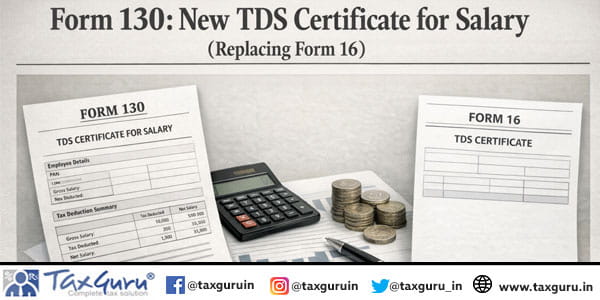
Form 130 is the new TDS certificate for salary introduced under the Income-tax Act, 2025, replacing Form 16 from 1 April 2026. While its core purpose remains unchanged—certifying tax deducted and deposited—it features a redesigned structure with three parts: basic details, TDS summary, and a detailed computation with annexures. It applies not only to salaried employees but also to pensioners and specified senior citizens. The form will be system-generated based on quarterly TDS returns (Form 138) and must be issued by 15 June following the tax year. A key change is the adoption of the “Tax Year” concept and renumbered deduction sections, requiring taxpayers to familiarize themselves with new references. Form 130 integrates more detailed disclosures, improving transparency and accuracy while reducing mismatches through automation. Overall, it is a structural upgrade aligned with digital compliance, ensuring continuity with enhanced clarity for taxpayers, employers, and professionals.
FAQs on Form 130 – New TDS Certificate for Salary
Q.1 What is Form 130 and when will it replace Form 16?
Ans.Form 130 is the new TDS certificate for salary introduced under the Income-tax Act, 2025. It replaces Form 16 with effect from 1 April 2026 while continuing to certify that tax has been deducted from income and deposited with the Government.
Q.2 Who will receive Form 130?
Ans.Form 130 will be issued to salaried employees, pensioners, and specified senior citizens whose tax is deducted by a specified bank. It must be issued by the employer or specified bank on or before 15 June following the relevant tax year.
Q.3 How is Form 130 different from the existing Form 16?
Ans.Unlike Form 16, which consists of two parts, Form 130 has three parts—Part A (basic details), Part B (TDS summary), and Part C with Annexures containing a detailed computation of income, deductions, tax liability, perquisites, and other relevant information.
Q.4 How is Form 130 generated?
Ans.Form 130 is system-generated after the employer files the quarterly TDS return in Form 138. Much of the information is auto-populated from the quarterly TDS statements, reducing manual errors and mismatches.
Q.5 How should taxpayers use Form 130 while filing their income tax return?
Ans.Taxpayers should compare the details in Form 130 with Form 168 (Tax Passbook) to verify that the TDS deducted has been correctly credited to their PAN. They should also use the detailed computation in Part C to cross-check the pre-filled information in their income tax return before filing.
Form 130 – The New TDS Certificate for Salary (Replacing Form 16 from 1 April 2026)
1. What is Form 130 and why the change?
With effect from 1 April 2026, the Income‑tax Act, 2025 (which replaces the Income‑tax Act, 1961) comes into force, bringing with it a complete renumbering and restructuring of tax forms.
Among the most visible changes for salaried individuals is the replacement of Form 16 with Form 130.
Form 130 is the new annual TDS certificate that employers (and specified banks in certain cases) will issue to:
- Salaried employees and pensioners on whom TDS has been deducted from salary/pension.
- Specified senior citizens (75 years and above) who have authorised their bank to compute and deduct full tax on interest income so they do not have to file a separate return.
In substance, Form 130 does what Form 16 did – it certifies that tax has been deducted from your income and deposited with the Government. However, the format is more detailed, the structure is different, and it aligns with the new numbering under the 2025 Act.
2. Old Form 16 vs New Form 130 – quick comparison
| Aspect | Old Form 16 (till 31 March 2026) | New Form 130 (from 1 April 2026) |
|---|---|---|
| Statute | Income‑tax Rules, 1962 (under 1961 Act) | Income‑tax Rules, 2026 (under 2025 Act) |
| Applicable to | Salaried employees only | Salaried employees, pensioners, and specified senior citizens (interest income) |
| Parts | Two parts: Part A (employer/employee details & TDS summary), Part B (detailed computation) | Three parts: Part A (details), Part B (summary), Part C with Annexures I & II (detailed computation) |
| Issuance | By employer on or before 15 June | By employer or specified bank on or before 15 Juneupstox+1 |
| Generation | System‑generated from TRACES after filing TDS return (Form 24Q) | System‑generated after filing new quarterly TDS return (Form 138, which replaces old Form 24Q |
| Reference year | “Financial Year” and “Assessment Year” | Simplified: “Tax Year” (e.g., Tax Year 2026–27 for income from 1 April 2026 to 31 March 2027) |
| Section references | Old numbering (80C, 80D, 80G, etc.) | New section numbering under the 2025 Act (e.g., section 123 for standard deduction/investments, section 126 for mediclaim, section 129 for education loan interest) |
3. Structure of Form 130 – three parts explained
Form 130 is divided into three main parts, as per draft released by the Central Board of Direct Taxes (CBDT):
Part A – Basic details
Contains:
- Employer/bank details: Name, address, PAN, TAN, email, contact number.
- Employee/specified senior citizen details: Name, address, PAN.
- Tax year (e.g., 2026–27).
- Period of employment: From (dd/mm/yyyy) to (dd/mm/yyyy) – a new field showing exactly how long the employee worked with that employer during the year.
This part establishes who deducted tax from whom and for which period.
Part B – Summary of TDS
Shows the quarterly summary of:
- Amount paid/credited (salary, pension, or interest).
- TDS deducted at source (including surcharge and health & education cess).
- TDS deposited (quarter‑wise receipt numbers from original quarterly TDS statements under section 397(3)(b) of the 2025 Act).
Part B gives you a high‑level TDS position – total income credited and total tax deducted and deposited.
Part C – Detailed computation (Annexures I and II)
Part C is the most important section for ITR filing. It contains:
- Annexure‑I: Detailed computation of salary/pension/interest income, including:
- Gross salary (broken into basic, allowances, perquisites, profits in lieu of salary).
- Exemptions and deductions under various sections (standard deduction, house rent allowance, leave travel concession, professional tax, etc.).
- Net salary after exemptions.
- Income from house property, other sources (as reported by employee for TDS purposes).
- Gross total income.
- Deductions under Chapter VIII (replacing old Chapter VI‑A), such as:
- Section 123 deductions (LIC, PPF, NSC, etc. – replacing old 80C).
- Section 126 for mediclaim premium (replacing old 80D).
- Section 129 for education loan interest (replacing old 80E).
- Section 127 for donations (replacing old 80G).
- And other applicable deductions.
- Total income after all deductions.
- Tax payable at applicable rates (including surcharge and cess).
- Relief under section 90/91 (for foreign tax credit, if applicable).
- Net tax payable and TDS already deducted.
- Annexure‑II: Detailed break‑up of perquisites (value of rent‑free accommodation, car, loan facilities, etc.) and profits in lieu of salary (like compensation on termination, commuted pension, gratuity exemptions).
Part C effectively gives you a ready computation sheet of your taxable income and tax liability, which you can cross‑check and use for filing your return.
4. Who must issue Form 130 and by when?
4.1 Employers
- Every employer (company, firm, individual, trust, government department, etc.) who has deducted TDS from salary/pension under section 392 of the 2025 Act must issue Form 130 to each employee/pensioner.
- Due date: On or before 15 June of the financial year immediately following the tax year for which TDS was deducted.
For example:
- For Tax Year 2026–27 (income from 1 April 2026 to 31 March 2027), employer must issue Form 130 by 15 June 2027.
4.2 Specified banks (for senior citizens)
- A specified bank is required to issue Form 130 to a specified senior citizen (person of 75 years or above who has opted under section 393 of the 2025 Act for the bank to compute and deduct tax on his interest income so that he need not file a return).
- Same due date: 15 June of the next financial year.
5. How will Form 130 be generated?
Form 130 will be system‑generated and downloadable from the tax/TDS portal (similar to how Form 16 was generated from TRACES), after:
- The employer files the quarterly TDS return (now called Form 138, which replaces old Form 24Q) for the relevant quarters.
- The bank (for senior citizens) files the relevant TDS return for interest income.
Key points:
- Form 130 is not manually prepared; it is auto‑generated based on the data filed by the deductor.
- Much of the information in Form 130 (especially Part B and some fields in Part C) will be pre‑filled by the system from the employer’s quarterly filings, reducing chances of data entry errors and mismatches.
- Employers download Form 130 from the portal and provide it to employees in digital format (PDF, etc.) or in physical form, as per practice.
6. How employees and pensioners will use Form 130
6.1 Cross‑checking with Tax Passbook (new Form 168)
- Under the 2025 Act, the earlier Form 26AS (Annual Information Statement) has been replaced by Form 168 (Tax Passbook).
- Form 168 will consolidate all tax credits (TDS, TCS, advance tax, self‑assessment tax) in one place, similar to the old 26AS.
Before filing your return, you should:
- Download Form 130 from your employer or bank.
- Download your Form 168 (Tax Passbook) from the income tax portal.
- Cross‑verify the TDS figures in Form 130 with your Form 168 to ensure there is no mismatch (i.e., that all TDS deducted by employer has actually been deposited with the Government and credited to your PAN).
6.2 Using Form 130 for ITR filing
- Form 130 contains detailed computation in Part C (Annexure‑I), which breaks down your gross salary, exemptions, deductions under Chapter VIII (replacing old Chapter VI‑A), and net taxable income.
- When you file your ITR (which will also be a renumbered form under the 2025 Act, though specific ITR form numbers are still being finalised), the portal will pre‑fill salary income and TDS details based on Form 138 quarterly statements filed by your employer.
- You should verify the pre‑filled data against your Form 130, and if there are any discrepancies (missing allowances, exemptions not correctly shown, deductions not claimed by employer), you can add or correct them in your return.
Form 130 thus acts as your primary reference document for salary income and TDS, just as Form 16 did earlier.
7. Key changes and new section numbering
7.1 Tax Year concept
The 2025 Act drops the dual terminology of “Financial Year” and “Assessment Year”.
- Instead, a single term “Tax Year” is used.
- Tax Year 2026–27 refers to the period 1 April 2026 to 31 March 2027 (income earned in that period), and the return for that period is filed in the following year (just as you did under the old regime).
This simplifies language and reduces confusion, especially for first‑time taxpayers.
7.2 New section numbers for deductions
The most visible change for salaried persons is the renumbering of deduction sections. A quick mapping (illustrative):
| Old section (1961 Act) | New section (2025 Act) | Description |
|---|---|---|
| 80C | Section 123 | Life insurance, PPF, NSC, ELSS, etc. |
| 80D | Section 126 | Mediclaim premium |
| 80E | Section 129 | Education loan interest |
| 80G | Section 127 | Donations |
| 80TTA/80TTB | Section 133/134 (or equivalent) | Interest on savings |
| Standard deduction | Section 123 (or separate sub‑section) | Standard deduction on salary |
In Form 130, Part C (Annexure‑I) will show these new section numbers and will itemise deductions under each.
Taxpayers and practitioners must familiarise themselves with the new numbering to avoid confusion when reading Form 130 and filing returns.
8. What if you worked under multiple employers in the same year?
This situation is handled as follows (similar to the old Form 16 practice):
- Part A and Part B of Form 130 will be issued separately by each employer for the period during which you were employed with them.
- Part C (Annexure‑I) can be issued:
- Either by each employer separately (if each computed tax independently), or
- By the last employer only, at the option of the employee, if the employee furnishes details of previous employment income and TDS to the last employer.
In practice:
- If you join a new employer mid‑year, inform the new employer of your previous salary and TDS using Form 127 (the new form replacing old Form 12B, used to transfer previous employment details).
- The last employer can then issue a consolidated Part C, showing total salary from both employers, aggregate TDS, and net tax liability for the full year.
- However, each employer will issue separate Part A and Part B for their respective period.
When filing ITR, you will need to aggregate all such Part A/Part B components and use the consolidated Part C (or do your own consolidated computation if each employer gave separate Part C).
9. Practical implications for taxpayers and professionals
9.1 For salaried employees and pensioners
- Nothing changes substantively in how you receive your TDS certificate; it is only the form number and structure that change.
- You will still get the certificate by 15 June and use it to file your return.
- More detail in Part C: The new format provides more granular break‑up of exemptions, perquisites and deductions, which may actually help you understand your tax computation better.
- New section numbers: You need to learn the new numbering (123, 126, 129, etc.) – but portal pre‑filling and Form 130 itself will guide you.
Advice: Download your Form 130 as soon as your employer issues it, and compare it with your Form 168 (Tax Passbook) to ensure all TDS is correctly credited to your PAN before filing ITR.
9.2 For employers and HR/payroll teams
- Quarterly TDS return is now Form 138 (replacing old 24Q).
- You must continue to file quarterly statements of TDS within the due dates.
- After filing, the system will auto‑generate Form 130 for download and issuance to employees.
- Deadline remains 15 June: you must issue Form 130 by this date to each employee/pensioner.
- Training required: Payroll staff must update their knowledge on:
- New section numbering (123, 126, 127, 129, etc.).
- New form structure (three parts with Annexures).
- Correct data entry in quarterly Form 138 to ensure accurate pre‑filling in Form 130.
Advice: Conduct internal training sessions before the first quarterly filing under the 2025 Act, and dry‑run the new Form 138 and Form 130 generation process to avoid last‑minute issues in June 2027.
9.3 For tax practitioners and consultants
- Clients will approach you with “Form 130” instead of Form 16 from June 2027 onwards.
- You must be comfortable reading the three‑part structure and mapping old section numbers (80C, 80D, etc.) to new section numbers (123, 126, etc.).
- Form 168 (replacing 26AS) will be your primary reconciliation tool for all TDS/TCS credits.
- ITR forms will also be renumbered; CBDT is expected to release the new ITR forms for the 2025 Act in due course.
Advice: Update your internal checklists, templates and SOP documents to reflect the new form numbers and section references. Prepare a simple mapping chart (old vs new) to share with clients and staff for easy reference during transition.
10. Conclusion – Form 130 is Form 16 in new packaging, but more detailed
Form 130 is not a conceptual change; it is the same TDS certificate on salary that you have been receiving as Form 16 for decades. The fundamental purpose remains identical: to certify that tax has been deducted from your income and deposited with the Government, and to give you a detailed computation to help you file your return.
What is changing:
- The name and number (Form 16 → Form 130).
- The structure (two parts → three parts with more detailed annexures).
- The section references (80C, 80D, etc. → new numbering under the 2025 Act).
- The year terminology (Financial Year/Assessment Year → Tax Year).
For salaried taxpayers, the transition should be seamless, provided employers file correct TDS returns and issue Form 130 on time. For employers and professionals, a small upfront investment in training and process updates will ensure smooth compliance from 1 April 2026 onwards. The income tax department has indicated that much of Form 130 will be auto‑populated from quarterly employer filings, which should reduce manual errors and improve data consistency between the certificate and the annual Tax Passbook (Form 168).
In short: same wine, new bottle – but a slightly more detailed and digitally integrated bottle, aligned with the new Income‑tax Act, 2025.









For salary TDS certificates being issued for Q4 FY 2025-26 (income earned in the year just ended), you still use Form 16 — the changeover to Form 130 applies from FY 2026-27 onwards. The key is the financial year of the income, not when you file. If your payroll software is generating Form 130 for last year salary, flag it to your vendor immediately. For companies on the new Act for advance tax, confirm with your CA which form covers each period before issuing certificates to employees.