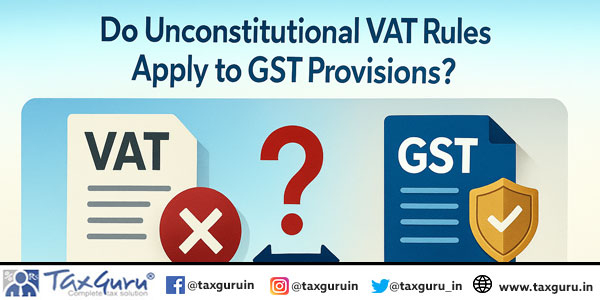
Whether the Provisions declared as unconstitutional or read down under the erstwhile Indirect Tax Acts would also cover under Similar provisions of GST Act ?
GST Act which is a Goods and Services Act 2017 sloganed as “Good and Simple Tax” has become more of a complicated Act as there were circulars, amendments, Notifications, time and again brought to the GST Act. GST Act was introduced in the midnight of 1st July 2017 by the Prime Minister of India Sri. Narendra Damodar Das Modi Ji and from that time onwards the Act came into force and was running rather implemented in a Jet Speed manner.
Though the GST Act is a very beautiful and nice Act but the provisions and the Rules made by the executive has made it more complicated which we are able to visualize day in and day out.
Though the GST Act was introduced in 2017, the framers of GST Law has not forecasted about certain things and if at all they have visualized certain things then they have followed the erstwhile indirect taxes and implemented the same provisions.
To specify such provisions in this article, I am only referring to section 16(2)(c) r/w Section 41 under GST Act which are akin to AP & Telangana VAT Act provisions like section 9(2)(g) of Delhi VAT Act. For the benefit of the readers of this article, I am reproducing the relevant sections.
Section 9(2)(g) of Delhi VAT Act 2004:-
(2) No tax credit shall be allowed — (a) xxxxxx
to
(f)xxxxxx
(g) to the dealers or class of dealers unless the tax paid by the purchasing dealer has actually been deposited by the selling dealer with the Government or has been lawfully adjusted against output tax liability and correctly reflected in the return filed for the respective tax period.
[Inserted vide DVAT (Amendment) Act, 2009; No.F.14(16)/LA-2009/LJ/10/vlaw/1, dated 06.01.2010 and come into force vide No.F.3(23)/Fin.(T&E)/2009-10/jsfin/286, dated 01.04.2010 w.e.f. 01.04.2010.]
Section 16 of CGST Act 2017 :-
Eligibility and conditions for taking input tax credit.—
(1) xxxxx
(2) Notwithstanding anything contained in this section, no registered person shall be entitled to the credit of any input tax in respect of any supply of goods or services or both to him unless,–
(a x b) xxxxx
(c) subject to the provisions of section 41, the tax charged in respect of such supply has been actually paid to the Government, either in cash or through utilisation of input tax credit admissible in respect of the said supply; and
Section 41 of GST Act 2025:- Claim of input tax credit and provisional acceptance thereof.—
(1) Every registered person shall, subject to such conditions and restrictions as may be prescribed, be entitled to take the credit of eligible input tax, as self-assessed, in his return and such amount shall be credited on a provisional basis to his electronic credit ledger.
(2) The credit referred to in sub-section (1) shall be utilised only for payment of self- assessed output tax as per the return referred to in the said sub-section.
To be more precise, sections under the VAT Act and GST Act are akin to each other and a slight variance can be noted but what the VAT Act and the GST Act 2017 says is when the seller sells the goods to the purchaser and on such goods the purchaser pays the tax to the seller and the seller in turn does not pay the tax to the Government then the purchaser is liable to pay the input tax that he has availed in cash or to reverse the input tax claimed or set off by him to the Government.
In nutshell all the these provisions either under the AP & Telangana VAT Act 2005 or Delhi VAT Act 2004 or under the GST Act 2017, what the Government intends is to tax the purchaser who has already paid the tax to the seller who has not paid the tax to the Government. Ultimately according to me the Government has visualized and is providing under the GST Act to the purchaser a RCM which according to me is double taxation. Added to this penalty under section 73 or 74 is added and interest under section 50 of GST Act 2017 is further added.
What I write in this article is when the Government has to do business in a country like ours which is a sovereign. Democratic and secular country, the Government as is notable to do the business except for some institutions, wanted the citizens to do the business and pay the taxes. So far if it is the end customer , the taxes would be paid to the Government but in indirect tax system and in a multiple tax system as the Government is not able to collect from the persons who are doing the business , the Government has in turn directed the businessmen to collect and pay to the Government.
So far so good but the dispute arises when the Government is not getting the taxes collected by the seller and in order to squeeze the blood of the purchaser the Government is imposing such type of restrictions on the purchaser as if the Government is giving some undue benefit to the purchaser.
Therefore this issue was cropped up because of the input tax credit had it not been given the input tax credit, there would not be any problem and the Government is saying that the selling dealers who sold the goods at the time of selling though registered later found to be unregistered is blocking the credit ledger on the ground that the purchaser has availed wrongful input tax credit under section 86A. This provision has been dealt by many High Courts and the High Courts have rendered in favour of the assessee.
In most of the cases, the departmental authorities are resorting to section 86A referring to section 16(2)(c) of the GST Act.
Under the Delhi VAT Act 2004, the Hon’ble High Court of Delhi in the case of On Quest Merchandising India Vs. Govt. of NCT, and in the case of Shanti Kiran India Pvt. Ltd. Vs. Commissioner Trade & Tax Dept. reported in 57 VST 405 (Del), the Hon’ble High Court of Delhi has read down the provision Section 9(2)(g) saying that if the seller is not paying tax to the Government , the purchasers should not be burdened to pay the tax. The department has gone to appeal to the Hon’ble Supreme Court and the Hon’ble Apex Court in Arise India Limited has dismissed the Special Leave Petition.
Recently in the case of Commissioner of Trade and Tax, Delhi vs. M/s. Shanti Kiran India Pvt Ltd., New Delhi has reiterated the law and in very detailed manner saying that when the selling dealer is registered dealer on the date of the transaction and neither the transactions nor invoices in question have been doubted, the Hon’ble Court did not find a good reason to doubt the transaction and deny the input tax credit claimed by the purchaser and upheld the judgment of the Delhi High Court. This judgment was reported in TS-691-SC-2025-VAT.
In fact the Andhra Pradesh High Court way back in 2014 itself has rendered a judgement in the case of Harsh Jewellers Vs. Commercial Tax Officer and Ors. reported in (2012) 54 APSTJ 133, (2013)57VST538(AP) saying that when the selling dealer is a registered dealer when he has made the sales but later on he canceled the registration or his registration is terminated, does not absolve the purchaser from claiming input tax credit.
Several writ petitions have been filed by the dealers before various High Courts and the High Court of Kerala , Patna and Gujarat upheld section 16(2)(c) but the High Courts of Kolkata and Delhi rendered judgements in favour of the dealers and a Special Leave Petition was filed before the Hon’ble Apex Court in SLP (C) No. 008505/2024 and the matters are ripe for hearing before the Hon’ble Supreme Court.
In fact when a similar matter has come up before the Hon’ble Supreme Court , the Hon’ble Supreme Court has asked how can the Government impose the tax though by a reversal mechanism on the purchasing dealer who has paid the tax.
I am quite astonished that the Government though is saying that it is a good and simple tax, but is trying to collect the tax by way of arm twisting methods, leaving tax evaders, from the persons who are tax abiding citizens. In fact when I was working as Senior Standing Counsel for Central Excise, Customs, Service Tax and GST till I resigned where I have won the cases and got revenue to the Government of India worth Rs. 1167 Crores, I have in fact suggested that this would lead to unwanted litigation but no one has heard and the concept of the principal –agent relationship is forgotten totally by the Government and it imposes tax, penalty and interest. Some of the judgements of various High Courts are given below for the kind consideration of the readers.
1) Nahasshukoor Vs. Assistant Commissioner second Circle, State Goods & Service Tax Department and Ors reported in :[2024]123GSTR41(Kerala), 2023/KER/56993
2) D. Y. Beathel Enterprises Vs. The State Tax Officer (Data Cell) (Investigation Wing) -(2021) 86 GST 400 (Madras), 2022[58] G.S.T.L. 269, [2021]91GSTR300(Mad).
3) Christie’S India Private Limited vs. Union Of India and Ors. (20.09.2025 – MHOR) : MANU/MHOR/30974/2025
What I like to emphasize is that such action of the Government either under the VAT Act or under the GST Act is brought to notice of the Court, some of the High Courts have raised their eye brows and also Hon’ble Apex Court and rendered judgements either striking down or reading down the provisions. In fact in Harsh Jewellers Vs. Commercial Tax Officer and Ors. reported in (2012) 54 APSTJ 133, (2013)57VST538(AP) case is first of its kind which was argued by me.
I request all the prudent readers to give a thought about section 16(2)(c) r/w section 41 which are akin to the VAT provisions and which have to be read down by the Hon’bel Apex Court and to give a thought about the importance of judicial decision though rendered under a different statute may be when the GST Act has come into force, the Hon’ble Apex Court would not delivered its judgement because of which the framers of the statute have kept section 16(2)(c) alive but when the Hon’ble Apex Court in 2017 ending in the case of Arise India has set aside the departmental appeal then the Government or framers of the Act should have opened their eyes and should have remove or modified the provision.
I therefore humbly opine that the Hon’ble Supreme Court will definitely consider this provision as nugatory, null and void , crippling the business of the purchasing dealers and would render justice there upon.
I hope that this article has thrown light on the topic and any suggestions if any may be addressed to me so as to improve myself.