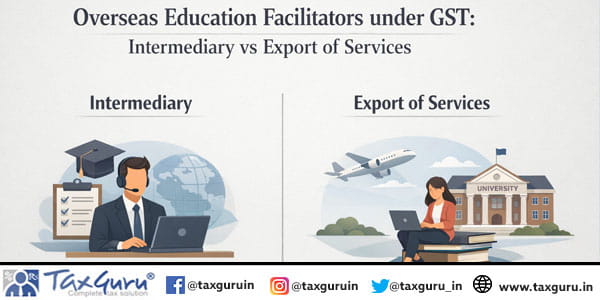
Overseas Education Facilitators under GST: Intermediary versus Export of Services – A Post KC Overseas and Vodafone India Analysis
Introduction
Under the GST regime, the concept of “intermediary services” has emerged as one of the most contentious areas in cross-border service taxation. Overseas education facilitators have been frequent targets of scrutiny on the premise that they arrange or facilitate the supply of education services between foreign universities and Indian students. Such characterisation attracts Section 13(8)(b) of the IGST Act, deeming the place of supply to be the location of the supplier in India, thereby denying export benefits and refund of accumulated input tax credit (“ITC”).
Judicial pronouncements, however, have consistently cautioned against an over-expansive interpretation of the intermediary definition. The controversy has now reached a substantial degree of closure following the Bombay High Court’s decision in KC Overseas[1] and its affirmation by the Supreme Court, read in the light of the Supreme Court’s authoritative exposition on export of services in Vodafone India[2].
Business Model of Overseas Education Facilitators
Overseas education facilitators generally operate under bi-partite agreements with foreign universities. Under such arrangements, the Indian entity undertakes student outreach, counselling, preliminary screening, application assistance, and coordination. Crucially, the facilitator does not possess authority to grant admissions, issue enrolment letters, or bind the university contractually. The final decision on admission rests solely with the foreign university.
Consideration for these services is paid by the foreign university, often in convertible foreign exchange and sometimes linked to successful enrolments. In many models, no fee is charged to students, or any student-facing fee is independent of the consideration payable by the university. This commercial structure is central to determining the recipient of service, the nature of supply, and the place of supply under the IGST Act.
Statutory Framework
Export of Services
Section 2(6) of the IGST Act defines “export of services” and prescribes five cumulative conditions, including that the supplier be located in India, the recipient be located outside India, and the place of supply be outside India. The determination of place of supply is governed by Section 13 of the IGST Act where either the supplier or recipient is located outside India.
Intermediary Services
Section 2(13) of the IGST Act defines an “intermediary” as a person who arranges or facilitates the supply of goods or services between two or more persons but expressly excludes a person who supplies such goods or services on his own account. Where a supply qualifies as intermediary services, Section 13(8)(b) deems the place of supply to be the location of the supplier.
Recipient of Service
Section 2(93) of the Central Goods and Services Tax Act, 2017 (“CGST Act”) provides that where consideration is payable, the person liable to pay such consideration is the “recipient” of the service. This statutory definition has assumed decisive importance in recent judicial interpretations.
Departmental Approach
Tax authorities have often proceeded on the assumption that overseas education facilitators are intermediaries merely because their activities incidentally connect students with foreign universities. Such an approach conflates facilitation of one’s own contracted service with facilitation of a third-party supply and overlooks the exclusionary limb of Section 2(13) of the IGST Act.
Judicial Evolution
Courts have repeatedly emphasised that the intermediary definition cannot be applied mechanically and that the substance of the contractual and commercial arrangement must prevail over labels or perceived facilitation.
1.Ernst & Young Ltd. v. Additional Commissioner, CGST (Delhi High Court)[3]
The Delhi High Court in Ernst & Young Ltd. laid down foundational principles governing intermediary services. It held that an intermediary merely arranges or facilitates a supply between two other persons and does not himself provide the main supply. A person who supplies services directly to the recipient on a principal-to-principal basis cannot be treated as an intermediary merely because the services are rendered “on behalf of” another entity. The Court underscored that the exclusionary portion of Section 2(13) ensures that actual service providers are not subsumed within the intermediary definition.
2.KC Overseas Education Pvt. Ltd. v. Union of India (Bombay High Court)[4]
Applying the above principles to the overseas education sector, the Bombay High Court held that the foreign university, being liable to pay consideration, is the recipient of service within the meaning of Section 2(93) of the CGST Act. The services rendered by the facilitator were held to be supplied on its own account to the foreign university and not in the nature of arranging or facilitating the supply of education services between the university and students.
Consequently, the place of supply was governed by Section 13(2) of the IGST Act, being the location of the recipient outside India, and the services qualified as export of services. The Court directed grant of refund subject to receipt of consideration in foreign exchange.
3. Supreme Court: Affirmation through SLP Dismissal[5]
The Supreme Court dismissed the Department’s Special Leave Petition against the KC Overseas judgment. Though by a non-speaking order, the dismissal lends considerable finality to the Bombay High Court’s reasoning, particularly when read with earlier Supreme Court jurisprudence on export of services.
4. Reinforcement from Vodafone India Limited: Recipient-Centric Export Principle[6]
The Supreme Court’s decision in Commissioner of Service Tax v. Vodafone India Limited marks a significant reaffirmation of export-of-services jurisprudence. While rendered in the context of the pre-GST service tax regime, the Court reiterated principles of enduring relevance to GST.
The Court emphasised that service tax (and by extension GST on services) is a destination-based consumption tax and that services exported out of India are not intended to be taxed. It held that the decisive factors for export are the location of the service recipient and receipt of consideration in convertible foreign exchange, rather than the place of performance or the identity of the end user.
In Vodafone India, inbound roaming and allied services were held to be exports because the contractual obligation was owed to, and consideration was paid by, foreign telecom operators, notwithstanding that the services were enjoyed by subscribers located in India. The Court explicitly recognised that users or beneficiaries of a service may be different from the recipient in law, and that such distinction cannot be blurred for tax purposes.
This recipient-centric reasoning directly strengthens the KC Overseas rationale. In the overseas education facilitation model, students may be beneficiaries of counselling or assistance, but the contractual recipient is the foreign university that pays for the service. Applying Vodafone India, the presence of student interaction in India cannot displace the export character of services rendered to a foreign recipient.
The Kerala Dimension: Advance Ruling Cross-Currents
In Kerala, the Authority for Advance Ruling in Maryland Study Abroad Private Limited[7] adopted a contrary view, classifying similar services as intermediary services. Although such rulings are binding only on the applicant and the jurisdictional officer, they are frequently relied upon by field formations to initiate proceedings.
From a precedential standpoint, however, Advance Rulings occupy a lower rung in the judicial hierarchy and cannot override High Court judgments or Supreme Court orders. In light of KC Overseas read with Vodafone India, the Kerala AAR approach appears doctrinally fragile, though it underscores the need for robust contractual and documentary discipline in the State.
Analytical Test for Classification
Synthesising the judicial precedents, the following analytical framework emerges:
- Identification of the contractual parties and supplies involved;
- Determination of the person liable to pay consideration and, therefore, the recipient of service;
- Examination of whether the facilitator supplies services on its own account or merely arranges a third-party supply; and
- Assessment of the extent of authority conferred on the facilitator to bind or represent the foreign university.
Where the arrangement is principal-to-principal, the foreign university controls admissions, and consideration flows from the university in foreign exchange, the intermediary classification is legally unsustainable.
Proposed Amendment to Place of Supply for Intermediary Services
In its 56th meeting held on 3 September 2025, the GST Council recommended a significant policy shift in relation to intermediary services by proposing the omission of clause (b) of Section 13(8) of the IGST Act.
The proposal seeks to align the place of supply for intermediary services with the general rule under Section 13(2), i.e., the location of the recipient of service, instead of the present deeming fiction that fixes the place of supply at the location of the supplier.
Nevertheless, the said proposal is not yet legally notified/implemented. If legislatively implemented, this change would mark a decisive move towards reinforcing the destination-based character of GST, substantially mitigate long-standing disputes concerning export of intermediary services, and reduce litigation in cross-border service transactions, including overseas education facilitation models.
Until the statutory amendment is enacted, the existing scenarios as discussed supra continue to apply.
Refund Eligibility and Compliance Considerations
Where overseas education facilitation services qualify as export of services, suppliers may undertake such supplies either
- under a Letter of Undertaking as zero-rated supplies and claim refund of unutilised ITC under Section 54(3) of the CGST Act read with Rule 89 of the CGST Rules or
- under with payment of integrated tax claim refund of such tax paid under section 54 of the CGST Act read with Rule 96 of the CGST Rules
For past periods where GST was paid under an erroneous intermediary classification, refund strategies must be assessed in light of limitation, unjust enrichment, and procedural compliance.
While courts have consistently adopted a liberal approach on substantive classification, procedural lapses remain a common ground for rejection.
Conclusion
The GST controversy surrounding overseas education facilitators has largely reached doctrinal closure. The combined reading of Ernst & Young, KC Overseas, and the Supreme Court’s exposition in Vodafone India firmly establishes that facilitation of overseas student recruitment, when undertaken on a principal-to-principal basis for foreign universities, does not amount to intermediary services.
For Kerala-based facilitators, while Advance Ruling uncertainties persist, the weight of High Court and Supreme Court jurisprudence decisively favours export classification and refund eligibility. Moreover, the said advance ruling does not have binding authority to all taxable persons other than the applicant and his jurisdictional proper officer[8].
Most prominently, it is essential to analyse the contracts/agreements and confirm the commercial structure of each case to determine the recipient of service, the nature of supply, and the place of supply, prior proceeding to reap the benefits of zero-rates supply.
The evolving jurisprudence reaffirms a foundational principle of indirect taxation: exports must remain zero-rated, and the intermediary concept cannot be stretched to tax genuine cross-border service exports merely because elements of performance or benefit arise in India.
For any clarifications or feedback, please feel free to reach me @ [email protected].
[1] 2025 (3) TMI 1526 – BOMBAY HIGH COURT.
[2] 2025 (8) TMI 938 – Supreme Court.
[3] 2023 (73) GSTL 161 (Del.).
[4] 2025 (3) TMI 1526 – BOMBAY HIGH COURT.
[5] 2025 (9) TMI 469 – SC Order.
[6] 2025 (8) TMI 938 – Supreme Court; see also reliance on Paul Merchants Ltd. and Microsoft Corporation (I) Pvt. Ltd. as approved by the Supreme Court.
[7] Ker 21/2025 dated 01.07.2025.
[8] Section 103 of the CGST Act 2017