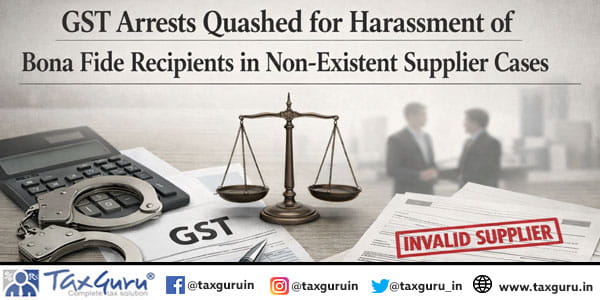
Misuse of Section 69 CGST arrest powers and Section 70 summons against bona fide recipients in non‑existent supplier cases, in violation of BNSS safeguards and principles of natural justice.
Genuine recipients can and should push back against this pattern using both case‑law and procedure. Courts and the Supreme Court have repeatedly cautioned GST officers against using summons and arrest powers to harass bona fide taxpayers, especially where the default is at the supplier’s end.
Below is a practical, litigation‑oriented framework you can use, with key judgments and a sample ground‑draft you can adapt.
1. Core principles you can rely on
Summons cannot be used for harassment
High Courts have held that Section 70 summons must be for bona fide enquiry, not to harass or coerce taxpayers, and that repeated or day‑long summons without clear purpose can amount to abuse of power.
In Sapna Jain (SC, 2019, in context of GST summons), and later HCs like Gujarat and Calcutta (e.g., Vimal Yashwant Giri Goswami; Shyam Sel & Power), courts discouraged the use of summons as a pressure tactic and encouraged protection of cooperating assessees.
ITC of bona fide recipient cannot be denied merely because supplier is non‑existent / defaulted later
GARGO TRADERS v. JCCT (Calcutta HC): ITC to recipient cannot be denied only because the supplier’s registration was retrospectively cancelled; the buyer, having tax invoice, e‑way bill and banking‑channel payment, cannot be burdened with supplier’s default.
Gauhthi HC has read down provisions which deny ITC solely due to supplier non‑compliance, observing that it leads to cascading and punishes bona fide purchasers.
Academic and case‑law syntheses (including pre‑GST DVAT rulings like Arise India) emphasise that putting impossible verification burdens on recipients (tracking whether supplier paid tax) violates Article 14.
Criminal proceedings/summons cannot continue where summons have been duly replied
A High Court quashed prosecution under Section 174 IPC where assessees had responded to Section 70 summons; once replies are on record, treating them as non‑compliant is “abuse of process”.
BNSS/CrPC safeguards and SC’s Radhika Agarwal ruling
The Supreme Court in Radhika Agarwal v. Union of India (DGGI case) upheld arrest powers but made it clear that BNSS/CrPC protections apply fully to GST/Customs arrests, and that warrantless arrests by revenue officers must be strictly regulated and not used as recovery tools.
Later decisions (Gauhati HC, Bombay HC, others) apply BNSS Section 35(3) (old Section 41–41A CrPC) to GST: if the person joins investigation, arrest without recorded, individualized reasons is illegal.
2. Strategy for genuine recipients facing such summons/arrest risk
A. Before and during summons
Always attend and always document
Attend on time; record arrival/departure times, officers present, and any long waiting periods (e.g., kept idle 10:30 to 5:00, interrogation only late evening). This helps build a harassment narrative later.
Bring a written brief and evidence of bona fides
Payment proofs through banking channels, transport/e‑way details, stock records, supplier’s GST registration status at time of supply, etc. This aligns you with GARGO TRADERS and similar bona fide recipient cases.
Protect the statement record
Make sure your statement clearly records:
You received goods,
You paid through banking channels,
You checked GST registration and e‑way bills,
You had no role in supplier’s non‑filing/fake activity.
If pressured to accept “no receipt of goods”, insist on modifying or adding your version; if refused, follow up with a written retraction/clarification promptly. Courts do look at immediate retractions.
B. When arrest is threatened or used against recipients
Grounds to challenge arrest
Summons compliance and full cooperation; no risk of absconding or tampering; arrest used purely as coercion – contrary to Radhika Agarwal and BNSS‑based protections.
Arrest of buyer, while virtually no meaningful action against defaulting supplier, shows arbitrary targeting of the easiest “face” rather than actual mastermind – an Article 14 angle you can highlight.
Typical reliefs sought
Writ of habeas corpus or 226 petition questioning custody; or
Pre‑arrest/regular bail with strong emphasis on: bona fide recipient, documentary trail, and full cooperation.
C. Judgments you can marshal (recipient‑friendly or process‑protective)
Below is a non‑exhaustive but useful list, with the angle each supports (you can replace with precise citations from your library):
| Issue / angle | Illustrative case / material | Key proposition |
|---|---|---|
| Summons not for harassment | Vimal Yashwantgiri Goswami v. State of Gujarat; Shyam Sel & Power Ltd. v. UOI; Sapna Jain (SC interim) | Section 70 summons must be bona fide; repeated, purposeless or coercive use is abuse of power. |
| Replies to summons bar 174 IPC | HC decision discussed in Taxo article “Criminal proceedings dropped when summons duly replied” | When replies to summons are on record and accepted, prosecution for non‑attendance is abuse of process. |
| Bona fide buyer ITC protection | GARGO TRADERS v. JCCT (Cal HC); summary at TMI | ITC cannot be denied merely because supplier’s registration later cancelled/non‑existent if buyer had tax invoice, e‑way bill, banking payment. |
| Supplier non‑payment, ITC denial read down | Gauhati HC case reading down GST ITC‑denial linked to supplier default | Denying ITC solely for supplier’s non‑compliance creates cascading and is unconstitutional against bona fide recipients. |
| Conceptual defence of bona fide recipients | Analysis on denying ITC to bona fide recipients (IndiaCorpLaw article) | Courts (pre‑ and post‑GST) have consistently favoured protecting bona fide purchasers from supplier’s tax default. |
| BNSS/CrPC safeguards apply to GST arrests | Radhika Agarwal v. Union of India (SC); commentaries | BNSS/CrPC protections on arrest fully apply to GST/Customs; warrantless arrests must be narrowly exercised. |
| Non‑compliance with procedural safeguards vitiates GST arrest | Gauhati HC, other HCs discussed in Taxo/Taxmann summaries | Arrest is illegal if Section 35(3) BNSS (old 41–41A CrPC) and related safeguards are ignored for a cooperating assessee. |
You can add more recent ITC‑recipient decisions from your own database (e.g., Suraj Impex, RT Infotech, state VAT analogues) to deepen the Article 14 line.
4. Draft‑style grounds you can adapt (for writ/bail/representation)
Below is a short, adaptable draft skeleton, phrased generically so you can tailor to a specific case:
Harassment via misuse of summons
“That the Petitioner is a bona fide registered recipient who has, on each occasion, appeared in response to summons under Section 70 of the CGST Act at 10:30 AM and remained present till late evening, but the Respondent‑officers deliberately deferred appearance till after normal office hours and commenced interrogations in an intimidating atmosphere, thereby misusing the power of summons for harassment rather than bona fide enquiry, as deprecated by various High Courts.”
Full cooperation and documented bona fides
“That the Petitioner has produced all primary documents – tax invoices bearing valid GSTIN, e‑way bills auto‑generated from the common portal, payment proofs through banking channels, and stock/transport records – demonstrating genuine receipt of goods and satisfaction of all statutory conditions under Section 16.”
Unlawful shifting of supplier’s default onto recipient
“That merely because the selling supplier was subsequently reported as non‑existent or its registration was cancelled, the entire ITC of the Petitioner has been rejected and criminal proceedings initiated, contrary to the law laid down in GARGO TRADERS (Cal HC) and other rulings which protect bona fide recipients from supplier‑side defaults and hold that ITC cannot be denied solely on such ground.”
Arbitrary targeting of recipient instead of defaulting supplier
“That the Respondents have initiated coercive proceedings including arrest against the Petitioner while taking negligible or no effective action against the defaulting suppliers identified in their own reports, which amounts to arbitrary and discriminatory enforcement in violation of Article 14.”
Violation of BNSS/CrPC safeguards and Radhika Agarwal
“That notwithstanding the Petitioner’s attendance on every summons and cooperation, the Respondents have invoked Section 69 CGST without issuance of a valid notice or recording individualized reasons as mandated by Section 35(3) BNSS, and without properly communicating and furnishing the grounds of arrest in writing, rendering the arrest and detention illegal in view of the Supreme Court’s judgment in Radhika Agarwal and subsequent High Court decisions applying BNSS/CrPC safeguards to GST arrests.”
Abuse of criminal process for recovery/ITC disputes
“That the dispute, at its core, concerns the allowability of ITC to a bona fide buyer, which ought to be adjudicated in assessment proceedings; resort to custodial interrogation and arrest in such a scenario is disproportionate and constitutes an abuse of criminal process, as repeatedly cautioned by the Supreme Court and various High Courts in the context of GST investigations.”
You can convert these into separate grounds (A, B, C…) in a writ/bail petition or distil them into an internal “standard defence” note for clients.
5. Handling taxpayers’ fear of appearing under summons
For your clients who are afraid to attend:
Emphasise that non‑appearance can be twisted into non‑cooperation; instead, appear with counsel’s guidance, carry a written note asserting bona fides, and insist on normal‑hours questioning.
Provide them with a one‑page instruction sheet: what to carry, what to say, when to insist on breaks, how to record coercion, and that they may contact you before signing anything.
Assure them that courts are now more sensitive to such abuse – and that documented cooperation plus a clear paper‑trail markedly improves their position for any future relief.