
GST in Karnataka: When Analytics Replace Adjudication and Bona Fide Buyers Pay the Price
1. Introduction: A good law, a bad practice
The GST law, on paper, is a strong value‑added system. It promises seamless credit, protection for bona fide taxpayers, and a clear appellate structure with limited pre‑deposit and automatic stay.
In practice, especially in Karnataka, a very different system is running on the ground. Officers depend almost entirely on back‑end analytics, NGTP tags and internal emails. They avoid independent adjudication, delay decisions until limitation, confirm demands in bulk, and then hide behind the 10%+10% pre‑deposit structure.
The result is simple: real fraudsters move on; honest buyers and small entrepreneurs are trapped with huge demands, blocked credits, bank attachments and a permanent fear of the department.
2. How the present “system” actually works
It helps to describe the mechanics step by step, exactly as you see them in practice.
2.1 No real adjudication until the last minute
Many proper officers in Karnataka (both State and Centre) are not passing detailed speaking orders, even where the facts are clear and documents are on record.
Officers are afraid that if they allow ITC or drop allegations in a reasoned order, higher officers will open Suo motu revision and question them. That fear is real; internal culture rewards “high demand” and punishes “drop in demand”
So, for years, files lie unattended. Close to limitation, the officer confirms the full demand of tax, interest and 100% penalty under section 74, often in a cut‑and‑paste order.
2.2 Pushing everything into the pre‑deposit funnel
Once the order comes:
The assessee has no choice but to file first appeal under section 107, paying 10% pre‑deposit of disputed tax.
If the First Appellate Authority also simply confirms the order (often in a short, standard order), the only further remedy is Tribunal with another 10% pre‑deposit.
In the meantime, at least 20% of disputed tax sits with the department, even though the facts and law may clearly favour the assessee.
Recent commentary from various High Courts, including Karnataka, has held that recovery beyond the statutory pre‑deposit (10% at first appeal, 20% at Tribunal) is illegal, yet coercive recoveries and bank attachments are still common.
2.3 NGTP tags and internal emails replace field work
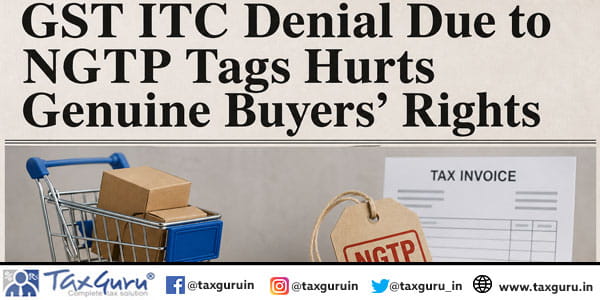
Officers receive NGTP / “non‑genuine” lists and internal emails instructing them to focus on cancelling registrations of buyers who are connected to so‑called non‑existent dealers, instead of investigating the root cases.
There is often no real proof of non‑existence beyond a single casual visit or analytics; yet these tags are treated as final proof.
Genuine buyers, who dealt with suppliers when they were active and valid on the portal, are declared non‑genuine. Registrations of buyers are cancelled, and ITC is denied down the chain.
In the process, revenue is actually harmed: once you cancel a bona fide buyer and kill his business, you lose a compliant tax base which would have paid GST continuously in future years.
3. The RISI‑type example: a real audit order that shows the problem
Consider a real pattern I described, which is very typical:
A buyer in Karnataka purchases goods from a supplier who is active and genuine at the time of supply, with valid GST registration.
The buyer has full documents: invoices, e‑way bills, stock records, bank trail.
The supplier later files GSTR‑1, declares the outward supplies to this buyer, and discharges the tax. The invoices appear correctly in the buyer’s GSTR‑2B, satisfying section 16(2) and section 16(2) (aa).
Later, someone tags the supplier as NGTP and cancels his registration retrospectively, alleging non‑existence or bogus activity based on analytics or later inspection.
In one client example:
An audit under section 65 is done.
The Commercial Tax Officer accepts that documents are produced and verified; this is reflected in the order.
Yet, solely because the supplier is now tagged NGTP with retrospective cancellation, the officer denies the entire ITC, demands around ₹2 crore, adds interest under section 50 and 100% penalty under section 74.
The buyer is a genuine businessman. He has no means to pay ₹2 crore. To even challenge the order, he must find ₹20 lakh for 10% pre‑deposit under section 107(6). If he cannot, he may shut down, disappear, or become non‑compliant.
Legally, this is in direct conflict with recent Karnataka High Court jurisprudence protecting genuine buyers and reading down section 16(2)(c) for non‑collusive cases, as well as with national trends that refuse to punish buyers for supplier defaults when documents and payment are genuine.
But the ground reality still runs on “NGTP tag = bogus = deny everything”.
4. Why officers are doing this
It is important to understand the human and institutional reasons:
Target culture and performance metrics
Officers are constantly under pressure to show “numbers”: demands raised, cancellations done, recoveries achieved.
It is safer for them to raise higher demands and let appeals/writs settle the law later than to take a balanced view and risk internal audit and vigilance.
Fear of Suo motu revision and audit
If an officer allows ITC or drops a proposed demand, higher authorities can call for records, review the order and even initiate proceedings against the officer.
This creates a risk‑averse mindset: better to confirm every demand than to “stick one’s neck out” in favour of a taxpayer, even when the facts justify it.
Over‑reliance on AI tools and NGTP concept
Analytics and NGTP lists give an easy shortcut: if the system says “non‑genuine”, the officer feels safe mechanically following it instead of doing field verification and explaining a contrary conclusion.
SOPs like the Delhi circular on non‑genuine taxpayers even encourage ab‑initio cancellation, making all transactions appear void in hindsight.
Lack of accountability for wrongful demands
When a huge demand is later struck down by Tribunal or High Court, there is rarely any consequence for the officer who raised it, even if the order was patently mechanical.
The cost of wrongful demand—pre‑deposit blocked, business destroyed, litigation expense—is borne entirely by the taxpayer.
5. What taxpayers and professionals can realistically do
The question is: in this environment, what can a bona fide buyer or practitioner actually do? A few concrete, practical points:
5.1 Strengthen your factual defence beyond minimum
Maintain full documentation: invoices, contracts, goods receipt notes, stock registers, e‑way bills, transport documents, bank statements, reconciliation with GSTR‑2B.
Where possible, retain proof that supplier was active and valid on GST portal at the time of supply (printouts, screenshots, internal KYC notes).
For larger vendors, it is sensible to keep photographs of premises or inspection notes; this later supports your “due diligence” argument.
5.2 Attack NGTP labels and analytics directly in replies
In replies to SCN, audit objections or DRC‑01:
Demand the complete NGTP file: reasons, inspection reports, analytics, e‑way bill mismatches, statements.
Argue that NGTP is a risk label, not statutory proof, and that bona fide buyers cannot be punished without transaction‑wise evidence.
Rely on recent case law (like Instakart and Karnataka HC NGTP decisions) to show that section 16(2)(c) and analytic flags cannot override genuine transactions.
5.3 Use writ jurisdiction strategically, not as a last resort
Where orders are completely mechanical (no discussion of documents, one‑paragraph confirmation, pure NGTP reliance), consider writ petitions in the High Court instead of only relying on statutory appeals.
Karnataka High Court has already:
Struck down coercive recovery and directed refund of amounts recovered beyond pre‑deposit when GSTAT is not formed, relying on Circular 224/18/2024‑GST
Emphasised that departmental actions must follow the spirit of the circular and cannot resort to back‑door recovery.
A writ is not needed in every case, but when the system behaves like a machine with no human mind, writ jurisdiction is the constitutional safety valve.
5.4 Build collective pressure and professional record
Professionals and trade bodies should document patterns:
NGTP‑based cancellations of buyers without facts,
mass demands close to limitation,
refusal to examine books or grant hearings.
These patterns, with redacted orders, can be used for:
representations to the Commissioner / Chief Secretary / GST Council Secretariat,
articles in journals and websites,
6. Why this approach is dangerous for the department itself
It is important to explain that this is not an “anti‑department” position. This culture ultimately harms revenue and public trust.
Loss of genuine tax base
When bona fide buyers are cancelled or bank accounts are frozen, they close operations or go partially underground. Revenue loses a regular compliant taxpayer.
False sense of achievement
High “demand” numbers and NGTP cancellations look good on paper but do not translate into actual collections. At the same time, litigation and refunds after years show that the underlying demands were unsound.
Courts will step in more aggressively
As more cases reach High Courts, judges see the same pattern: mechanical NGTP use, no evidence, blind denial of ITC. The result is stricter judicial scrutiny, directions for refunds, and criticism of the department’s approach.
International credibility and FATF/PMLA narrative
India is trying to show the world that it has a modern tax system and a serious anti‑laundering framework. Over‑use of “money laundering” language in routine GST disputes weakens that narrative. Better to reserve PMLA focus for real frauds and treat honest taxpayers with respect.
7. What the data on fraud actually shows since 2017
From various CBIC and press reports, there is no doubt that large frauds exist:
All‑India drives have identified tens of thousands of fake GST registrations and bogus ITC claims running into tens of thousands of crores.
SOPs like the Delhi non‑genuine taxpayer circular arose because fraudsters misused Aadhaar/PAN of innocent people to create dummy firms and issue fake invoices.
But these numbers often cover the same fraud chains analysed multiple times, and they say nothing about how many bona fide taxpayers were wrongly hit in the process. No official database tells you:
How many NGTP‑tagged suppliers later turned out to have real business,
How many ITC denial orders against genuine buyers have been reversed by appellate forums, or
How much demand is actually collected versus how much is created on paper.
This missing data is the real problem: policy is driven by headline “fraud detected” numbers, not by quality of adjudication.
8. A better way forward: ground work, not just dashboards
My point to the alternative model: old‑fashioned ground work combined with modern tools.
What would that look like?
Officers use analytics to identify risk cases, but then actually go to the field, talk to trade, inspect premises properly, and distinguish:
real shell entities with no business, and
small but genuine dealers with compliance lapses.
Instead of mass cancellations and NGTP tags, they invest time in rectifying registrations, educating taxpayers, and tightening initial KYC and verification.
They talk with trade bodies and professionals, understand transaction patterns in that sector, and design better filters.
If this is done, two things happen:
Genuine fraud is targeted more precisely.
Honest taxpayers start seeing the department as a partner in compliance, not as a distant authority firing missiles from a dashboard.
9. Conclusion: from dictatorship by dashboard to human‑centred GST
India is a constitutional democracy. Tax administration is not allowed to function as a dictatorship of dashboards, NGTP tags and target emails. Every officer is bound first by the Act, Rules and Constitution, not by internal instructions that ignore them.
GST, as a law, is not the enemy. The problem is the way parts of the administration are implementing it: by refusing to look at books, refusing to exercise judgement, and converting every allegation into a confirmed demand plus pre‑deposit pipeline.
For taxpayers and professionals, the path is not easy, but it is clear:
Keep your factual record spotless.
Challenge NGTP and analytics wherever they are used as a shortcut to deny ITC.
Use writ jurisdiction when necessary to enforce the spirit of High Court and Supreme Court decisions.
Write, publish and speak about these patterns so that officers and policymakers see the unintended consequences.
For the department, the message is also clear:
Listen to courts. Recent Karnataka decisions on recovery, pre‑deposit and bona fide buyers are not suggestions; they are binding directions.
Trust your own officers to adjudicate independently based on evidence, without fear of revision just because a demand was dropped.
Use analytics as a tool, not as a verdict.
If that change happens, GST in Karnataka can become what it was meant to be: a fair, predictable system where real fraud is punished hard, and honest taxpayers can run their business without living in fear of a tag on a portal.
And also, along with this article I have written with honestly open letter to GST OFFICERS IN KARNATAKA, because silence is no longer helping either the department or the tax payers
Open letter title
An Open Letter to GST Officers in Karnataka: Please Judge with Evidence, Not Only with Tags
Dear Officers of the State GST and Central GST in Karnataka,
This letter is written with respect for your office, your workload, and the pressures under which you function. It is also written with honesty.
Those of us who work daily with businesses, appeals, audit files and adjudication orders are seeing the same pattern again and again. A good law is being reduced to a mechanical system. A label is replacing evidence. An internal tag is replacing adjudication. A demand is replacing reasoning. And, in the end, a bona fide taxpayer is being pushed into appeal, pre-deposit, and financial distress without any real determination of facts.
This letter is not written to defend fraud. Fake billing exists. Bogus firms exist. Circular trading exists. Non-existent dealers exist. No honest professional or honest trader wants fraudsters to survive in the GST system. In fact, genuine taxpayers suffer most because of them. But there is a growing difference between fighting fraud and presuming fraud, and that difference matters.
1. The problem on the ground
Today, in many cases in Karnataka, the real adjudication is not taking place at the original stage. Officers receive analytics reports, NGTP tags, cancellation inputs, backend mismatch reports and internal directions. Once that happens, the file often moves in only one direction. The supplier is treated as non-genuine. The buyer is treated as suspicious. The documents produced by the taxpayer are mentioned in the order, but not truly examined. Then comes the expected result: demand confirmed, interest added, penalty imposed.
Even where the buyer has:
valid tax invoices,
payment through banking channels,
e-way bills or transport proof,
stock records,
books of account,
reflection in GSTR-2B,
the final reasoning is often one line: supplier is non-existent / NGTP / retrospectively cancelled; therefore, ITC is denied.
This is not adjudication. This is conclusion first, reasoning later.
2. The law is not asking you to do this
The recent Karnataka High Court trend does not support this mechanical approach. The Court has made it clear that a bona fide recipient cannot be denied ITC merely because the supplier defaulted, where the recipient has complied with the conditions within his control. In the Instakart ruling, the Karnataka High Court read down section 16(2)(c) so that genuine buyers are not punished for the supplier’s failure to deposit tax, unless the transaction itself is non-genuine or tainted by collusion.
That is a very important message. It means the law still expects you to ask a basic question: Was this buyer genuine or was he part of the fraud?
Similarly, recent reporting on Karnataka High Court intervention in NGTP-related cases shows that the mere tagging of a supplier or taxpayer as “non-genuine” cannot, by itself, justify denial of ITC without proper inquiry. The Court has stressed the need for actual verification of evidence such as e-way bills, vehicle details, and transaction records.
That too is a very important message. It means analytics may start the case, but they cannot finish the case for you.
3. Why the present practice is unfair
Consider the position of a genuine buyer. He purchases from a supplier who is active on the GST portal. The supplier issues invoice. Payment is made through bank. Goods are received. Goods are sold onward or consumed in business. The outward supply is reported by the supplier in GSTR-1, and the credit appears in the buyer’s GSTR-2B. Years later, the supplier is retrospectively cancelled or tagged NGTP. Then the buyer is told that his purchase was bogus from the beginning.
What is that buyer supposed to do? Travel back in time? Re-open the supplier’s office of three years ago? Force the supplier to remain compliant forever? The law does not compel the impossible, and the Karnataka High Court has recognized precisely this unfairness in protecting bona fide recipients.
When a taxpayer has done what a normal businessman can do—verify GSTIN, keep invoice, pay by bank, maintain books, receive goods—he should not be treated like a participant in fraud unless there is actual evidence of collusion.
4. The hidden pressure inside the department
It is also necessary to say openly what many officers privately admit. There is fear in the system. Some officers do not pass fair adjudication orders because they fear review, revision, audit objection, vigilance questions, or displeasure from higher authorities if a demand is dropped. Some feel safer confirming demand and letting the appellate authority or court deal with it later. That fear may be institutionally understandable, but legally it is dangerous.
An adjudication order must reflect the officer’s own independent application of mind. If a proper officer stops acting independently because of internal pressure, the whole purpose of adjudication collapses. Then the first real hearing happens only at appeal stage, after the taxpayer has already paid 10% pre-deposit. If the first appeal fails, he pays again for Tribunal. The system then becomes a pipeline for extracting pre-deposit instead of a forum for deciding rights.taxinformation.
That is not what the GST law intended.
5. Recovery and coercion also need restraint
The same concern appears in recovery matters. Karnataka High Court has recently intervened where coercive recovery continued despite the statutory appeal framework and the practical difficulty created by non-constitution of the Tribunal, directing refund of amounts recovered beyond what could properly be retained as statutory pre-deposit.
This is another reminder that recovery powers are not meant to punish first and hear later. The appellate structure in GST is part of due process, not a formality.
6. Why overuse of NGTP hurts the department too
There is a second side to this issue. Over-reliance on NGTP tags and retrospective cancellation does not merely hurt taxpayers. It also damages administration.
First, it destroys trust. A trader who sees his registration threatened because of another person’s tag stops viewing GST as a rule-based system and starts seeing it as a danger.
Second, it encourages paper demands instead of real collections. A demand of ₹2 crore with tax, interest and 100% penalty may look impressive in statistics, but if it is built on weak reasoning, it only creates litigation, pre-deposit, hardship and later reversal. That is not durable revenue administration.
Third, it punishes future compliance. When bona fide businesses are shut down or financially crippled, the government loses continuing tax revenue from legal business activity.
Fourth, it distracts the department from the real root issue: how did fake registrations enter the system in the first place? Recent commentary has correctly pointed out that fake GSTINs and shell entities often survived because initial registration checks and verification were weak. If so, the answer is not to punish every downstream buyer, but to improve front-end scrutiny and field verification.
7. A better administrative approach
A fair and effective GST administration in Karnataka can still be built. The answer is not to reject analytics. The answer is to use analytics properly.
Use analytics to select cases. Then verify.
Use NGTP tagging as an alert. Then investigate.
Use retrospective cancellation carefully. Then distinguish between a collusive buyer and a bona fide buyer.
Before denying ITC, ask:
Did the buyer produce books?
Were they actually examined?
Is there stock correlation?
Is there payment trail?
Is there e-way bill or transport evidence?
Is there any evidence of commission, circular movement of funds, or collusion?
If the answer shows a genuine transaction, the law does not expect you to sacrifice that taxpayer because the supplier later failed.
If the answer shows collusion or sham trade, then act firmly and fully. Honest taxpayers will support you.
8. A request on cancellation of buyers
There is one more issue that needs urgent attention. Reports and practical experience suggest that, in some instances, higher officers are informally directing field formations to concentrate on cancellation of buyers connected to so-called non-existent dealers. This is extremely risky unless backed by real evidence.
A buyer should not lose registration merely because he purchased from a person later alleged to be non-existent. Cancellation is a serious civil consequence. It affects turnover, employment, contracts, banking and future tax payment. If used carelessly, it harms revenue instead of protecting it.
A lawful administration should first prove the buyer’s own wrongdoing, not assume it by association.
9. What officers can do immediately
There are a few practical steps that can improve fairness without weakening enforcement:
Record clear reasons when relying on NGTP tag; do not stop at the tag itself.
Examine the taxpayer’s books and documents physically where necessary.
Give specific discrepancy tables, not general allegations.
Distinguish supplier default from recipient collusion.
Avoid retrospective cancellation logic being used blindly against past buyers.
Avoid recovery beyond what the law permits at each appellate stage.
Pass speaking orders that show evidence-based reasoning.
These are not concessions to taxpayers. They are the minimum requirements of lawful administration.
10. Final word
The GST officer is not only a tax collector. The GST officer is also a statutory decision-maker. That role carries constitutional responsibility. A taxpayer may lose money, business, creditworthiness and peace of mind because of one order. That order cannot be based only on fear, only on targets, or only on what a portal says.
The department in Karnataka has many capable and sincere officers. This letter is written in the hope that such officers will reclaim adjudication from automation, and judgement from administrative pressure.
Please do not let the system become one where:
the software suspects,
the higher office directs,
the proper officer confirms,
and the taxpayer pays first to be heard later.
The law deserves better. Officers deserve the freedom to apply it honestly. Taxpayers deserve the dignity of being judged on evidence.
That is how trust returns. That is how revenue becomes stable. That is how GST becomes lawful in practice, not only on paper.






Based on ground realities. Nice and practical.