From Self-Assessment to System-Driven Mechanism: Analysing GSTN’s Tax Liability Break-up, as Applicable and Table 5.1: Interest and Late Fee for Previous Tax Period
The GST compliance framework is steadily evolving from a self-assessment-based regime to a system-enabled validation model. In this evolving landscape, the GST portal is no longer merely a reporting interface but an active participant in determining tax and interest liabilities.
A significant step in this direction is the introduction of the “Tax Liability Break-up, as Applicable” along with system-computed interest in Table 5.1: Interest and Late Fee for Previous Tax Period of GSTR-3B. While these changes may appear procedural at first glance, they carry substantial implications for interest computation, compliance accuracy, and future scrutiny.
Tax Liability Breakup – Concept and Functional Relevance
The Tax Liability Break-up mechanism seeks to identify the actual period to which a tax liability pertains, rather than merely relying on the period in which it is reported.
In practice, taxpayers often report invoices of earlier periods in subsequent returns due to delays, amendments, or corrections. While such reporting may be permitted, the timing of tax discharge becomes critical from an interest perspective.
The Breakup table enables the system to distinguish between:
- liability pertaining to the current tax period, and
- liability pertaining to earlier tax periods but discharged subsequently
This distinction forms the basis for automated interest computation.
How the portal behaves for different scenarios?
1. Where no invoices pertaining to earlier tax periods exist in the current period – the portal directly provides the option to “Proceed to file”.

Where invoices pertaining to earlier tax periods are reported in the current period – the portal does not provide a direct filing option. Instead, it first requires the user to review the Tax Liability Break-up, as applicable tab, after which the user can proceed further.

Legal Framework – Interest under GST
Interest liability under GST is governed by Section 50 of the CGST Act, 2017 which mandates payment of interest where tax remains unpaid beyond the prescribed due date. Relevant extract is as follows:
50. (1) Every person who is liable to pay tax in accordance with the provisions of this Act or the rules made thereunder, but fails to pay the tax or any part thereof to the Government within the period prescribed, shall for the period for which the tax or any part thereof remains unpaid, pay, on his own, interest at such rate, not exceeding eighteen per cent, as may be notified by the Government on the recommendations of the Council:
[Provided that the interest on tax payable in respect of supplies made during a tax period and declared in the return for the said period furnished after the due date in accordance with the provisions of section 39, except where such return is furnished after commencement of any proceedings under section 73 or section 74 [or section 74A] in respect of the said period, shall be payable on that portion of the tax which is paid by debiting the electronic cash ledger.]
(2) The interest under sub-section (1) shall be calculated, in such manner as may be prescribed, from the day succeeding the day on which such tax was due to be paid.
[(3) Where the input tax credit has been wrongly availed and utilised, the registered person shall pay interest on such input tax credit wrongly availed and utilised, at such rate not exceeding twenty-four per cent. as may be notified by the Government, on the recommendations of the Council, and the interest shall be calculated, in such manner as may be prescribed.]
The statutory framework thus clearly links delay in payment with interest liability at the rate of 18% per annum, making accurate period classification essential. Further, a higher rate of interest i.e. 24% per annum applies in cases involving wrong availment and utilisation of ITC.
System-Based Interest Computation – Structural Shift
With recent updates, the GST portal computes interest automatically based on underlying return data. The computation is driven by key parameters such as:
- document date of supply
- reporting period in GSTR-1 / GSTR-1A / IFF
- date of discharge of liability in GSTR-3B
Based on these inputs, the system determines
- Whether the liability pertains to a prior period
- The duration of delay
- Applicable interest liability
This represents a transition from manual estimation to algorithm-based determination, thereby enhancing consistency and reducing subjectivity in interest computation.
Integration of Tax Liability Breakup with Table 5.1 of GSTR-3B
Any incorrect classification at the Break-up stage can lead to:
- Incorrect computation of interest
- System-generated mismatches
- Potential exposure during scrutiny
Accordingly, any inaccuracy in classification at the Breakup stage directly impacts interest computation under Table 5.1: Interest and Late Fee for Previous Tax Period.
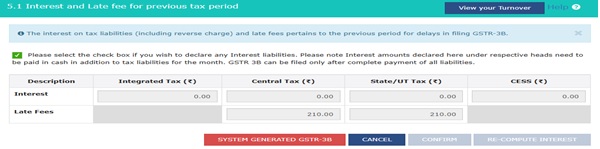
Practical Scenarios – Breakup and Interest Implications
The following scenarios illustrate how the system interprets different situations:
| Scenario | Facts | System Trigger | System Classification | Interest Outcome |
|---|---|---|---|---|
| Late reporting of invoice | Invoice of January month reported and paid in March month | Yes | Treated as previous period liability | Interest becomes applicable |
| Amendment via GSTR-1A | Earlier invoice of December modified in March | Yes | Retains original period classification | Interest exposure may arise |
| Timely reporting and payment | Invoice reported and paid in same period | No | Current period liability | No interest |
| Credit notes in subsequent period | Adjustment against earlier supply of February month | Yes | Classified as prior-period liability | Interest impact depends on net effect |
| IFF reporting (quarterly filers) | Supply of earlier January or February reported later in March | Yes | Classified as prior-period liability | Interest applicable |
It is pertinent to note that the system primarily relies on the document date of supply, and not merely the reporting period, while determining the period of liability.
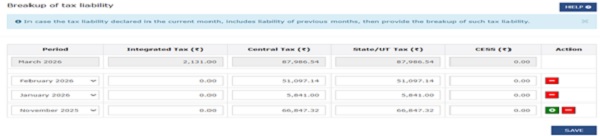
The screenshot below illustrates the manner in which the Tax Liability Break-up is reflected on the GST portal.
ITC vs Cash Component – Impact on Interest
A critical aspect of interest computation is the distinction between ITC utilisation and cash payment.
| Mode of Discharge | Interest Applicability | Remarks |
|---|---|---|
| Through ITC | Not applicable | Covered by proviso to Section 50 |
| Through Cash | Applicable | Core area of exposure |
| Mixed payment | Applicable only on cash portion | Requires careful segregation |
This distinction necessitates careful evaluation of cash utilisation while reviewing system-computed interest. Notably, recent system-driven updates aligned with Rule 88B (1) of the CGST Rules, 2017, indicate that in certain cases, interest computation may take into consideration such balance available in the electronic cash ledger for the relevant period. However, the application of such provisions requires careful analysis based on specific facts and system behaviour.
Relevant extract of Rule 88B (1) of CGST Rule, 2017:
88B (1) In case, where the supplies made during a tax period are declared by the registered person in the return for the said period and the said return is furnished after the due date in accordance with provisions of section 39, except where such return is furnished after commencement of any proceedings under section 73 or section 74 96aa [ or section 74A ] in respect of the said period, the interest on tax payable in respect of such supplies shall be calculated on the portion of tax which is paid by debiting the electronic cash ledger, for the period of delay in filing the said return beyond the due date, at such rate as may be notified under sub-section (1) of section 50:
96b [Provided that where any amount has been credited in the Electronic Cash Ledger as per provisions of sub-section (1) of section 49 on or before the due date of filing the said return, but is debited from the said ledger for payment of tax while filing the said return after the due date, the said amount shall not be taken into consideration while calculating such interest if the said amount is lying in the said ledger from the due date till the date of its debit at the time of filing return.]
The computation broadly follows the standard formula:
| Component | Description |
|---|---|
| Tax Amount (Tax) | Amount of delayed liability |
| Rate of Interest (Rate) | 18% / 24% |
| Period of Delay (Days) | From due date till actual payment |
| Computation | Tax × Rate × Days / 365 |
This represents a transition from manual estimation to system-driven determination.
To understand the implications, consider the following example:
Invoice Date: January 2026
Reported in GSTR-1: March 2026
Tax Liability: Rs.1,00,000
Due Date of January Return: 20th February 2026
Actual Payment Date: 20th April 2026
Period of Delay: 59 days
Standard Interest Calculation: Rs.1,00,000 * 18% * 59 / 365 = Rs.2,904 (approx.)
For instance, where the balance in the Electronic Cash Ledger fluctuates between Rs.75,000 (on due date), Rs.50,000 (on payment date), and a minimum of Rs.40,000 during the intervening period, the system may consider such balance while determining the effective tax on which interest is payable.
Accordingly, the interest liability may be reduced: Rs. (1,00,000-40,000) * 18% * 59 / 365 = Rs.1,746 (approx.)
However, the exact computation would depend on system logic and specific facts, and should be carefully validated with system-generated values.
Re-computation Facility – Limited Relief
GSTN has introduced a “Re-compute Interest” functionality to address discrepancies in system calculations.
This becomes relevant in cases such as:
- non-consideration of available cash ledger balance
- technical inconsistencies
- subsequent corrections in relevant data
However, it is important to note that:
- The recomputed value reflected in the system-generated PDF is generally treated as authoritative
- Manual intervention is restricted, particularly where it results in lower interest liability
Legal and Litigation Perspective
While system-based computation enhances efficiency, it raises important legal considerations.
The statutory provisions governing interest continue to prevail over system logic. Accordingly:
- System-computed interest may not always be legally conclusive
- Taxpayers may challenge discrepancies where computation deviates from legal provisions
- The extent to which automated computation can override statutory interpretation remains a potential area of litigation
Therefore, reliance on system output must be balanced with legal evaluation.
Mandatory Confirmation – Compliance Implication
The confirmation of Tax Liability Breakup cannot be treated as a mere procedural step. It has substantive implications, as it:
- forms the basis for interest computation
- creates a digital audit trail
- may be relied upon in future scrutiny or litigation
Incorrect confirmation may lead to:
- excess payment of interest
- inconsistencies in system records
- increased compliance risk exposure
Accordingly, this step must be approached with due diligence and professional judgement.
Recommended Practices
From a professional standpoint, the following practices are essential:
Do’s
- Perform thorough reconciliation between GSTR-1 and GSTR-3B
- Validate document dates with reporting periods
- Review impact of GSTR-1A amendments and IFF disclosures
- Examine the system-generated GSTR-3B PDF for interest computation
- Use the re-computation facility wherever discrepancies are observed
- Ensure accurate classification of liability before confirmation
Don’ts
- Avoid mechanical confirmation without verification
- Do not rely blindly on auto-populated values
- Do not ignore the impact of cash ledger balances
- Do not attempt to understate interest liability
- Do not treat this as a one-time compliance formality
Emerging Compliance Landscape
These developments reflect a broader transformation in GST administration:
- increasing reliance on system-driven validation
- reduced scope for subjective interpretation
- enhanced use of data analytics and cross-verification
- gradual shift from computation to validation by taxpayers
This necessitates stronger internal controls and reconciliation mechanisms.
Conclusion
The integration of Tax Liability Break-up with system-driven interest computation under Table 5.1 represents a decisive shift towards automated and data-backed GST compliance.
While positioned as a procedural enhancement, it has far-reaching implications for:
- accurate classification of tax liability
- determination of interest exposure
- strengthening return reconciliation
- long term compliance implications
In this system-driven environment, accurate data reporting is no longer merely a compliance requirement—it directly influences the determination of tax and interest liabilities.
Going forward, taxpayers must recognise that system validations are likely to become increasingly decisive, thereby necessitating a proactive and data-driven approach to GST compliance.
***
Author: Kopal Agarwal — Reviewed by CA Shefali Jain.