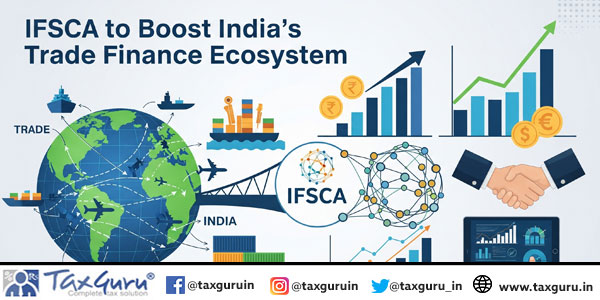
The International Financial Services Centres Authority (IFSCA) has implemented several measures to establish the GIFT International Financial Services Centre (IFSC) as a central hub for global trade finance. This initiative is aimed at helping India reach its export target of $2 trillion by 2030. The authority has enabled both Indian and foreign banks to set up IFSC Banking Units (IBUs), which provide a range of trade finance services, including trade credit and risk management tools. In addition to banks, finance companies have been registered to conduct factoring and forfaiting activities, with an upcoming legal framework for the assignment of receivables. The IFSCA has also facilitated the creation of International Trade Financing Services (ITFS), which are digital platforms that offer various financing options and connect to a wider pool of international capital.
International Financial Services Centres Authority
Let noble thoughts come to us from all directions
PRESS RELEASE
Enablers for Trade Finance in IFSC
Trade finance is the lifeblood of cross-border commerce. Around 80 percent of all global trade is supported by some form of trade finance instrument, such as letters of credit, supply chain financing, invoice discounting, and receivables financing1. At the same time, according to the Asian Development Bank (ADB), the global trade finance gap has widened from USD 1.5 trillion in 2018 to over USD 2 trillion2.
For India, trade continues to play a strategic role in driving industrial upgradation, innovation, and employment generation. In FY 2024-25, India’s exports stood at USD 824.9 billion, and the Hon’ble Commerce and Industry Minister has set an ambitious target of USD 2 trillion in annual exports by 2030. Achieving this goal will require not only enhanced competitiveness in goods and services but also accelerated access to trade finance, encompassing credit, risk mitigation instruments, and other financial services.
Role of IFSC and IFSCA
The International Financial Services Centres Authority (IFSCA), as the unified regulator for financial products, financial services, and financial institutions in IFSCs in India, has recognized the crucial role of trade finance in India’s economic trajectory. In GIFT IFSC, IFSCA has taken a series of enabling measures to position the centre as a hub for global trade finance.
IFSC Banking Units and Trade Finance
Under the IFSC framework, both Indian and foreign banks can set up IFSC Banking Units (IBUs) in branch form, which act as important conduits for trade finance by offering trade credit, factoring, and forfaiting services. Following the recent RBI approval permitting Indian exporters to open and maintain foreign currency accounts with overseas banks, IBUs are expected to play a pivotal role in facilitating such accounts and delivering customized financing solutions to Indian exporters
In addition, exporters and importers can access a wide range of risk management instruments through IBUs, such as foreign exchange and interest rate derivatives, which enable them to hedge exposures and ensure greater predictability in cash flows.
Further, IBUs support syndicated lending and cross-border financing by extending multicurrency trade loans and connecting clients to global pools of capital.
Outstanding trade finance disbursed by IBUs in GIFT stood at USD 13.79 billion at the end of June 2025.
Finance Companies and Trade Finance
Beyond banks, IFSCA has also facilitated the setting up of Finance Companies or Units, (akin to NBFCs in India) to undertake trade finance activities. Registered under the IFSCA (Finance Company) Regulations, 2021 and /or under Factoring Regulation Act, 2011, such entities provide lending solutions, including trade finance products, as well as services like factoring and forfaiting.
IFSCA has also issued the ‘IFSCA (Registration of Factors and Registration of Assignment of Receivables) Regulations, 2024’, thereby creating a comprehensive legal framework for assignment of receivables and strengthening the overall trade finance ecosystem.
Currently, four finance companies, including subsidiary of EXIM Bank India, are registered to carry out factoring and forfaiting activities. The trade finance volumes handled by these finance companies amounted to approximately USD 9.38 million in FY 2024-25, with the trend indicating steady growth in the current year.
Trade Finance through International Trade Financing Services (ITFS) platform
ITFS are fully digital platforms to finance global trade by offering a range of services, including factoring, forfaiting, supply chain finance, bill discounting, and export credit. The core aim of these platforms is to promote price discovery through competitive bidding, faster processing, and access to a broader pool of international capital by enabling on-boarding of global financiers.
At present there are four entities operating these platforms, significantly enhancing the efficiency and ease of international trade transactions originating from or routed through India. IFSCA also permits the ITFS to connect with any other electronic platform/market infrastructure, within and outside IFSC, to bring in efficiency and also undertake secondary market transactions.
The trade finance volumes facilitated through ITFS platforms stand at USD 29.79 million in FY 2024-25, with the figures showing an upward growth trend.
International cooperation:
IFSCA is at an advanced stage of collaborating with global bodies such as Factors Chain International (FCI) to integrate with international factoring networks, which will expand access to global trade finance ecosystem for entities in IFSC.
Sustainable and Green Trade Finance
IFSCA has mandated lending institutions in IFSC a target of 5% of their loan outstanding as on the previous financial year. This target can also be met by financing towards sustainable trade finance transactions. This acts as a step towards aligning financial flows with global ESG goals and strengthening India’s role in sustainable supply chains.
Raising capital through listing of bonds
GIFT City, India’s International Financial Services Centre (IFSC), continues to create a globally competitive investment environment for international investors. The regulatory regime notified by IFSCA, based on globally benchmarked regulations, enables Indian exporters to raise foreign capital through listing of foreign currency/ masala bonds on the recognised stock exchanges in the IFSC.
Non-resident investors subscribing to bonds issued by Indian companies or business trusts and listed on recognized stock exchange platforms in GIFT City enjoy a highly favorable withholding tax rate of only 9% on interest income. This attractive tax framework significantly boosts post-tax returns for global investors and positions GIFT City as a preferred destination for capital raising and investment, reinforcing India’s vision of establishing a world-class financial hub.
Insurance and Risk Mitigation
The insurance sector in IFSC complement trade finance by offering trade credit insurance to safeguard exporters against buyer defaults and non-payment risks. Currently to support the Indian exporters the IFSC Insurance Offices (IIOs) offers insurance products, covering export related risk such as –
i. credit risk
ii. political risk
iii. non-acceptance risk
iv. re-shipment
v. re-import risks.
IIOs assess the market risk and provide advisory to exporters to mitigate potential risk.
Gandhinagar
August 29, 2025
*****
1 https://www.pib.gov.in/PressReleasePage.aspx?PRID=1911117
2 ADB Brief – Trade Finance Gaps, Growth, and Jobs Survey 2023