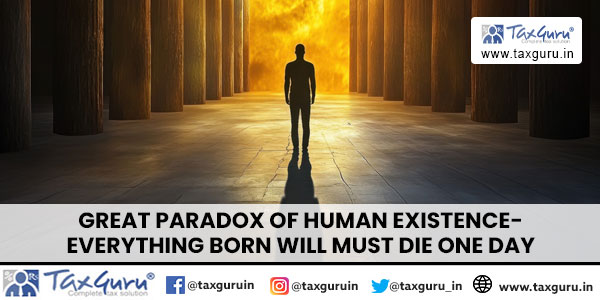
The Great Paradox of Human Existence
It is one of the deepest truths of life that everything born must one day die. No one escapes this fate—not kings, not saints, not scientists, not philosophers. From a grain of sand to the largest galaxies, everything follows the cycle of birth, growth, decay, and death. Yet, despite this unchangeable reality, human beings live in constant fear of the future, of losing what they have, or not becoming what they hope to be.
This paradox lies at the heart of our suffering: we know we are temporary, and yet we live as if we are permanent. We accumulate wealth, status, possessions, relationships, and plans in the hope of creating a safe, predictable future. And in doing so, we often sacrifice the present moment.
The question then arises: Is it possible to live fully in the now, without worrying about the future? And if yes, how?
The Nature of Human Anxiety and Accumulation
Human beings have evolved with a powerful prefrontal cortex, which gives us the unique ability to imagine the future, remember the past, and create meaning. While this has led to extraordinary achievements—civilizations, technologies, arts—it has also become the root of our anxiety.
Our tendency to accumulate—money, memories, degrees, emotions, even spiritual knowledge—is an unconscious way to prepare for an unpredictable tomorrow. But this accumulation is never enough. Once we reach one milestone, we set another. Once we acquire something, we fear losing it.
This behaviour keeps us locked in a status quo, where we are constantly preparing for life, but rarely living it.
Why “Living in the Now” Feels So Difficult
Live in the now” has become a spiritual cliché, yet very few are actually able to do it. Why?
Because the present moment is uncertain. It has no guarantees. It is fresh, raw, and unpredictable. The ego—our sense of individual identity—thrives on control, on knowing, planning, and achieving. The now offers none of that.
To live in the now means to surrender the illusion of control. It means accepting that the next moment is unknown. It means letting go of the story you have about your life, your achievements, your goals.
For peoples, this is terrifying.
Death as the Doorway to Clarity
When you realize deeply that you could die at any moment, it does not make life meaningless—it makes it intensely meaningful. Small things become precious: the laughter of a child, a cup of tea, a cool breeze. You begin to ask, “If I were to die tonight, have I truly lived today?”
In many spiritual traditions, contemplating death is not morbid—it is liberating. It reminds you that time is limited and urges you to live fully, now.
The Illusion of a “Better” Future
We accumulate not because we love things, but because we hope they will give us a better life later. This “later” never arrives. When it does, the mind has already projected a new “better.”
This cycle keeps us unsatisfied. Even after reaching our goals, we find that peace remains elusive.
The truth is, the only moment you can ever live is now. There is no other time. The past is memory, the future is imagination.
When you see this clearly, you stop postponing life.
The Joy of Dying Every Moment
To truly live in the now, you must be willing to die every moment—to let go of your identities, attachments, and desires.
This “death” is not physical. It is the death of ego, of illusion, of fear. And with each death, something new is born—a fresher, lighter, freer you.
Yes, everything born must die. But in this very truth lies the key to freedom.
Because once you accept death, you no longer need to fear life.
You can finally say: “This moment is enough. I am enough. Life is enough.