
For instance, suppose you sell your inherited house and net ₹50 lakhs. Then, consider the case where your employer gives you a ₹50 lakh incentive payment. Both scenarios involve the receipt of the exact sum, yet according to the provisions of the Income Tax Act, 1961, there can be no greater disparity between them. While one may remain exempt from income tax altogether, the latter would incur maximum tax liability. Welcome to one of the most basic, yet most contentious, differences in Indian taxation law: capital receipt vs. revenue receipt.
Understanding the difference between capital receipt and revenue receipt is crucial, as it impacts whether the receipt is taxable, the nature of its taxation, the rate of such taxation, and any relevant exemptions. Inaccuracies in this classification could result in underpayment of taxes or even legal battles. However, interestingly enough, neither term is explicitly defined in the Income Tax Act. Instead, over a period of many years, the judiciary has had to define both terms through interpretations in various cases. This article seeks to clarify this concept from an academic standpoint, while remaining comprehensible to a law undergraduate, a budding entrepreneur, and even a seasoned chartered accountant revisiting their basics.
- The Core Distinction: What Are We Really Talking About?
- Legal Framework Under the Income Tax Act, 1961
- Key Differences: A Comparison Table
- Landmark Case Laws: Where the Distinction Was Tested
- 1. CIT v. Rai Bahadur Jairam Valji (1959) — The Landmark Test
- 2. Kettlewell Bullen & Co. Ltd. v. CIT (1964)
- 3. Oberoi Hotel Pvt. Ltd. v. CIT (1999) – Lease Premiums
- 4. Padmraje R. Kardambande v. CIT (1994)
- Practical Examples: Bringing It to Life
- Grey Areas and the Judicial Tightrope
- Subsidies and Grants
- Conclusion: A Distinction Worth Mastering
- References and Citations
The Core Distinction: What Are We Really Talking About?
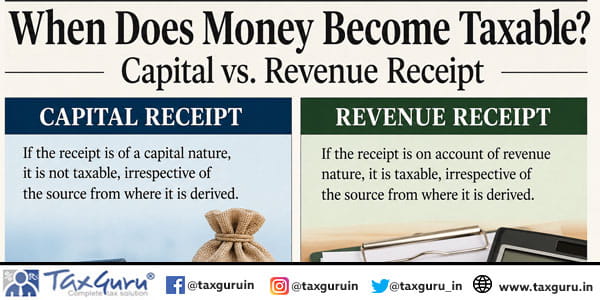
To start with the most simplistic definition, a revenue receipt may be described as anything that is received while running a business or a profession; it results from income-producing activity. Revenue receipts can be seen as the fruits produced by the tree. In contrast, a capital receipt may be said to be an infrequent receipt that is directly related to the income-producing apparatus itself. The sale of the tree itself would be considered a capital receipt.
This concept arises out of a simple and basic concept, namely that of income tax being a tax on income. The capital used to generate income is not income but the base upon which income is generated. Income-producing capital converted to cash is not income but liquidation.
Legal Framework Under the Income Tax Act, 1961
The Income Tax Act, 1961 does not provide any all-encompassing definition of either of these terms. Nevertheless, there are some other provisions which are worth considering:
Section 2(24): This provision states the meaning of “income” and includes therein any profit or gain of whatever kind and from whatever source derived.
Section 45: This section imposes tax on capital gains that arise out of the transfer of capital assets and clearly recognizes that capital receipts are liable to tax but only as a distinct head and not under any general head of taxation, having its own computation system.
Section 28: This provision deals with the taxability of profits and gains of any business or profession and provides for taxing revenue receipts from business or professional activity.
Section 4 (charging section): It levies tax on the “total income” of the person and it is from judicial interpretation alone that what constitutes the total income of the person has been arrived at.
The lack of statutory definition has rendered this a wholly judge-made law with the Supreme Court and various High Courts interpreting it innumerable times.
Key Differences: A Comparison Table
| Parameter | Capital Receipt | Revenue Receipt |
|---|---|---|
| Nature | Non-recurring, one-off | Recurring, continuous |
| Source | From capital resources | From operational activities |
| Taxes | Normally exempt (taxable in case of capital gains under Section 45) | Taxable as income |
| Impact on Assets | Affects capital resources/Affects physical assets | Has no bearing on capital resources |
| Examples | Sales of machinery/Goodwill revenue/Compensation for loss of right | Rental fees/Salary/Interest income/Operational gains |
| Legal Reference | Section 45, Section 48 (capital gains) | Section 28, Section 56 (profits by virtue of being a partner/business) |
| Recurrence | Not recurring | Continuous, predictable |
| Book Entry | Recorded on Balance Sheet | Recorded on Profit & Loss Account |
Landmark Case Laws: Where the Distinction Was Tested
1. CIT v. Rai Bahadur Jairam Valji (1959) — The Landmark Test
This remains perhaps the most cited case on the subject. The Supreme Court held that to determine whether a receipt is capital or revenue in nature, one must look at the purpose for which the payment was made and the nature of the right surrendered. The Court articulated the enduring benefit test: if a payment secures an advantage for the enduring benefit of the trade — creating or adding to a capital asset — it is capital in nature.
2. Kettlewell Bullen & Co. Ltd. v. CIT (1964)
In this case, a managing agency company received compensation for the premature termination of its managing agency. The Supreme Court held this was a capital receipt, not taxable as income. The rationale: the termination destroyed a source of income itself. The receipt compensated for the loss of a profit-making apparatus, not merely the loss of profits. This case crystallized the critical distinction between compensation for loss of a source of income (capital) and compensation for loss of future profits (revenue).
3. Oberoi Hotel Pvt. Ltd. v. CIT (1999) – Lease Premiums
The Supreme Court ruled that a lease premium received as a lump sum for granting a long-term lease was a capital receipt. The Court reasoned that granting a long-term lease amounts to parting with a capital asset, and the premium received represents consideration for that parting not periodic income earned in the ordinary course of business.
4. Padmraje R. Kardambande v. CIT (1994)
This case is instructive on compensation received by employees. The Court held that compensation paid for loss of employment could be a capital receipt if it replaced the source of earning, rather than merely substituting periodic salary payments. This nuance is critical in employment-related disputes even today.
Practical Examples: Bringing It to Life
Example 1: The Factory Owner
Mr. Sharma owns a textile unit. He receives ₹20 lakhs as rent from leasing out excess factory space this is a revenue receipt, taxable under “Income from House Property” or “Business Income.” However, if he sells the factory building itself for ₹2 crores, the gain is a capital receipt taxable (if at all) as capital gains under Section 45, with indexation benefits and the potential for exemption under Sections 54 or 54EC.
Example 2: The Software Startup
A startup receives ₹1 crore from a client as advance for a multi-year software maintenance contract. Revenue receipt taxable. But if a competitor pays ₹1 crore to acquire the startup’s proprietary source code and shut it down, it is compensation for destruction of a capital asset likely a capital receipt, taxable as capital gains.
Example 3: Cancellation of a Contract
A distributor receives ₹25 lakhs from a manufacturer for premature termination of a distribution agreement. If the distributorship was the sole business of the distributor, courts have generally held this to be a capital receipt following the Kettlewell principle. But if it was merely one of several income streams, it could be taxed as revenue.
Grey Areas and the Judicial Tightrope
Subsidies and Grants
The question of the taxability of government subsidies remained unresolved for many years before the legislature stepped in with Explanation 10 to Section 43(1) and the addition of “certain” subsidies under Section 2(24). Whether or not a specific subsidy is a capital receipt or a revenue receipt continues to perplex courts because it depends on what it was intended for – establishing a business (capital) or operating it (revenue).
Non-Compete Payments
Previously, payments made for not competing were considered capital receipts. But now, following a legislative change in Section 28(va) of the Income Tax Act, such payments are explicitly included as income from a business.
Forfeited Advance Payment on Capital Assets
When an individual forfeits any advance payment made by him for the purchase of a capital asset, is it a capital receipt or income from a business for the person who received it? The Supreme Court in CIT v. Travancore Rubber & Tea Co. Ltd. has ruled that the forfeited amount is indeed a capital receipt – it is directly related to the sale of a capital asset.
These gray areas contribute greatly to the litigation potential of this area.
Why This Matters for Taxpayers and Tax Planning
The practical considerations in this regard are huge. Receipts in nature of capital do not fall within the ambit of taxation under Section 45 (gains out of transfer of capital assets) and hence remain free from tax – and are extremely attractive in tax planning terms. Gains out of long term capital assets on listed stocks are entitled to concessional rates of taxation under Section 112A. Revenue receipts, on the other hand, attract slab rates of taxation (individuals) or flat rates (companies) which extend up to 30%, plus surcharges.
Complexities involved in tax planning always include structuring of transaction such that receipts generated by way of such transaction are characterised as capital receipt, rather than revenue receipt, depending upon the commercial reality, of course. The tax authorities have become more and more aware of any such structure which is an attempt to avoid tax and are covered under GAAR under Chapter XA of Income Tax Act.
Conclusion: A Distinction Worth Mastering
As a conceptual idea, the capital-versus-revenue receipt test sounds easy, yet in practice, it is extremely difficult to administer. The Supreme Court once characterized this test as being “one which cannot have formulated any formula of universal application.” And such judicial honesty says it all about how contextualized the process must be.
As taxpayers, you should know that the characterization of your receipts will make all the difference in how much taxes you pay. As professionals like lawyers and chartered accountants, learning about this distinction between capital and revenue receipts is crucial, both legally and practically. For those who are students or researchers, this field provides a rich topic to explore – intellectually stimulating, practically relevant, and always evolving as per judicial discourse.
Ultimately, the reason why your cash flow will be considered taxable or not may not have anything to do with the actual amount. What really matters is the underlying reason, story, and background behind each of your receipts.
References and Citations
1. CIT v. Rai Bahadur Jairam Valji, (1959) 35 ITR 148 (SC)
2. Kettlewell Bullen & Co. Ltd. v. CIT, (1964) 53 ITR 261 (SC)
3. Oberoi Hotel Pvt. Ltd. v. CIT, (1999) 236 ITR 903 (SC)
4. Padmraje R. Kardambande v. CIT, (1994) 195 ITR 877 (SC)
5. CIT v. Travancore Rubber & Tea Co. Ltd., (2000) 243 ITR 158 (SC)
6. Income Tax Act, 1961 — Sections 2(24), 4, 28, 45, 48, 112A, Chapter X-A
7. Kanga & Palkhivala, The Law and Practice of Income Tax (10th ed., LexisNexis)
8. Chaturvedi & Pithisaria, Income Tax Law (6th ed., LexisNexis Butterworths)





