Amresh Shukla Liquidator Vs State of Madhya Pradesh (NCLT Indore)
The application was filed by the liquidator of a corporate debtor under Rule 11 of the National Company Law Tribunal Rules, 2016, seeking directions against certain government officials for allegedly breaching confidentiality during the liquidation process by sharing an email dated 09.02.2024 with a prospective bidder. The liquidator contended that the email disclosed details of discussions held in a Stakeholders’ Consultation Committee (SCC) meeting regarding bidding modalities and related matters, which, according to him, constituted confidential information. He argued that confidentiality is essential to the liquidation process, that disclosure could prejudice fairness and transparency, and that the officials’ continued refusal to provide an affidavit assuring confidentiality in future reflected disregard for their obligations. The liquidator also sought departmental action against the concerned officer.
The respondents denied any intentional breach and submitted that the liquidator had exceeded his statutory role by seeking punitive action against government officials. They argued that the relevant regulations primarily govern insolvency professionals and do not impose the same confidentiality obligations on statutory authorities. According to them, the email in question merely recorded objections raised by the Commercial Tax Department during the SCC meeting and did not disclose confidential bids, valuation details, or strategic negotiation parameters. They further explained that the prospective bidder’s inclusion in the email chain occurred inadvertently due to the email system’s auto-suggest feature, since earlier communications from the liquidator had included the bidder in the recipient list. They maintained that the information shared was procedural or already known to stakeholders and that there was no mala fide intent or wrongful disclosure.
After considering the record, the Tribunal observed that confidentiality is an important element of insolvency and liquidation proceedings, particularly in matters involving competitive bidding, as disclosure of deliberations may create an uneven playing field. At the same time, the Tribunal noted that the nature and context of the information shared must be examined. On review, it found insufficient material to establish that the email dated 09.02.2024 contained confidential financial bids, valuation metrics, or strategic negotiation details. The contents mainly reflected objections and concerns raised by the Commercial Tax Department, and there was no conclusive evidence that commercially sensitive information had been disclosed.
The Tribunal also found merit in the respondents’ explanation that the inclusion of the prospective bidder in the email chain occurred because of the auto-suggest feature, especially since an earlier email dated 07.02.2024 from the liquidator had been circulated to all SCC members, including that bidder. It held that, in the absence of clear evidence showing deliberate intent to confer undue advantage, the allegation of intentional breach could not be sustained. A singular and isolated inadvertent communication, without proof of wrongful gain, misuse of information, or serious prejudice to the applicant’s rights, was held insufficient to justify punitive or coercive action. The Tribunal further held that Regulation 5(3)(c), which permits confidentiality undertakings, is enabling in nature and does not mandate affidavits in every case, and that directing departmental action against government officials was beyond the Tribunal’s jurisdiction under the Insolvency and Bankruptcy Code.
Accordingly, while observing that inclusion of a prospective bidder in such communication reflected lack of due caution and was not desirable, the Tribunal concluded that no deliberate or mala fide breach of confidentiality had been established. It declined the prayers seeking explanation, affidavit, and departmental action, dismissed the application, and directed all stakeholders, including statutory authorities and the liquidator, to exercise greater diligence in handling communications so that confidentiality, fairness, and transparency are maintained in the ongoing liquidation process.
FULL TEXT OF THE NCLT JUDGMENT/ORDER
The case is fixed for pronouncement of the order.
The order is pronounced in open Court vide separate sheet.
The present Application, filed dated 16.11.2025, under Rule 11 of the National Company Law Tribunal Rules 2016, by Mr. Amresh Shukla liquidator of M/s Girdharilal Sugar 86 Allied Industries Limited seeking directions as given below.
a) The present Application may kindly be allowed and this Hon’ble Tribunal be pleased to direct Respondent no. 3/4 to furnish an explanation as to why email dated 09.02.2024 was shared with a prospective bidder.
b) Respondent no. 3/4 be directed to furnish an Affidavit to the Applicant specifying that confidentiality of the meetings or any other discussion with the Applicant and Stakeholders would be maintained in future.
c) Respondent no. 1 and 2 be directed to take appropriate departmental action against Respondent no. 4.
1. The Applicant’s case in brief is:
a) The applicant submits that he is acting as the Liquidator of the Corporate Debtor, M/s Girdharilal Sugar 86 Allied Industries Limited, pursuant to order dated 05.08.2022.
b) It is submitted that the Tribunal vide order dated 25.01.2024 directed bidding between two bidders, namely Radheshyam Dairy and Labhanshi Multitrade Pvt. Ltd., and in furtherance thereof, the 9th meeting of the Stakeholders’ Consultation Committee (SCC) was convened on 05.02.2024 and rescheduled to 09.02.2024, wherein the modus operandi of negotiations between bidders was discussed. The applicant submits that under Regulation 7(2)(h) of the Insolvency and Bankruptcy Board of India (Insolvency Professionals) Regulations, 2016 and Regulation 21 on confidentiality, an insolvency professional is duty bound to maintain confidentiality of all information relating to the process, and may obtain confidentiality undertakings, as also recognized by the Hon’ble Supreme Court in Vijay Kumar Jain v. Standard Chartered Bank (2019).
c)) The applicant further submits that immediately after the SCC meeting dated 09.02.2024, Respondent no. 3/4, vide email dated 09.02.2024 at 4:46 PM, shared details of the discussions held in the meeting with prospective bidder M/s Labhanshi Multitrade Pvt. Ltd. on their email ID, thereby disclosing insider and confidential information without authority. It is submitted that such information, including negotiations and utilization of funds of the Corporate Debtor, was not required to be shared with any prospective bidder. The applicant replied to the said email on 10.02.2024 and recorded the conduct in the Minutes of Meeting dated 11.02.2024, and further called upon Respondent no. 3/4 to furnish an affidavit affirming non-bias and undertaking not to disclose SCC discussions in future, which was also placed for voting vide email dated 14.02.2024. Despite repeated reminders dated 16.02.2024, 17.06.2025, 19.06.2025, 11.08.2025 and earlier communications, Respondent no. 3/4 failed to furnish the affidavit.
d) It is further submitted that Respondent no. 3/4 raised false and frivolous objections vide email dated 04.06.2025 regarding continuation of the liquidation process, to which the applicant responded on 12.06.2025, also bringing such conduct to the notice of Respondent no. 2, but no action has been taken. The applicant submits that Respondent no. 3/4, being a Government Officer governed by M.P. Civil Service (Conduct) Rules, 1965, is duty bound to maintain integrity and discipline, and the act of sharing confidential SCC discussions casts serious doubts on such integrity and amounts to misconduct. It is further submitted that Respondent no. 3/4 had earlier attempted to adjourn meetings on untenable grounds, including citing a holiday on 31.05.2025 and the Hon’ble Prime Minister’s visit, without substantiating inability to attend.
e) The applicant submits that confidentiality is vital to the liquidation process and any breach, even of minor details, can seriously prejudice the proceedings, particularly where sale of assets is ongoing. It is contended that Respondent no. 3/4 deliberately shared confidential information with a prospective bidder to provide undue advantage, thereby compromising fairness and transparency of the process. The continued failure to submit the affidavit further demonstrates disregard for confidentiality obligations. Accordingly, the applicant prays that this Hon’ble Tribunal be pleased to direct Respondent no. 3/4 to furnish an explanation as to why the email dated 09.02.2024 containing confidential SCC discussions was shared with a prospective bidder, and to pass appropriate orders in the interest of justice.
The Submissions of Respondent No.3 and 4:
a) The respondents have submitted that the Liquidator has acted beyond his statutory mandate under the Insolvency and Bankruptcy Code, 2016, by assuming an adjudicatory and punitive role against government officials, which is arbitrary, without jurisdiction, and contrary to law. It is argued that neither the Code nor the regulations empower a Liquidator to initiate or recommend disciplinary or punitive action against officers of government departments. The observations made by the Liquidator in the SCC meeting dated 09.02.2024, including directing officials to file affidavits regarding bias, are alleged to be an abuse of authority, reflecting arbitrariness, overreach, and violation of professional conduct standards.
b) The respondent further contends that the Liquidator himself has been found guilty of biased conduct by the Disciplinary Committee of the IBBI, which resulted in suspension of his registration for six months. This, according to the respondent, establishes that the Liquidator acted with prejudice against the Commercial Tax Department.
c) It is also submitted that the Commercial Tax Department acted bona fide in discharge of its statutory duties to safeguard public revenue and raised legitimate concerns before the Liquidator. Due to repeated disregard of these concerns, the Department was compelled to file an interlocutory application being I.A. no. 158 of 2023 challenging the Liquidator’s actions, which remains pending for orders.
d) The respondent denies allegations of breach of confidentiality, stating that the reliance placed by the Liquidator on Regulation 5(3)(c) of the IBBI (Liquidation Process) Regulations, 2016 is misplaced, as the provision applies only to persons engaged in the liquidation process and not to statutory authorities. It is argued that no confidential or privileged information was disclosed, the email in question merely recorded objections raised during the SCC meeting and involved information already known to stakeholders.
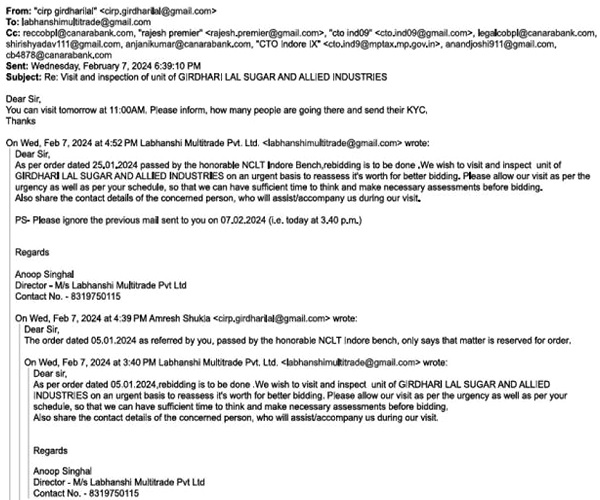
e) The respondents submitted that all email communications addressed to the department are centrally received, accessed, and responded to by authorized departmental officers in the ordinary course of official business. Accordingly, the email dated 07.02.2024 was addressed to the Commercial Tax Department and circulated to all members of the Stakeholders’ Consultation Committee, which included Labhanshi Multi-Trade Private Limited. It is further submitted that, subsequent to the meeting, when the Commercial Tax Officer circulated the departmental objections, the said email was inadvertently forwarded to Labhanshi Multi-Trade Private Limited. This occurred due to the auto-suggest feature in the email system, which prompts inclusion of email addresses from the immediately preceding email chain. Notably, prior emails dated 07.02.2024 sent by the liquidator, Amresh Shukla, were addressed to Labhanshi Multi-Trade Private Limited with copies marked to CTO-9 and other members of the Stakeholders’ Consultation Committee. Further, it is contended that any email communication including third parties occurred inadvertently due to auto-suggest features and without any mala fide intent. The information shared pertained to procedural or already disclosed matters such as distribution, claims, and bidding processes, and therefore cannot be construed as confidential. The extract of the Email dated 07.02.2024 is produced below:
f) The respondent also alleges lack of transparency and unauthorized continuation of the Liquidator in office despite a suspension order dated 11.12.2025. It is stated that the Liquidator failed to disclose SCC voting details or obtain requisite approvals for continuation, rendering his actions arbitrary, non-transparent, and legally unsustainable.
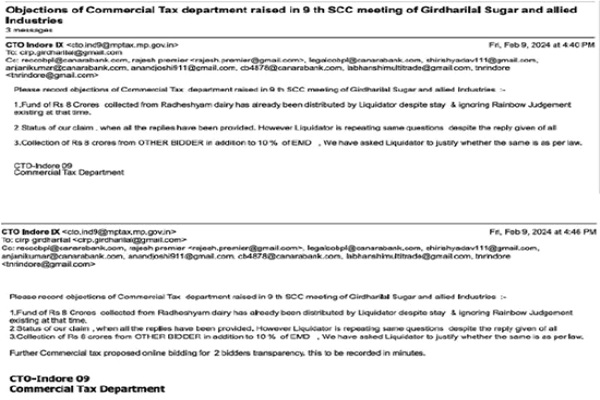
g) The respondent has denied the allegation that the email dated 09.02.2024 constituted a breach of confidentiality, terming it false, misconceived, and unsustainable in both law and facts. It is submitted that the said email merely sought to record objections raised by the Commercial Tax Department during the 9th Stakeholders’ Consultation Committee meeting of Girdharilal Sugar and Allied Industries and did not disclose any confidential, privileged, or third-party information. Without prejudice, the respondent has further clarified that the issues mentioned in the email were already within the knowledge of all stakeholders. The contents of the email are replied to point-wise as under:
| Sr. No. | Issue Raised in the email dated 09.02.2024 by the Commercial tax department | Point-wise Explanation Establishing Non-Confidentiality (the points / issues in the email were not confidential at all and not an insider information) |
|---|---|---|
| 1 | Distribution of Rs. 8 Crores collected from Radheshyam Dairy despite subsistence of stay order and the Rainbow Papers judgment | The fact of distribution was already within the knowledge of all stakeholders. Proceedings challenging such distribution had been filed by Labhanshi Multitrade Private Limited as well as by the Commercial Tax Department. Further, the order dated 21.04.2023 was available in the public domain on the NCLT portal. Hence, no confidential information was disclosed through the email dated 09.02.2024. |
| 2 | Status of the Commercial Tax Department’s claim and repeated queries by the Liquidator | All replies and supporting documents had already been furnished to the Liquidator. The observation regarding repeated queries merely reflects a procedural grievance, which had already been raised before this Hon’ble Tribunal. The same does not involve disclosure of any confidential or privileged material. |
| 3 | Collection of Rs. 8 Crores from another bidder in addition to 10% EMD and suggestion for online bidding between two bidders | The same was only a departmental suggestion seeking clarification on legal compliance and transparency, intended to be recorded in the SCC meeting minutes. In any event, Labhanshi Multitrade Private Limited, being a bidder, would necessarily be informed of bidding terms and EMD requirements through the prescribed statutory process. No confidential or exclusive information was shared. |
The extract of the two Emails are given below:
In view of the foregoing facts and submissions, it is respectfully submitted that the allegation of breach of confidentiality in respect of the email dated 09.02.2024 is wholly baseless, misconceived, and unsustainable both in law and on facts. It is further submitted that the Department has acted bona fide in the discharge of its statutory duties and in furtherance of public interest.
h) The respondents have further submitted that the reliance placed on Regulation 5(3)(c) of the IBBI (Liquidation Process) Regulations, 2016 is misconceived, as the said provision is merely enabling in nature and does not mandate filing of affidavits. It is reiterated that Regulation 21 of the IBBI (Insolvency Professionals) Regulations, 2016 applies only to Insolvency Professionals and not to statutory authorities such as the respondents, and therefore no obligation of confidentiality under the said regulation can be imputed upon them. Further, Section 208(2)(e) of the Insolvency and Bankruptcy Code, 2016 obligates the Insolvency Professional to act within the framework of the Code and Regulations and does not empower the Liquidator to initiate proceedings or complaints against government officials.
i) It is submitted that the Applicant has misapplied the judgment in Vijay Kumar Jain v. Standard Chartered Bank, which is limited to the context of confidentiality undertakings in resolution plans and cannot be extended to bona fide statutory communications made by government authorities. The reliance placed thereon is therefore misplaced and does not support the Applicant’s case.
j) The respondents have submitted that the Liquidator has acted in a biased, arbitrary, and discriminatory manner in the conduct of SCC meetings. Despite repeated requests, Respondent Nos. 3/4 were denied permission to participate through video conferencing, contrary to Regulation 23 of the applicable regulations, while similarly placed member Oyster India was permitted to attend virtually on 27.06.2025. Such selective treatment demonstrates hostile discrimination, lack of transparency, and violation of principles of natural justice.
k) It is further submitted that the Liquidator arbitrarily rejected requests for adjournment and virtual participation despite valid official constraints of the respondents, who constitute a significant voting share in the SCC. The tabulated sequence of communications clearly establishes that the Liquidator insisted on physical presence without justification and disregarded reasonable requests, thereby intentionally excluding a major stakeholder and vitiating the decision-making process of the SCC.
l) The respondents have also submitted that the Minutes of Meeting have been improperly recorded, incorporating matters not discussed during the meeting and using intemperate and condemnatory language against departmental officers. Such unilateral recording renders the minutes unreliable and devoid of evidentiary value.
m) It is further submitted that the repeated emails sent by the Liquidator to higher departmental authorities constitute an abuse of position and are beyond the scope of powers conferred under the Code. The Liquidator is not empowered under the IBC to approach superior government authorities or initiate complaints against statutory officers, and any grievance, if at all, lies before the Hon’ble Tribunal. Such conduct is arbitrary, mala fide, and indicative of personal vendetta.
n) The respondents have reiterated that the allegations raised in various paragraphs (3.7 to 3.15) are false, misleading, and afterthoughts intended to harass the department and divert attention from the Liquidator’s own irregularities. The objections raised by the respondents were bona fide, supported by records, and pertained strictly to statutory claims without any nexus to alleged disclosures.
o) It is submitted that the conduct of the Liquidator stands conclusively established as improper and violative of the liquidation framework, as also recorded in the Disciplinary Committee order dated 11.12.2025. The said order confirms contraventions including improper conduct of SCC meetings, violation of timelines, and exclusion of stakeholders.
p) In view of the above, the respondents have prayed that the present application be dismissed as frivolous, vexatious, and an abuse of process.
3. Applicant’s Written Submissions:
i. The Applicant has submitted that the email dated 07.02.2024 was merely an intimation to SCC members regarding the visit of M/s Labhanshi Multitrade Pvt. Ltd., and the subsequent email dated 08.02.2024 pertained only to KYC requirements. It is contended that the Respondents are attempting to mislead the Tribunal by justifying the inclusion of the said entity in the email dated 09.02.2024, and that the plea of “auto-suggestion” or inadvertent transmission is an afterthought.
ii. The Applicant has further submitted that the Respondents have failed to acknowledge the breach of confidentiality, neither tendering any apology nor furnishing an affidavit assuring that such breach would not recur. It is argued that the issue is not the nature of the information disclosed, but the act of sharing such communication with a third party having no nexus with SCC decisions.
iii. It is also submitted that reliance on the judgment in Vijay Kumar Jain v. Standard Chartered Bank (2019) and Regulation 5(3)(c) of the IBBI (Liquidation Process) Regulations, 2016 establishes that confidentiality undertakings can be sought and enforced, and the Respondents’ reluctance to provide such undertaking reflects adversely on their conduct.
iv. Further, the Applicant contends that being statutory authorities does not grant the Respondents any privilege to breach confidentiality, and they remain bound to act in accordance with law. It is alleged that the Respondents are attempting to mislead the Tribunal by referring to past conduct without proper context.
v. Lastly, it is submitted that the Applicant, being duty bound, reported the misconduct to higher authorities and, upon inaction, approached this Hon’ble Tribunal. The Applicant asserts the right to take appropriate legal action where actions of the Respondents interfere with duties or breach confidentiality.
4. Observation and Analysis:
1. We have carefully considered the submissions made by both parties and perused the documents placed on record.
2. The present Application has been filed under Rule 11 of the National Company Law Tribunal Rules, 2016 by the Liquidator of M/s Girdharilal Sugar 86 Allied Industries Limited seeking, inter alia, directions against Respondent Nos. 3 and 4 for alleged breach of confidentiality in relation to the email dated 09.02.2024, along with consequential reliefs including submission of explanation, furnishing of affidavit, and initiation of departmental action.
3. At the outset, it is pertinent to examine the statutory framework governing the role and responsibilities of a Liquidator. Under Section 35 of the Insolvency and Bankruptcy Code, 2016, the Liquidator is entrusted with the duty to conduct the liquidation process in a fair, transparent, and efficient manner, while preserving and protecting the assets and value of the Corporate Debtor. Further, Section 208(2)(e) of the Code mandates that an Insolvency Professional shall perform his functions in accordance with the provisions of the Code and the regulations framed thereunder. Regulation 7(2)(h) of the IBBI (Insolvency Professionals) Regulations, 2016 casts an obligation upon an Insolvency Professional to maintain confidentiality of all information relating to the insolvency resolution, liquidation, or bankruptcy process. Similarly, Regulation 21 of the said Regulations underscores the duty to ensure that confidentiality is preserved in the conduct of the process.
4. In addition, Regulation 5(3)(c) of the IBBI (Liquidation Process) Regulations, 2016 empowers the Liquidator to obtain confidentiality undertakings from stakeholders, wherever deemed necessary, to safeguard the sanctity of the process.
5. The importance of confidentiality in insolvency proceedings has been recognized by the Hon’ble Supreme Court in Vijay Kumar Jain v. Standard Chartered Bank, wherein it was held that while transparency is essential, dissemination of sensitive commercial information must be balanced with the need to preserve confidentiality to ensure fairness in the process.
6. In the present case, it is not in dispute that a meeting of the Stakeholders’ Consultation Committee (SCC) was convened on 09.02.2024, wherein discussions were held regarding the modality of bidding between prospective bidders. It is also an admitted position that an email dated 09.02.2024 was sent by Respondent Nos. 3/4, which included M/s Labhanshi Multitrade Pvt. Ltd., a prospective bidder, in the recipient list. The core issue for determination is whether such inclusion constitutes a breach of confidentiality warranting the directions sought by the Applicant and whether the acts of Respondent Nos. 3 and 4 have resulted in any irreparable loss or prejudice to the rights of the Applicant.
7. The Respondents have sought to justify the said communication on the grounds that (i) the email was sent inadvertently due to the auto-suggest feature, (ii) the contents of the email merely reflected objections already discussed in the SCC meeting, and (iii) no confidential or commercially sensitive information was disclosed. They have further contended that the regulatory provisions relied upon by the Applicant apply primarily to Insolvency Professionals and not to statutory authorities.
8. This Tribunal finds that confidentiality is indeed a cornerstone of the insolvency and liquidation framework, particularly in matters involving competitive bidding and negotiation between prospective resolution applicants or bidders. Any disclosure of deliberations relating to negotiation strategies, financial considerations, or inter-se discussions among stakeholders has the potential to prejudice the fairness of the process. Even if the information appears procedural, its disclosure to one bidder, to the exclusion of others, may create an uneven playing field.
9. However, at the same time, it is equally necessary to assess the nature, content, and context of the alleged disclosure. A perusal of the material placed on record indicates that the email dated 09.02.2024 primarily contained objections and concerns raised by the Commercial Tax Department during the SCC meeting. There is insufficient material to conclusively establish that any specific confidential financial bids, valuation metrics, or strategic negotiation parameters were disclosed to the prospective bidder. The distinction between “confidential information” and “information already within the knowledge of stakeholders” assumes significance in this context.
10. Further, the explanation furnished by the Respondents regarding inadvertent inclusion of the email address due to auto-suggestion, though requiring cautious scrutiny, cannot be outrightly discarded in the absence of cogent evidence demonstrating deliberate or mala fide intent. The Applicant has alleged deliberate conduct to confer undue advantage but such allegation must be supported by clear and convincing material, which is presently lacking.
11. On the issue of applicability of confidentiality obligations, while it is correct that Regulation 21 of the IBBI (Insolvency Professionals) Regulations, 2016 directly governs Insolvency Professionals, this Tribunal is of the considered view that all participants in the insolvency ecosystem, including statutory authorities forming part of the SCC, are expected to adhere to basic standards of confidentiality to preserve the integrity of the process. Nevertheless, the mechanism for enforcing such standards against government officials cannot be equated with disciplinary control exercised over Insolvency Professionals under the Code.
12. Insofar as the relief sought by the Applicant directing Respondent Nos. 3/4 to furnish an affidavit is concerned, Regulation 5(3)(c) of the Liquidation Process Regulations is enabling in nature and does not mandate compulsory furnishing of such undertakings in all circumstances.
13. Further, the prayer seeking directions to Respondent Nos. 1 and 2 to initiate departmental action against Respondent No. 4 is clearly beyond the jurisdictional contours of this Tribunal. The Hon’ble NCLT, while exercising jurisdiction under the Insolvency and Bankruptcy Code, is not vested with the authority to direct initiation of disciplinary proceedings against government officials under service rules such as the M.P. Civil Services (Classification, control and appeal) Rules, 1965. Any such action falls within the exclusive domain of the competent administrative authorities.
14. It is also noted that the Respondents have raised allegations regarding the conduct of the Liquidator, including findings recorded by the Disciplinary Committee of the Insolvency and Bankruptcy Board of India. While such aspects may have a bearing on the overall conduct of the process, this Tribunal refrains from adjudicating upon the same in the present Application, as they are not directly related to the limited issue of alleged breach of confidentiality.
15. In the present case, there appears to be no material on record to demonstrate that the actions of Respondent Nos. 3 and 4 have led to any irreparable loss or caused serious prejudice to the substantive rights of the Applicant. The alleged act, even if assumed to be inadvertent or improper, does not, by itself, establish that the Applicant has suffered any permanent or irreversible harm. There is no evidence to suggest that any confidential information has been misused in a manner that has adversely affected the legal or commercial position of the Applicant.
16. Further, it is pertinent to note that mere procedural lapses or inadvertent acts, without demonstrable consequences affecting rights or interests, do not amount to irreparable injury. In the absence of any tangible loss, damage, or prejudice, the claim of irreparable harm remains unsubstantiated.
17. Accordingly, this Tribunal is of the considered view that the Applicant has failed to establish that the acts of Respondent Nos. 3 and 4 have caused any irreparable loss or prejudice warranting intervention.
18. Upon perusal of the emails placed on record by the Respondents, it is observed that the email dated 07.02.2024 was circulated by the Liquidator to all members of the Stakeholders’ Consultation Committee, including M/s Labhanshi Multitrade Pvt. Ltd. In light of the same, the plea taken by Respondent Nos. 3 and 4 that the subsequent email dated 09.02.2024 was forwarded to recipients appearing in the “To” and “CC” fields of the earlier communication assumes significance and merits consideration. This Tribunal finds substance in the explanation furnished by the Respondents that the inclusion of the prospective bidder in the email chain occurred on account of the auto-suggest feature of the email system and was not a deliberate or conscious act. Further, on a conjoint reading of the email dated 09.02.2024 along with the explanations tendered by the Respondents, it is evident that the contents of the said communication primarily pertain to observations and objections raised by the Commercial Tax Department during the meeting and do not disclose any commercially sensitive or confidential information relating to the liquidation process. Accordingly, the email dated 07.02.2024 lends belief that the subsequent email dated 09.02.2024 was sent inadvertently and without any mala fide intent.
19. In continuation thereof, it is of the considered view that a singular and isolated instance of inadvertent communication, as established in the present case, cannot be construed as an intentional or deliberate breach of confidentiality, particularly in the absence of any material indicating wrongful gain or undue advantage conferred upon any stakeholder. The explanation furnished by Respondent Nos. 3 and 4 appears plausible and consistent with the surrounding circumstances. Therefore, such an isolated and unintentional lapse, viewed in the light of the clarifications provided, does not warrant any adverse or punitive inference against the Respondents.
20. In view of the foregoing analysis, this Tribunal is of the considered opinion that although the inclusion of a prospective bidder in the email communication reflects lack of due caution and is not a desirable practice in the conduct of liquidation proceedings, the material on record does not establish a deliberate or mala fide breach of confidentiality warranting coercive or punitive directions as sought by the Applicant.
21. Accordingly, the present Application is disposed of with the observation that all stakeholders, including statutory authorities and the Liquidator, shall exercise greater diligence in handling communications relating to SCC deliberations and shall ensure that the principles of confidentiality, fairness, and transparency are strictly adhered to in the ongoing liquidation process. The prayers seeking explanation, affidavit, and departmental action are liable to be declined.
22. Therefore, the I.A. No. 577 of 2025 is dismissed and disposed of. No order as to costs.