Voluntary Liquidation is a gateway for easy exit for company which has not defaulted on any debt and has no intention to defraud creditors. An application for Voluntary Liquidation (hereinafter referred as “VL”) can be made where a firm has not defaulted on any debt (or where a firm has no debt), it may make any application to be liquidated voluntarily in such manner as may be specified by the Board (IBBI).
Under Section 59 of the Insolvency and Bankruptcy Code, 2016 read with Insolvency and Bankruptcy Board of India (Voluntary Liquidation Process) Regulations, 2017 allows a solvent company to close its operations on its own. This means the company is not in financial distress and is able to pay off all its dues. It is a formal process that a company chooses to follow when it decides to shut down business activities permanently, usually due to internal business decisions or the end of its purpose.
Liquidator appointed by the Board of the Directors of the Company plays a crucial role in various acts prescribed under The Insolvency and Bankruptcy Board of India (Voluntary Liquidation Process) Regulations, 2017.
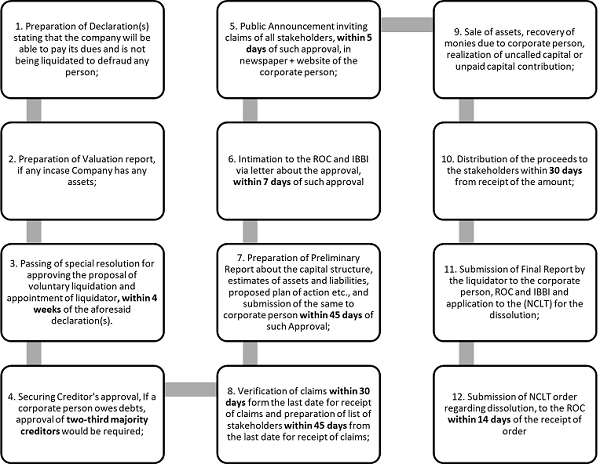
While the above steps, briefly summaries the activities to be undertaken by the Corporate Person and Liquidator – We shall now deep dive into the Pre – Voluntary Liquidation and Post- Voluntary Liquidation commencement process.
Pre – Voluntary Liquidation
1. Due Diligence of the Company – It is quite pivotal to conduct a heath check-up of the company proposing to initiate for Voluntary Liquidation. The said process shall involve looking into the brief background, annual Filings with ROC, scrutiny of the Financials, pending litigations, capital structure etc.
A careful analysis of above will help in avoiding any future roadblocks that deviate the purpose and timely completion of VL process.
Once the same is done, The Liquidator can take up the assignment forward and suitably guide company.
2. Convening of the Board Meeting – The Board shall in the meeting consider and approve below matters placed before it:
i. Declaration of Solvency signed by majority of the directors
ii. Commencement of VL and Appointment of Liquidator
iii. Convening of the meeting of the members of the company to approve the VL
iv. Closure of existing bank accounts of the Company
Once the Board passes the above items, the matter is then put forward before the members.
3. Extra – Ordinary General Meeting – The shareholders/members need to consider and approve the special resolution to approve the VL and Appointment of Liquidator. In case, the company has preference shareholders, then approval required to be sought from them as well (the said meeting needs to be convened with 4 weeks of signing of Declaration of solvency by majority of Directors).
4. Other Aspects – If a corporate person owes debts, approval of two-third majority creditors would also be required.
-
- A Valuation report is required, if company has assets apart from Bank balance
- Post completion of all the paperwork, the company shall file Form MGT-14 – Initiation of Voluntary Liquidation and Form GNL-2 – Declaration of Solvency with the concerned Registrar of Companies (ROC).
Post – Voluntary Liquidation
1. Public Announcement – On and from the Liquidation commencement date, the Liquidator takes the possession of the assets of Company. The liquidator shall make a public announcement in Form A of Schedule I within 5 days from his appointment.
Invitation of claim: The public announcement shall (a) call upon stakeholders to submit their claims as on the liquidation commencement date (hereinafter referred as LCD); and (b) provide the last date for submission of claim, which shall be thirty days from the LCD.
2. Opening of Separate Bank Account – The liquidator shall proceed to open a separate Bank Account in a scheduled bank in name of Corporate person followed by the words “In Voluntary Liquidation”.
3. Preliminary Report Preparation – The liquidator shall submit a Preliminary Report to the corporate person within 45 from the LCD having below details:
I. the capital structure of the corporate person;
II. the estimates of its assets & liabilities as on LCD based on the books of the corporate person;
III. Whether he intends to make any further inquiry in to any matter relating to the promotion, formation or failure of the corporate person or the conduct of the business thereof; and
IV. the proposed plan of action for carrying out the liquidation, including the timeline within which he proposes to carry it out and the estimated liquidation costs.
4. Liquidator prepares the List of Stakeholders and submits to the Company as well as IBBI;
5. Verification of Claims by Liquidation and subsequent acceptance/rejection of the same;
6. Sale of assets, recovery of monies due to corporate person, realization of uncalled capital or unpaid capital contribution;
7. Distribution of the proceeds to the stakeholders within 30 days from receipt of the amount;
8. Submission of Final Report by the liquidator to the corporate person, ROC and the Board and application to the National Company Law Tribunal (NCLT) for the dissolution;
9. Submission of NCLT order regarding the dissolution, to the concerned ROC within 14 days of the receipt of order in Form INC-28.
Time Limit
Process Duration
The voluntary liquidation process as per the regulations is stipulated to be completed within a defined period. If the company has creditors involved, the process should ideally be completed within 270 days from the date of approval. If there are no creditors, it must be completed in about 90 days.
Time line for Voluntary Liquidation Process
| T=Liquidation Commencement Date | |||
| Sl. No | Section / Regulation | Description of Task | Norm (Number of Days) |
| 1 | Section 59(3)(a), Regulation 3(1) (a) | Declaration from majority of directors / partners regarding solvency of corporate person and it not being liquidated to defraud any person | T – 28 |
| 2 | Section 59[(3)(c) and (5)], Regulation 3(1) (c) and 3(3 | Passing of resolution / special resolution by members / partners about commencement of voluntary liquidation process and appointment of insolvency professional as liquidator | T= 0 |
| 3 | Proviso to Section 59(3)(c), Regulation 3(1)(c) | Approval of creditors representing two-third in value of debt, if the corporate person owes any debt, of the resolution passed under section 59(3)(c) or regulation 3(1)(c) | T+7 |
| 4 | Regulation 5(2) | Intimation by Insolvency Professional regarding his appointment as Liquidator, to the Board | T+7 |
| 5 | Regulation 14 (1) | Public Announcement in Form A by the Liquidator | T + 5 |
| 6 | Section 59(4), Reg. 3(2) | Notification to ROC and Board about the resolution passed under section 59(3)(c) and regulation 3(1)(c) or subsequent approval of creditors thereto, as the case may be, by corporate person | T + 7 or T + 14 |
| 7 | Section 38(1), Regulation 14 (2) | Submission of claims by stakeholders | T + 30 |
| 8 | Section 38(5) | Withdrawal/ modification of claim by stakeholders | T + 44 |
| 9 | Regulation 9(1) | Submission of preliminary report to the corporate person by the Liquidator | T + 45 |
| 10 | Regulation 29(1) | Verification of claims by the Liquidator | T + 60 |
| 11 | Section 40 (2) | Intimation about decision of acceptance /rejection of claim to the stakeholders by the Liquidator | T + 67 |
| 12 | Regulation 30(2) | Preparation of list of stakeholders by the Liquidator | T + 45*/75 |
| 13 | Section 42 | Appeal by creditor against the decision of the Liquidator | T + 81 |
| 14 | Regulation 35(1) | Distribution of the proceeds to stakeholders by the Liquidator | Date of realization + 30 days |
| 15 | Regulation 39(2) | Deposit of amount of unclaimed dividends and undistributed proceeds in Corporate Voluntary Liquidation Account by the Liquidator | Prior to submission of application under sub section (7) of section 59 |
| 16 | Regulation 38(2) | Submission of Final Report to the Board and Registrar of Companies by the Liquidator | T + 90*/270 |
| 17 | Section 59(7), Regulation 38(3) | Submission of Final Report, along with the application for dissolution, to AA | T + 90*/270 |
| 18 | Regulation 37(1) | Completion of Voluntary Liquidation Process | T + 90*/270 |
| 19 | Regulation 37(2) | Meeting of Contributories and presentation of Annual Status Report. | T + 365 |
| *Applicable where approval of creditors was not required under section 59(3)(c) or regulation 3(1) (c) | |||
| Source: The IBBI (Voluntary Liquidation Process) Regulations,2017 | |||
Source – www.icsi.edu, www.ibbi.gov.in
For educational purpose only.