1. Why section 7 is the “entry gate” of GST
Before we talk about rates, exemptions or ITC, one basic question must be answered – is there a “supply” at all under GST? If the reply is “no”, GST cannot be levied, whatever may be the value or nature of the transaction. Section 7 of the CGST Act, 2017, is the central provision which defines the scope of supply.
In practice, most disputes I see in my office on GST – especially on notices for tax, interest and penalty – start with a wrong or over‑broad understanding of section 7. Either the department stretches section 7 to bring every movement or entry into the net, or the taxpayer assumes that if there is no invoice or no money, there is no supply. Both extremes are dangerous. Section 7 is neither that narrow, nor that wide.
In this article, I am trying to explain section 7, clause by clause, with examples and my own interpretation as a practitioner. I am also giving guidance to taxpayers and professionals on how to handle wrong interpretations by the department and how to frame replies to notices.
2. Structure of section 7 – an overview
The present section 7 (after the 2018 amendment) has four important parts:
1. Section 7(1) – inclusive definition of supply
2. Section 7(1A) – linkage with Schedule II (goods vs services)
3. Section 7(2) – exclusions by reference to Schedule III and notified activities
4. Section 7(3) – power to notify certain activities as supply of goods or of services (earlier clause (d) moved through 7(1A))
Along with this, three Schedules sit around section 7:
- Schedule I – supplies without consideration which are still treated as supply.
- Schedule II – classification as supply of goods or supply of services when you have already concluded that it is a supply.
- Schedule III – activities which are neither supply of goods nor supply of services (completely out of GST).
Understanding section 7 means understanding this full circle: what is covered by sub‑section (1), what is still supply even without consideration (Schedule I), what is completely outside (Schedule III), and for the balance, how we classify between goods and services (Schedule II).
3. Section 7(1)(a) – normal supplies in business with consideration
3.1 Bare idea of 7(1)(a)
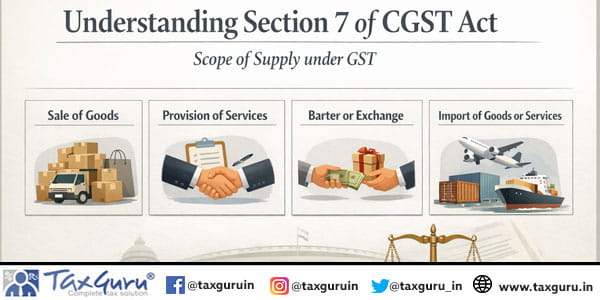
Section 7(1)(a) states that, for the purposes of this Act, “supply” includes all forms of supply of goods or services or both such as sale, transfer, barter, exchange, licence, rental, lease or disposal, made or agreed to be made for a consideration by a person in the course or furtherance of business.
Three conditions are fundamental here:
1. It should be a supply of goods or services or both.
2. It should be for a consideration.
3. It should be in the course or furtherance of business.
If any one of these three is missing, we must then see whether it is covered elsewhere (for example Schedule I, or import of services under 7(1)(b)), otherwise it may fall outside the scope of supply.
3.2 What is covered – simple examples
Some simple illustrations of section 7(1)(a):
- Sale of cement by a dealer to a contractor – clearly a supply of goods, for a price, in business.
- Monthly office rent paid by a company to a landlord – supply of service (renting of immovable property) for consideration, in course of business of landlord.
- A hotel giving banquet hall on hire for a wedding – renting service, taxable supply.
- Barter between two traders – cotton given in exchange of wheat; there is no “money”, but there is consideration in kind, so this is also supply.
On the other hand, some transactions are not covered by 7(1)(a):
- Sale of old car by a salaried employee, who is not in the business of cars – not in furtherance of business of that person, so not a supply under 7(1)(a).
- Sale of old household jewellery by a housewife to a jeweller – similarly, not business activity for her, hence not a supply in her hands.
But this is not the end of the story; department may still argue “business” is wide enough to include one‑off vocational activities, and there are judgments both ways. This is where proper facts, accounts and intention recorded in books become crucial.
4. Section 7(1)(b) – import of services for consideration
Section 7(1)(b) deals with a special situation: import of services for a consideration, whether or not in the course or furtherance of business.
The logic here is very simple – GST is a destination‑based consumption tax. If a service is consumed in India, Government wants to tax it even if the recipient is not in “business” in the strict sense. So:
- If you are importing services and paying consideration, it is supply, even if you are an individual using it for personal work; however, specific exemptions exist, for example Notification 9/2017‑IGST for certain imports for personal use.
This clause operates mainly through reverse charge on import of services. For practitioners, the key is to check:
- Whether the person is in business or not;
- Whether any specific exemption covers the transaction;
- Whether the department is trying to tax something which is actually outside India or not “service” at all.
5. Section 7(1)(c) and Schedule I – supplies without consideration
Section 7(1)(c) says that activities specified in Schedule I, made or agreed to be made without a consideration, shall be treated as supply.
Schedule I covers mainly:
- Permanent transfer or disposal of business assets where ITC has been availed.
- Supply between related persons or between distinct persons (for example, head office and branch in another State) in course or furtherance of business, even without consideration.
- Supply of goods by principal to agent and vice‑versa in specified cases.
- Import of services from related person or own establishment outside India when used for business.
The rationale is clear – if there is an internal movement or free supply between related establishments which affects the credit chain or value addition, the law does not want these to escape purely because there is no invoice value.
Example: Head Office in Karnataka transfers capital goods to Branch in Tamil Nadu without consideration. Under Schedule I, this is still a supply between “distinct persons” (separate GSTINs), and GST is payable even though there is no sale price.
Many audits and notices arise because taxpayers ignore these Schedule I situations. Practitioners must always check: Is there any movement or internal transfer between related/distinct persons without consideration? If yes, bring it into tax net, or be prepared with a solid legal argument why that particular movement is not “supply” (for example, mere stock movement within same GSTIN).
6. Section 7(1A) and Schedule II – deciding goods vs services
Section 7(1A) was inserted by the 2018 Amendment Act with retrospective effect from 1‑7‑2017. It says, in simple words:
Where certain activities or transactions constitute a supply in accordance with sub‑section (1), they shall be treated either as supply of goods or supply of services as referred to in Schedule II.
Earlier, clause (d) of section 7(1) directly referred to Schedule II. Now, Schedule II only comes after you first conclude that something is a supply under section 7(1). This means:
- Schedule II does not independently create a supply.
- It only helps to classify – whether a particular supply is to be treated as goods or as services.
This point is important while replying to notices where the officer says, for example, “Entry so‑and‑so in Schedule II says this is a service, therefore GST applicable.” The correct reply is:
1. First test under section 7(1): is there even a supply? consideration? business? import of service? Schedule I?
2. Only then see Schedule II to decide goods vs services.
Case law trend is also on these lines – giving primacy to section 7(1) and treating Schedule II as a classification schedule, not as a charging provision. You can insert specific judgments here (for example, AAAR rulings on leasing, works contracts, and development rights).
7. Section 7(2) and Schedule III – what is totally outside GST
Section 7(2) is the other side of the coin. It says that certain activities or transactions:
- Specified in Schedule III, or
- Notified by Government under this sub‑section,
shall be treated neither as a supply of goods nor a supply of services.
7.1 Important items in Schedule III
Key entries in Schedule III include:
- Services by an employee to employer in course of employment.
- Services by any court or Tribunal.
- Functions performed by MPs, MLAs, local authority members etc.
- Services of funeral, burial, crematorium or mortuary including transport of deceased.
- Sale of land, and (subject to Schedule II para 5(b)) sale of completed building.
- Actionable claims, other than specified actionable claims like lottery, betting, gambling.
- Supply of goods from one non‑taxable territory to another without goods entering India (high‑sea supplies, merchanting trade, etc.).
These are completely outside GST. They are not exempt supplies; they are non‑supplies. This distinction is vital for reversal of ITC, computation of aggregate turnover, etc.
Example:
A builder sells a completed flat after obtaining completion certificate – this is covered by sale of building entry in Schedule III, hence no GST. However, sale of under‑construction flat before completion certificate is not in Schedule III and is treated as supply of service under Schedule II; GST applies.
Here again, there have been several High Court judgments on whether a particular activity fits within the words of Schedule III, especially for land and building transactions. You can select important cases to support your interpretation.
8. Section 7(3) – power to notify treatment as goods or services
Section 7(3) (read with the amended text) allows the Government, on recommendation of the Council, to specify, by notification, the transactions that are to be treated as:
- Supply of goods, or
- Supply of services.
This power has been used in some specific areas where classification disputes were common, for example:
- Development rights, FSI, long‑term lease of land to developers etc.
- Certain composite supplies where there was doubt whether it is goods or services.
Again, this power does not expand the meaning of supply under section 7(1). It only clarifies the character of supply (goods vs services) once you accept that it is a supply.
9. Typical interpretational disputes under section 7 and how to respond
From my practice, I find the same patterns repeating in show cause notices and audit objections on section 7. I am summarising a few with guidance for practitioners.
9.1 Free samples, discounts and promotional schemes
Departments often treat free samples to dealers, doctors, retailers etc. as taxable supplies, relying on Schedule I, even when they are not between related or distinct persons. Many High Courts and AARs have examined whether marketing schemes amount to supply or a mere sales promotion in the course of principal supply.
Practical approach:
- Check: Is it between related or distinct persons? If not, Schedule I may not apply.
- Examine the principal supply – sometimes the “free” item is part of a composite supply where entire consideration is already taxed.
- Keep clear documentation and scheme circulars. In reply to notice, take a principled stand based on section 7(1)(a) and Schedule I boundaries.
9.2 Employee‑related payments – salary vs director’s remuneration
There is recurring litigation on whether remuneration to directors is salary (Schedule III – employment) or consideration for services (taxable). Advance rulings and circulars discuss when a director is an employee and when he is an independent professional.
Practical approach:
- Study the employment contract, Board resolutions and how TDS is deducted under Income‑tax (salary vs professional fees).
- If it is a clear employment relationship, rely on Schedule III and section 7(2) and resist GST demand.
- If department still insists, use case law where courts have looked at substance over form – you can cite Karnataka or other High Court rulings.
9.3 Land and construction transactions
A big area of dispute is whether a particular sale of flat or land is pre‑completion (taxable) or post‑completion (Schedule III – not supply). Officers sometimes allege that even post‑completion transactions are taxable on some technical grounds.
Practical approach:
- Maintain proper records of completion certificate / occupancy certificate dates.
- Clearly show in agreements when possession is given and what was the stage of construction.
- In reply, first bring the transaction under Schedule III by facts. Once it is squarely in Schedule III, section 7 itself pushes it outside the definition of supply.
9.4 Pure reimbursements and pass‑through costs
Disputes arise when department wants to tax reimbursements recovered by one group entity from another, or by principal from customer, even when they are on cost‑to‑cost basis. Here the main issue is whether there is independent supply of service in respect of those reimbursements.
Practical approach:
- Analyse each component: is the person really providing a service, or only acting as a pure agent?
- Refer to the definition of “consideration” and conditions of pure agent under valuation rules, but always tie back to section 7(1)(a) – there must be supply for consideration in course of business.
- Support with judgments where courts have differentiated pure reimbursements from value of supply.
10. Compliance strategy when department takes a wrong view of section 7
When a notice or audit objection is based on wrong reading of section 7, I generally advise the following step‑by‑step strategy to taxpayers and young professionals:
1. Start with the bare section
- Quote section 7(1) to 7(3) and relevant Schedule entries briefly, in your own words, not as a copy‑paste. This shows the adjudicating authority that you are arguing from the statute itself.
2. Identify precisely which limb the department is invoking
- Are they relying on 7(1)(a), or 7(1)(b), or Schedule I, or saying it is not in Schedule III? Many notices are vague. Force clarity in your reply.
3. Apply the three tests of 7(1)(a)
- Is there a supply of goods/services?
- Is there consideration?
- Is it in course or furtherance of business?
- If any answer is “no”, explain with facts and evidence – agreements, books, invoices, board minutes.
4. Check Schedule I and Schedule III
- If department says “no consideration but still supply”, examine if it truly fits any of the four heads of Schedule I. If not, say so clearly.
- If you believe it is in Schedule III, build your argument around that – once in Schedule III, section 7(2) removes it from GST altogether.
5. Use case law as support, not as substitute for analysis
- First give your own reasoning, then cite 2–3 relevant judgments with short, original summaries in your language (not 1‑page extracts). Publishers are rightly objecting to copy‑paste approach; concise, reasoned use of judgments enhances credibility.
6. Conclude with a structured prayer
- Summarise the supply analysis, show why section 7 is not attracted (or attracted in a different limited way), and then request dropping of demand or restricting it.
If, despite a strong reply, the adjudication goes against you, the same reasoning forms your appeal grounds.
Conclusion – how taxpayers and practitioners should look at section 7
In my experience of indirect taxes from sales tax days to GST, I have learnt one simple lesson: if we get the charging section right, half the battle is won. Under GST, section 7 is that charging hinge.
Taxpayers should not be afraid of section 7; they should master it. Whenever you or your client faces a GST doubt, start with three questions:
1. Is there a supply of goods or services or both?
2. Is there consideration and business nexus, or are we in a special situation (import of services, Schedule I)?
3. Is this activity specifically kept out by Schedule III?
If we train our staff to approach every transaction in this disciplined way, much of the confusion will disappear. On the departmental side, many demands are raised by stretching section 7 beyond what the legislature intended. In such cases, a calm, clause‑by‑clause reading of the section, supported by limited but relevant case law, usually brings the dispute back to legal ground.
As authors and professionals, we must now also respect the concern of publishers: they want original thinking, not mere AI output. My request to fellow practitioners is – use tools only for cross‑checking bare provisions or case names, but write your own analysis, examples and conclusions. The law of supply under section 7 is wide, but it is also logical. The more we apply our own mind to it, the more confidently we can advise our clients and argue before the authorities.