#AD
Observers of the 2025 digital asset market faced a difficult contradiction. CoinGecko data shows the total market cap hit a mid-year peak of $4.4 trillion only to close the year near $3.0 trillion—a 10.4% year-on-year drop.
A massive $19 billion liquidation event in October largely drove this contraction, stalling the momentum built during Q3. While top-line figures suggested a market in retreat, infrastructure growth accelerated quietly in the background.
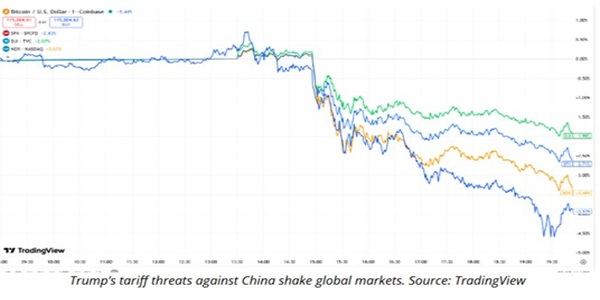
The International Monetary Fund characterized the broader macro environment as “shifting ground beneath the calm,” a description that fits the crypto sector’s specific “data fog.” With prices swinging wildly against a backdrop of strengthening fundamentals, investors had to stop watching charts passively and start interpreting the noise.
Why Price-Only Narratives Stopped Working
Standard price charts missed the reality of 2025’s market structure. Digital assets decoupled from traditional markets, breaking established correlations. Gold rallied 62.6% while Bitcoin fell 6.4%, according to CoinGecko.
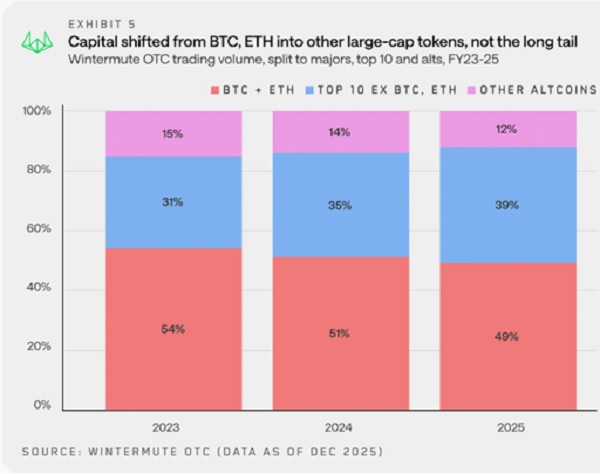
That divergence dismantled the assumption that crypto automatically outperforms commodities when fiat currencies are volatile. Internal market mechanics changed, too. Wintermute analyzed over-the-counter flows and found that liquidity stuck to the majors. Unlike previous cycles where capital trickled down to smaller tokens, it concentrated almost exclusively in Bitcoin and Ethereum.
Data from Wintermute reveals that altcoin rallies were brief—with a median duration of just 19 days in 2025. This is a steep drop from 61 days in 2024 and suggests a shift away from widespread speculation toward highly targeted capital deployment.
The “buy” signal was absent from retail charts but present in corporate treasuries. Digital Asset Treasury Companies (DATCos) deployed at least $49.7 billion to acquire crypto assets throughout the year, viewing the sector through a long-term lens rather than weekly candles. This institutional scale demands a different operational standard, prioritizing safety over short-term gains.
Binance Co-CEO Richard Teng noted this shift, “Binance’s 2025 numbers show scale, and most importantly, what that scale requires: regulatory anchors like ADGM authorization, resilience and security programs that prevent real losses.” He further emphasized the need for “strong data protection and AI governance, and product design that reduces friction for legitimate users while raising the cost of abuse.”
Stablecoin Utility on the Rise
Market participants looked to research to identify the signal within this price stagnation. That signal proved to be the utility of stablecoins.
A recent report highlights that stablecoin transactions now average $3.1 trillion in daily volume, a figure that surpasses the transaction volumes of traditional payment networks like Visa. Prices fluctuated but that didn’t stop the settlement layer keep expanding as a utility rail.
The total stablecoin market’s capitalization reached $300 billion in 2025. This greatly reinforced the infrastructure narrative. Data from the Binance ecosystem backs this up and shows sustained utility despite market noise. The platform processed $34 trillion in trading volume across all products in 2025, with stablecoins serving as the primary settlement engine. Beyond standard trading, user behavior shifted toward on-chain discovery mechanisms that bypass traditional order books.
Binance Co-CEO Yi He explained this evolution in user engagement, “Alpha illustrates how the definition of ‘trading on Binance’ has changed from ‘placing orders on an order book’ to discovering new ecosystems, earning rewards for early participation.” She added that users are “moving fluidly between centralized and on-chain environments – without losing the benefits of regulated infrastructure and deep liquidity that our platform offers.”
Users didn’t sit idle waiting for legacy assets to bounce back. Binance Alpha 2.0 onboarded 17 million users and processed over $1 trillion in volume in 2025 proving that market participants were actively hunting for opportunities in new ecosystems.
Trust as a Competitive Advantage
In an environment defined by high volatility and what researchers term “data fog,” the market premium shifted toward trust and verified compliance. Research in 2025 became less about price prediction and more about verifying infrastructure safety.
A global shift toward regulation defined the year, from the GENIUS Act in the US to new frameworks in the Middle East. Binance obtained a full global license under the ADGM that allowed the company to operate within one of the strictest regulatory environments available. The platform secured this standing and crossed 300 million registered users, a sign that adoption now moves in lockstep with regulatory clarity. Security metrics also translated directly into economic data. Trust can be measured in capital preserved.
Binance stopped $6.69 billion in potential fraud losses and shielded 5.4 million users in 2025. That capital stayed in the ecosystem instead of flowing to bad actors and strengthened the stability of the entire market infrastructure.
Markets Reward Clarity, Not Volume
The data from 2025 indicates that volume alone does not constitute a healthy market. The data fog proved that investors reward platforms and research desks capable of interpreting complex signals over those that simply amplify noise.
Looking ahead, Binance Research suggests a thematic shift in 2026 from this fog toward a “risk reboot.” As fiscal stimulus interacts with regulatory clarity, the ability to interpret market data will likely define influence in the next cycle.