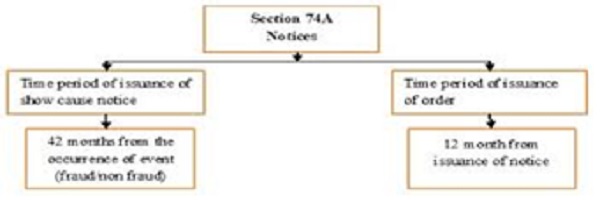
Goods and Services Tax : Section 74A replaces the earlier Sections 73 and 74, creating a unified framework for tax recovery in cases of short payment, erro...
Goods and Services Tax : This case explains situations where ITC is availed and utilised without receipt of goods or services. The ruling clarifies that su...
Goods and Services Tax : Highlights how authorities routinely invoke Section 74 without evidence of fraud and explains courts’ stance that such notices a...
Goods and Services Tax : Understand the process of GST intimation in Form DRC-01A, issued for tax discrepancies. Learn about the parts of DRC-01A, applicab...
Goods and Services Tax : Calcutta High Court stays a GST order, citing no force majeure for time limit extension under Section 73(9) of the CGST Act for FY...
Goods and Services Tax : KSCAA represents to the Finance Minister on the misapplication of GST Section 74 notices for small demands, urging restriction to ...
Goods and Services Tax : KSCAA highlights practical GST challenges in Sec 128A & Sec 16(4), urging clarifications on appeals, ITC, interest waivers, and mu...
Corporate Law : Supreme Court held that negligence on part of bank in presentation of cheque within the validity period of cheque leads to ‘defi...
Goods and Services Tax : The case clarifies that Section 74 requires clear evidence of fraud or wilful suppression. Mere reliance on third-party alerts wit...
Goods and Services Tax : The Court held that denial of input tax credit cannot be sustained without clear findings that suppliers failed to pay tax. The ma...
Goods and Services Tax : Karnataka High Court held that pigmy agents employed by the Bank can never be treated as business facilitators and qualifies as em...
Income Tax : The Court held that a summary in Form DRC-01 cannot substitute a proper show cause notice under Section 73. Proceedings initiated ...
Goods and Services Tax : New GST circular clarifies payment via GSTR-3B for Section 128A benefits, and appeal withdrawals for mixed period demands....
Goods and Services Tax : Learn about the Kerala SGST Act's interest and penalty waiver under Section 128A, eligibility, application process, and compliance...
Goods and Services Tax : Kerala SGST issues guidelines on issuing separate notices for Sections 73 and 74. Ensures clarity and uniformity in handling GST d...
The High Court held that export refunds cannot be denied based on alleged excess ITC without issuing an SCN under the CGST Act. The ruling reinforces that recovery proceedings must follow statutory procedure.
The High Court declined to retain the writ once the GST Appellate Tribunal became operational. The dispute was directed to be resolved through the statutory appellate mechanism.
The High Court held that GST demands for periods prior to approval of a resolution plan cannot survive once the plan is sanctioned under the IBC. Past statutory dues not forming part of the plan stand extinguished and cannot be enforced.
The Tribunal remanded the MAT issue after noting lack of factual verification on whether reserve withdrawals were credited to the P&L account. Key takeaway: MAT adjustments under section 115JB require strict, evidence-based verification.
The issue was whether GST show cause notices could be quashed at the threshold. The High Court held that alleged procedural lapses can be raised before the adjudicating authority, not in writ proceedings.
The Court held that the authority could not reject the ruling request based on earlier proceedings that were closed without deciding tax issues. The matter was remanded for fresh consideration.
Delhi High Court stayed the provisional attachment of the petitioner’s bank account, allowing filing of appeal against assessment order without further pre-deposit, pending departmental adjudication.
The Delhi High Court remands a GST order exceeding Rs. 7.5 crores due to denial of opportunity to be heard, granting the petitioner 30 days to file a reply to the SCN.
The Court refused to intervene against an SCN combining several financial years, noting that such consolidation is permitted under Sections 73 and 74. Since an appellate remedy existed, the assessee was relegated to appeal, with extension of time due to the pending writ. Recovery actions and attachments were set aside subject to filing the appeal.
The High Court remanded the assessment order after finding the petitioner was unaware of the SCN and did not attend a personal hearing. The matter will be reconsidered after the petitioner files a reply and a fresh hearing is conducted.