Income Tax : This clarifies how cash receipts are tested on daily, transaction, and occasion-based thresholds. It explains why breaking payment...
Income Tax : SEO Description: Explains which gifts qualify for exemption based on the statutory definition of “relative” and why not all fa...
Income Tax : The Tribunal held that penalty under Section 271DA cannot be imposed when the assessment order lacks recorded satisfaction of a 26...
Income Tax : Summary of income-tax rules on cash limits, including disallowance of cash expenditure, restrictions on loans, deposits, receipts,...
Income Tax : Indian tax law restricts cash transactions to promote digital payments. Limits apply to expense payments (Sec 40A(3): ₹10k/day),...
Income Tax : DON’T √ Accept cash of Rs. 2,00,000 or more in aggregate from a single person in a day or for one or more transactions r...
Income Tax : In order to achieve the mission of the Government to move towards a less cash economy to reduce generation and circulation of blac...
CA, CS, CMA : The Finance Bill, 2017 proposed an insertion of Section 271J in the Income-tax Act, 1961. Considering the undue hardships to be ca...
Income Tax : It has also been decided that the restriction on cash transaction under section 269ST shall not apply to withdrawal of cash from ...
Income Tax : In order to achieve the mission of the Government to move towards a less cash economy to reduce generation and circulation of blac...
Income Tax : The Tribunal held that consolidated Excel entries showing aggregate cash sales were insufficient to establish receipt of ₹2 lakh...
Income Tax : The issue was whether multiple medical bills constituted a single transaction under Section 269ST. The Tribunal held that separate...
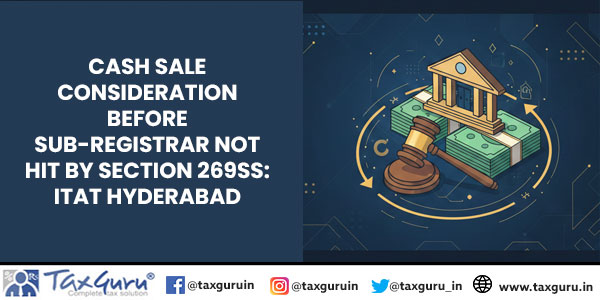
Income Tax : The Tribunal held that Section 269SS does not apply when cash is received as part of final sale consideration at the time of prope...
Income Tax : The Court issued notice in a plea to quash criminal proceedings where the applicant argued that alleged cash payments exceeding ...
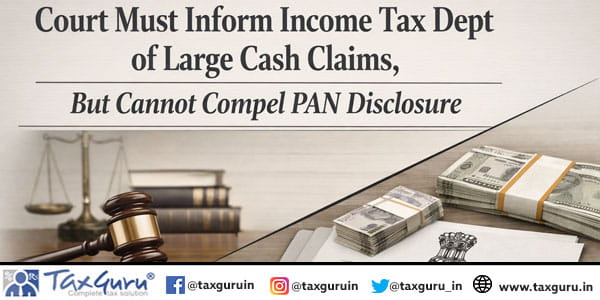
Income Tax : The High Court held that courts must intimate the Income Tax Department when suits involve cash transactions exceeding Rs.2 lakh. ...
Income Tax : Cash receipt by ‘Co-op. Society’ from dealer across multiple days not to be aggregated for Sec. 269ST purpose: CBDT Reference ...
Income Tax : CBDT issues Corrigendum to Notification No. 56/2021-Income Tax Dated: 7th May, 2021 and stated that word ‘payee ‘to ...
Income Tax : Hospitals / medical facilities providing #COVID19 treatment to patients can now receive cash payments even higher than ₹ 2 lakh....
Income Tax : Notification No. 8/2020-Income-Tax- CBDT has notified Other electronic modes by inserting New Income TAx Rule 6ABBA. It also amend...
Income Tax : Representations have been received from the stakeholders regarding applicability of income-tax provision to cash sale of agricultu...
Summary of income-tax rules on cash limits, including disallowance of cash expenditure, restrictions on loans, deposits, receipts, repayment rules, electronic payment requirements, and penalties for non-compliance under Sections 40A(3), 269SS, 269ST, 269SU and 269T.
ITAT Chennai held that when sales are accepted and supported by records, entire purchases cannot be treated as bogus merely because suppliers were untraceable. Addition restricted to 12.5% as profit element.
Indian tax law restricts cash transactions to promote digital payments. Limits apply to expense payments (Sec 40A(3): ₹10k/day), accepting loans/advances (Sec 269SS: ₹20k limit), and receiving funds (Sec 269ST: ₹2 lakh threshold). Non-compliance results in penalties or disallowance of expenditure.
This report provides a consolidated overview of the critical monetary threshold limits stipulated under various sections of the Income Tax Act, 1961, relevant for the Assessment Year (AY) 2026-27 (Financial Year 2025-26). These figures define taxability, exemption levels, eligibility for schemes, and compliance obligations for various categories of taxpayers, including individuals, corporations, and businesses.
The Karnataka High Court set aside a penalty notice and order under Section 271DA for violating Section 269ST, holding the proceedings were time-barred. Following the K. Umesh Shetty precedent, the Court ruled that the delay between the AO’s reference and the penalty notice constituted unreasonable laches, vitiating the entire action.
ITAT Ahmedabad held that provisions of section 69A r.w.s. 115BBE of the Income Tax Act gets applicable as source of undisclosed income admitted during the course of survey not explained. Merely disclosing and paying tax doesn’t protect assessee from clutches of section 69A.
Supreme Court ruling on cash property deal cites wrong tax law (269ST instead of 269SS), but mandates reporting of large cash transactions to IT dept.
SC directs all courts to report cash claims of ₹2L+ to Income Tax Dept under Sec 269ST for scrutiny, in judgment involving R.B.A.N.M.S. Trust dispute.
The plaintiff entity is a company engaged in the business of constructing and redeveloping immovable properties, either on a contractual or collaborative basis, and subsequently selling such properties.
Delhi High Court held that imposition of penalty under section 271DA of the Income Tax Act is justifiable since there is no inordinately and inexplicably delay in initiation of penalty proceedings. Accordingly, writ dismissed.