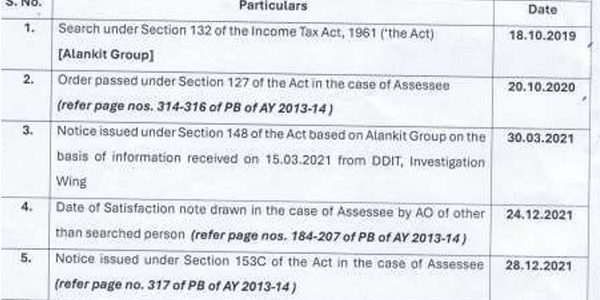
Income Tax : Judicial rulings clarify that satisfaction for initiating action against other persons in search cases must be recorded promptly. ...
Income Tax : Courts are divided on whether the DRP-specific deadline under Section 144C(13) overrides the general assessment time bar in Sectio...
Income Tax : CBDT issues new compounding guidelines simplifying process, eligibility, charges, and procedures under the Income-tax Act from Oct...
Income Tax : A summary of prosecution offences under Chapter XXII of the Income Tax Act (Sections 275A to 280), detailing the rigorous imprison...
Income Tax : CBDT's new Compounding of Offence Guidelines (2024) simplify the process but maintain strict compliance rules. Learn about eligibi...
Income Tax : Learn about the new block assessment provisions for cases involving searches under section 132 and requisitions under section 132A...
Income Tax : The case examined whether compensation paid to exit prior agreements was a sham arrangement. The Tribunal ruled it was a valid bus...
Income Tax : The Tribunal held that loan repayment cannot be treated as unexplained cash credit under section 68. The addition was deleted as i...
Income Tax : The issue was whether a notice granting less than the statutory minimum time is valid. The tribunal held that giving less than 7 d...
Income Tax : Reassessment proceedings was invalid for a notice issued beyond three years without the sanction of the prescribed higher authorit...
Income Tax : The Tribunal held that unsigned excel sheets without supporting evidence cannot justify additions. It ruled that absence of corrob...
Income Tax : Availability of Miscellaneous Functionalities related to ‘Selection of Case of Search Year’ and ‘Relevant Search...
The dispute concerned enhancement of house property income based on an unsigned lease found during search. The Tribunal held that such a document has no evidentiary value and cannot support additions.
The Tribunal set aside an appellate order confirming a ₹1.38 crore addition after finding that it lacked merit-based reasoning. The case was remanded for fresh adjudication with a speaking order.
The Revenue argued that incriminating material justified Section 153C action against a non-searched person. ITAT held that High Court quashing of notices conclusively ends jurisdiction under Section 153C.
Payments made pursuant to allotment confer valuable property rights. Their relinquishment through an agreement to sell amounts to a statutory transfer, entitling the assessee to compute gains or losses under capital gains.
The decision clarifies that voluntary admission and taxation of income post-search does not ipso facto warrant penalty. Absence of contumacious conduct weighed against the Revenue.
The Tribunal held that search-based reassessments issued beyond six assessment years are barred by limitation. Revenue appeals were dismissed as the statutory time limits could not be extended.
Revenue failed to produce a Section 153C satisfaction note showing the date of handing over seized material. ITAT treated the notice date as the deemed search date and held AY 2012-13 beyond jurisdiction.
The issue was whether an assessment could survive when statutory notices were issued in the name of a deceased person. The Tribunal held such notices invalid and quashed the entire assessment.
The Tribunal assessed compliance with revised reassessment provisions post Finance Act, 2021. It ruled that sanction by a lower authority after three years is non-est in law, leading to quashing of the reassessment.
ITAT Delhi held that for an unabated year, additions under section 153A require incriminating material. A seized loose sheet and retracted statements lacked corroboration, leading to deletion of the ₹100 crore addition.