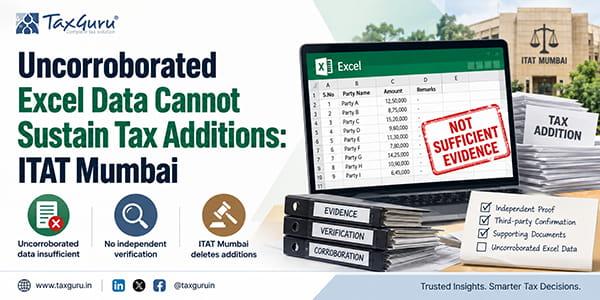
Income Tax : The ruling clarifies that unauthenticated digital chats and screenshots cannot form the sole basis of tax additions without proper...
Income Tax : Judicial rulings clarify that satisfaction for initiating action against other persons in search cases must be recorded promptly. ...
Income Tax : Section 270A penalties must specify the exact misreporting clause. Vague notices invalidate penalties and can restore immunity und...
Income Tax : Understand the three core processes of Indian Income Tax: Rectification of mistakes (Sec 154), the four types of Assessment (Summa...
Income Tax : Understand your legal rights and procedural protections during Income Tax and PMLA raids in India. Learn what to do and what to a...
CA, CS, CMA : Legal opinion sought by NFRA on auditing standards, penalties, and regulatory roles in India. Analysis of NFRA’s powers under th...
Income Tax : Learn about the new block assessment provisions for cases involving searches under section 132 and requisitions under section 132A...
Goods and Services Tax : The Ministry of Finance reports the arrest of a firm's finance head for GST evasion worth Rs 88 crore. Learn about the case and it...
Income Tax : The Central Board of Direct Taxes ( CBDT) has directed re-opening of all cases under the search and seizure label, income-escapin...
Income Tax : The ITAT Ahmedabad held that isolated WhatsApp messages and electronic communications cannot, by themselves, support additions in ...
Income Tax : ITAT Ahmedabad held that penalty under Section 43 of the Black Money Act could not be imposed when foreign assets were subsequentl...
Income Tax : The Hyderabad Bench emphasized that penalty under Section 271(1)(c) cannot be imposed solely because an addition survives appellat...
Income Tax : The Tribunal held that Section 263 cannot be invoked where the assessee never claimed the alleged expenditure as a deduction. With...
Income Tax : The Tribunal ruled that proportionate interest disallowance under Section 36(1)(iii) cannot be sustained when the assessee has ade...
Income Tax : Read the order issued by the Central Board of Direct Taxes (CBDT), Ministry of Finance, specifying the scope of the e-Appeals Sche...
Income Tax : Dispute arose between the Department and the assessees with regard to adjustment of such seized/requisitioned cash against advance...
The Tribunal ruled in favour of the assessee after noting that audited financials, PAN, bank statements, ITRs, confirmations, and MCA records of lenders were furnished. The ruling reinforces that documentary evidence can successfully rebut allegations of bogus loans.
The Hyderabad ITAT held that only the actual period lost during the limitation period can be excluded under Explanation-1 to Section 153. It ruled that the assessment order passed beyond the permissible period was invalid.
The Tribunal held that entries found in third-party ERP software during a search cannot alone justify unexplained investment additions under Section 69. Absence of corroborative evidence led to deletion of the entire addition.
The Tribunal ruled that the Revenue must establish a direct connection between seized material and the assessee’s taxable income before invoking Section 153C. Mechanical initiation of proceedings for multiple years was declared invalid.
The ITAT Ahmedabad held that reassessment under Section 147 was invalid because the Assessing Officer reopened the case for fictitious loan entries but made additions for alleged bogus LTCG from penny stock transactions. The Tribunal ruled that changing the basis of reopening is not permissible in law.
The Tribunal held that tax authorities cannot reject documentary evidence solely by labeling the explanation as an afterthought. Proper verification and rebuttal of evidence are necessary before sustaining additions under Section 69A.
ITAT Mumbai held that incomplete WhatsApp chats without proof of completed transactions cannot justify additions under Section 69A. The Tribunal found that the chats lacked corroborative evidence showing actual payment of money.
ITAT Delhi held that where sales are accepted and purchases are supported by invoices and banking transactions, only the profit element embedded in alleged bogus purchases can be taxed. The Tribunal restricted the addition by applying the average profit rate instead of sustaining the entire disallowance.
ITAT Mumbai deleted additions exceeding ₹10.57 crore made under section 56(2)(vii)(c) after finding that the Assessing Officer wrongly adopted an amended valuation approach retrospectively. The Tribunal upheld the CIT(A)’s deletion in entirety.
ITAT Delhi ruled that reassessment in search cases requires prior approval under section 148B before passing the order. Since the department failed to obtain the prescribed approval, the assessment was quashed as invalid in law.