Introduction
In recent years, there has been a sharp increase in Income Tax raids and Enforcement Directorate (ED) actions under the Prevention of Money Laundering Act (PMLA), 2002. These raids, often dramatic and high-stake, impact not just high-net-worth individuals and businesses, but also professionals and startups. While investigative agencies operate within statutory powers, the accused or the searched party retains certain legal rights that must not be overlooked.
This article demystifies the procedural rights and protections available to individuals during Income Tax and PMLA raids, focusing on practical advice and legal strategy.
Understanding the Legal Framework
Income Tax Raids – Section 132 of the Income Tax Act, 1961
- Empower officers to conduct search and seizure operations.
- Objective: uncover unaccounted income, undisclosed assets, or evidence of tax evasion.
PMLA Raids – Sections 17 & 18 of the PMLA, 2002
- Authorizes ED officers to enter, search, and seize property suspected to be involved in money laundering.
- Often initiated based on a predicate offence under IPC, NDPS, Companies Act, FEMA, etc.
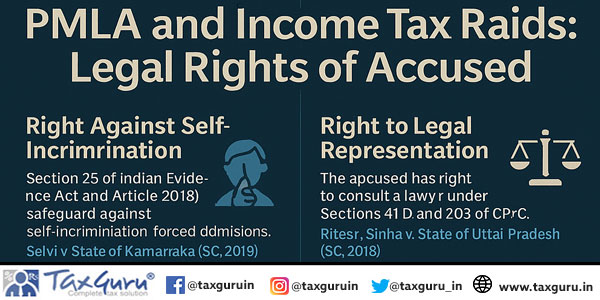 Key Legal Rights of the Accused During Raids
1.Right to See the Warrant
- Officers must carry a valid, signed search warrant.
- In PMLA raids, recording of ‘reasons to believe’ is mandatory under Section 17(1).
2. Right to Remain Silent
- The accused cannot be forced to self-incriminate under Article 20(3) of the Constitution.
3. Presence of Independent Witnesses
- Two independent witnesses (usually local residents) must be present during the search (mandatory under both laws).
4. Right to Get a Panchnama
- A Panchnama (search record) must be prepared and signed by witnesses and the party being searched.
5. Right to Legal Assistance
- Although immediate access to a lawyer may be restricted during raids, one may seek legal advice at the earliest opportunity.
6. Right to Inventory and Copy of Seized Documents
- Authorities must provide a list of seized articles and a copy of the seizure memo.
7. Time-bound Return of Seized Documents
- As per Rule 4 of PMLA (Maintenance of Records) Rules, documents should be returned within 180 days, unless extended by the Adjudicating Authority.
Do’s & Don’ts During Raids
| √ Do | × Don’t |
|---|---|
| Stay calm and cooperative | Argue or obstruct the officials |
| Ask for and read the search warrant | Hide or destroy any documents |
| Sign documents only after reading | Sign blank papers or statements |
| Insist on proper Panchnama & inventory | Invite outsiders or media during the raid |
Important Case Laws to Remember
| Case | Principle |
|---|---|
| K.T.M.S. Mohammed v. Union of India, AIR 1992 SC 1831 | Seizure must be reasonable and not excessive |
| Vikram Singh v. ED, 2022 SCC OnLine Del 1389 | Recording of reasons under Section 17 of PMLA is mandatory |
| R.R. Gavit v. Sherbanu Hassan Daya, AIR 1986 SC 962 | Rights under Article 20(3) apply during search and seizure |
Conclusion
Raids under PMLA and Income Tax laws are powerful tools against economic offences—but they must be executed within the framework of law. Accused persons and their advisors must be aware of their constitutional and procedural rights to ensure fair treatment and build a robust legal defence, if necessary.
Knowing your rights is not an act of resistance—it’s a safeguard for due process.