Corporate Law : upreme Court held that a trust is not a separate legal entity under the Indian Trusts Act, 1882, and only its trustees can be held...
Corporate Law : The Supreme Court of India ruled that presenting a cheque for its full amount after a partial payment was made does not constitute...
Corporate Law : The Supreme Court in Vishnoo Mittal v. M/s Shakti Trading Company quashed proceedings against a director under Section 138 of the ...
Corporate Law : SC rules that directors cannot face Section 138 NI Act cases if the cause of action arises after insolvency proceedings begin unde...
Corporate Law : Understanding territorial jurisdiction under Section 138 of the NI Act. Key rulings and amendments explain where cheque bounce cas...
Corporate Law : The Modi government in a bit to improve ease of doing business and unclogging courts has decided that 39 sections in 19 differen...
Corporate Law : Lok Sabha passes Negotiable Instrument (Amendment) Bill, 2018 a bill further to amend the Negotiable Instruments Act, 1881 by whic...
Corporate Law : It is, therefore, proposed to introduce the Negotiable Instruments (Amendment) Bill, 2017 to provide, inter alia, for the followin...
Corporate Law : Proposal to promulgate the Negotiable Instruments (Amendment) Ordinance, 2015 The Union Cabinet, chaired by the Prime Minister Shr...
Corporate Law : The main amendment included in this is the stipulation that the offence of rejection/return of cheque u/s 138 of NI Act will be en...
Corporate Law : The Court held that repeated dishonour of cheque and non-payment after notice established a prima facie case. It refused to quash ...
Corporate Law : The court interpreted the scope of Section 91 CrPC in summoning documents. It ruled that parties cannot demand documents as a matt...
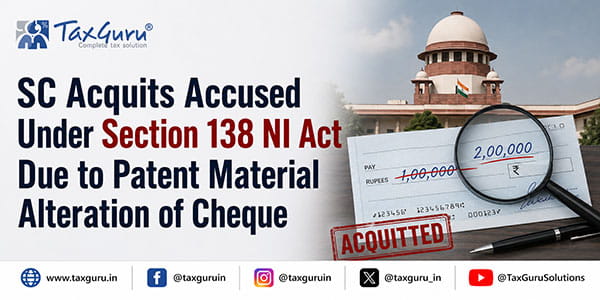
Corporate Law : Supreme Court held that negligence on part of bank in presentation of cheque within the validity period of cheque leads to ‘defi...
Corporate Law : The case examined whether the accused could disprove liability under Section 138. The court upheld conviction as the presumption r...
Corporate Law : The court analysed whether the reason account blocked falls within the scope of Section 138 of the Negotiable Instruments Act. It ...
Corporate Law : Pursuant to directions of Hon'ble Supreme Court of India, following Practice Directions are issued to all Courts dealing with case...
Finance : Central Government hereby declares every Saturday as a public holiday for Life Insurance Corporation of India, with immediate effe...
Corporate Law : This Act may be called the Negotiable Instruments (Amendment) Act, 2018. (2) It shall come into force on such date as the Central ...
Corporate Law : MINISTRY OF LAW AND JUSTICE (Legislative Department) New Delhi, the 29th December, 2015 The following Act of Parliament received t...
Corporate Law : NOW THEREFORE, in exercise of the powers conferred by clause (1) of article 123 of the Constitution, the President is pleased to p...
Court held that a cheque initially issued as security can mature into an enforceable liability once loan recall conditions are triggered. Disputed facts on repayment and breach must be examined at trial, not at quashing stage.
The Court held that violation of the ₹20,000 cash-loan limit under tax law attracts only penalty and does not void the debt. Cheque-bounce prosecutions under Section 138 NI Act remain valid despite such breaches.
The Court held that once evidence under Section 145 NI Act has commenced, returning the complaint solely due to the 2015 jurisdictional amendment is improper. It restored the case to the Kolkata court, emphasizing continuity of proceedings and preventing prejudice to either party.
Court held that cheque was issued for repayment of an unlawful job-related payment, which is not a legally enforceable debt. Acquittal was upheld as Section 138 NI Act did not apply.
The Court held that cost directions based on earlier guidelines cannot be enforced as binding precedent. It set aside the imposed costs since the complainant sought no further payment and the appellant could not comply.
The apex court removed the cost imposed to the State Legal Services Authority after parties settled a cheque dishonour dispute. The ruling confirms that prior Article 142-based cost schemes cannot mandate payment in every case. Takeaway: each settlement must be evaluated on its own merits, not by automatic precedent.
The Supreme Court upheld the disqualification of a councillor for suppressing her Section 138 NI Act conviction in her nomination affidavit. The Court ruled that concealment of criminal records violates voters’ right to informed choice and voids election results.
SC clarified that personal insolvency proceedings under Section 94 IBC do not stay criminal trials for cheque dishonour under Section 138 NI Act.
The Orissa High Court dismissed a plea by a Managing Director to discharge himself from a prosecution under Section 138 of the Negotiable Instruments NI Act, 1881, following his company’s entry into the Corporate Insolvency Resolution Process CIRP under the IBC, 2016.
Bombay High Court held that directors cannot escape personal criminal liability for dishonoured cheques even if the company is under insolvency proceedings.