
Officials of the Directorate General of GST Intelligence (DGGI), Ahmedabad Zonal Unit, arrested the alleged mastermind of a massive GST refund fraud of approximately ₹1,825 crore at Indira Gandhi International Airport upon his return from Dubai. Investigations revealed a sophisticated scheme involving fake firms, fraudulent Input Tax Credit (ITC), and inflated export claims. Dummy entities were created using borrowed KYC documents, with no real business activity, while fake invoices—primarily involving high-value tobacco products—were used to generate ineligible ITC. The fraud involved layered transactions, fictitious exports from Kandla SEZ, and fabricated transport documents. Funds showed circular movement with no genuine commercial basis. The accused also allegedly siphoned bank funds and faced additional proceedings by enforcement agencies including Central Bureau of Investigation and Securities and Exchange Board of India, highlighting a wide-ranging financial crime network.
Ministry of Finance
DGGI Ahmedabad Zonal Unit officials apprehend mastermind of the biggest GST refund fraud of around ₹1,825 crore at IGI Delhi airport
Posted On: 20 APR 2026
Mr. Kapil Chugh the mastermind of GST refund fraud wanted in many other economic criminal cases was arrested by the DGGI, AZU, Ahmedabad, on 19th April 2026 from IGI Airport upon returning from Dubai.
Mr. Kapil Chugh had evaded investigation and did not respond to multiple summons (22 in all) issued by DGGI, AZU, Ahmedabad and never joined investigations. He had fled to Dubai after committing GST refund fraud amounting to approximately ₹1,825 crore across multiple jurisdictions.
Investigation conducted in the instant case has revealed that Mr. Kapil Chugh, along with his associate Mr. Vipin Sharma, devised and operated a well-structured arrangement for fraudulent availment of Input Tax Credit (ITC) and subsequent encashment through refund claims on account of zero-rated supplies. Mr. Kapil Chugh emerges as the key mastermind and habitual economic offender who controlled the entire network through dummy firms, employees and close associates. The entities were created using borrowed KYC documents and were found to be non-functional or lacking infrastructure, manpower and genuine business activity at the declared premises. The dummy proprietors/directors were merely name lenders and were compensated with fixed monthly cash payments. All operational activities including GST registration, invoice generation, banking operations, filing of returns and submission of refund claims were handled centrally by the masterminds.
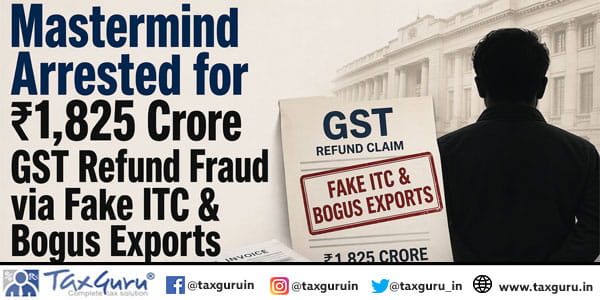
The masterminds generated fraudulent ITC by arranging fake purchase invoices without actual receipt of goods. High-value tobacco products were shown in invoices to create substantial ITC. These invoices were circulated through multiple intermediary firms forming a layered chain of transactions. The ITC so generated was passed from one entity to another through paper transactions, thereby creating an artificial trail of trading activity. This layering enabled the masterminds to introduce ineligible ITC into the GST chain and subsequently accumulate the same in selected entities which were projected as exporters, particularly from Kandla Special Economic Zone (KASEZ).
Parallel to the above paper transactions, low-value tobacco, inferior smoking mixtures and other tobacco products were procured locally at nominal prices, often without invoices. These goods were subsequently misdeclared as high-value products such as Kimam/Jarda and exported at artificially inflated values. No manufacturing facility or infrastructure existed to justify such conversion. The inflated turnover declared in GST returns was primarily on account of fake billing, thereby enabling fraudulent ITC accumulation and refund claims. The masterminds thereafter showed zero-rated supplies under Letter of Undertaking (LUT) without payment of tax and claimed refund of accumulated ITC. Investigation revealed that the exports were largely fictitious or grossly exaggerated. E-way bills were generated using doubtful or repeated vehicle numbers and transportation documents were fabricated to support paper transactions.
Financial trail analysis revealed negligible or circular fund movement despite large-value transactions. Payments received were routed through related entities or withdrawn in cash shortly thereafter. There was no corresponding commercial pattern such as genuine supplier payments or logistics expenses. Multiple firms shared common contact numbers, IP addresses and accounting personnel, evidencing centralized control by the masterminds.
Mr. Kapil Chugh also misrepresented and inflated turnover of his export business to siphon off approximately ₹11 crore from Yes Bank. He has also been charge-sheeted by CBI in another case involving fraudulent availing of credit facilities through forged documents. Further, SEBI vide order dated 30.03.2026 has taken action against Mr. Vipin Sharma, MD of M/s Elitecon, for inflating company valuation through fake turnover generated by bogus billing linked to GST fraud.
FAQs – ₹1,825 Crore GST Refund Fraud and DGGI Investigation
Q1. What was the alleged GST refund fraud uncovered by DGGI?
Answer: According to the investigation, the fraud involved fraudulent GST refund claims of approximately ₹1,825 crore through fake firms, ineligible Input Tax Credit (ITC), bogus invoices, and allegedly fictitious or inflated export transactions.
Q2. How was the alleged fraudulent Input Tax Credit (ITC) generated?
Answer: The investigation states that fake purchase invoices, primarily involving high-value tobacco products, were used to generate ineligible ITC. These invoices were circulated through multiple intermediary entities to create an artificial chain of transactions before the ITC was accumulated in selected exporting entities.
Q3. What methods were allegedly used to support the bogus refund claims?
Answer: The investigation alleges the use of dummy firms created with borrowed KYC documents, fake billing, inflated export values, fabricated transport documents, doubtful e-way bills, and layered paper transactions to support refund claims on zero-rated supplies.
Q4. What did the financial investigation reportedly reveal?
Answer: DGGI’s investigation reportedly found negligible or circular fund movement despite high-value transactions, with payments routed through related entities or withdrawn in cash. Multiple entities also allegedly shared common contact details, IP addresses, and accounting personnel, indicating centralized control.
Q5. Were any other enforcement actions mentioned in connection with the accused?
Answer: Yes. The release states that the accused allegedly siphoned approximately ₹11 crore from a bank by inflating business turnover, was charge-sheeted by the Central Bureau of Investigation (CBI) in another case, and that action was also taken by the Securities and Exchange Board of India (SEBI) against an associate in relation to alleged fake turnover and bogus billing.
****





Lot of loopholes are left for cheating GST. First of all, any tax collection system has to be fool proof.What do the vigilance intelligent wings of GST administration are doing. Do they get something from cheaters to keep their eyes closed?