1. Why is it that a taxpayer and the Income Tax Officer always share a Tom and Jerry kind of relationship? No matter how hard they try to stay at peace, a new chase always begins- one sends notices, the other replies; one disallows, the other appeals. And in the end, after running through rounds of scrutiny, appeals, and often the ITAT and the Courts, the taxpayer finally gets back what was rightfully theirs.
But, is this fair to taxpayers? Not everyone has the time, means, or courage to knock on the doors of a Tribunal or Court – especially when the disputed amount is small.
Take, for instance, the common issue of TDS Mismatch- where tax is deducted from the taxpayer’s income but not properly deposited or reported by the deductor. The result ? The taxpayer faces unnecessary hardship for no fault of their own.
2. How a simple TDS Mismatch Reached the Court: The petitioner, U.P. Rajya Nirman Sahakari Sangh Limited, is a cooperative society registered under the relevant Act, claiming exemption under Sec 80P of the Income Tax Act, 1961.
The society had a valid Form 16A showing Tax deducted at Source, and accordingly claimed a refund of the same.
The Income Tax Department refused to grant the refund on the grounds that the amounts claimed by the Society did not appear in Form 26AS, i.e., there was a mismatch between the Form 16A certificates and the entries in Form 26AS.
The Society challenged this in a writ under Article 226 of the Constitution of India, contending that the denial was unfair because the mismatch was not due to any fault of the petitioner. The fault lay with the deductor for not uploading the entries, and therefore, the refund/credit should not be withheld.
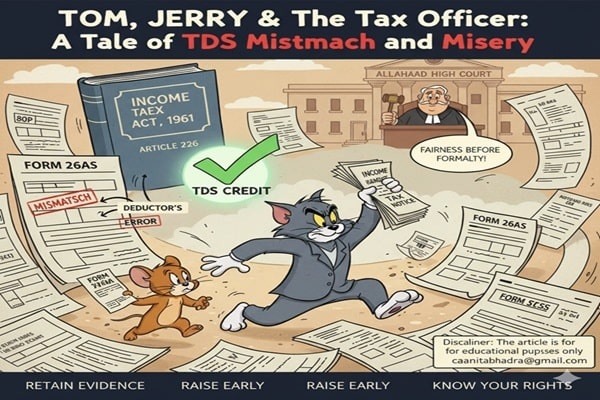
3. When the Court Stepped In: It was the Allahabad High Court that stepped in to resort justice. The Court made it clear that when tax has already been deducted from a taxpayer’s income, the credit for such tax cannot be denied just because the deductor failed to deposit or reflect it correctly. The Bench strongly reminded the department that the taxpayer cannot be held responsible for someone else’s actions. The Court emphasised that the authorities must act in accordance with fairness and cannot deny a refund merely because of a mismatch in Form 26AS
It is once again reiterated that a taxpayer cannot be left at the mercy of the Assessing Officer who chooses to delay the payment of genuine refunds.
This judgment deserves the attention of every taxpayer.
4. Court’s Advice to the Department: Interestingly , the High Court did not just stop at delivering justice in this case- it also took the opportunity to remind the tax department of its larger responsibility. Referring to earlier judgements on similar issues , the Court directed the department
(a) When an assessee approaches the Assessing Officer with the requisite details and particulars, the said Assessing Officer will verify whether or not the deductor has made payment of the TDS and if the payment has been made, credit of the same should be given to the assessee.
(b) It is the duty of the Assessing Officer to carry out verification and, if necessary, communicate with the deductor or the TDS circle to ascertain the truth, not to dismiss the taxpayer’s claim mechanically.
(c) The Assessing Officer is at liberty to ascertain and verify the true and correct position about the TDS certificate.
(d) The Bench noted that the CBDT Instruction No. 05/2013, dated 08.07.2013, had already directed all field officers to follow the procedure laid down in Court on Its Motion (Delhi High Court) and ensure that TDS credit is not denied when the assessee produces valid certificates.
4. Key Takeaways for Taxpayers: The Judgement once again reinforces a simple but vital principle – a genuine taxpayer should not be made to suffer for lapses committed by others. The responsibility to ensure proper credit of TDS rests with the department once the tax has been deducted. For a taxpayer , a few key takeaways emerge from this case:-
Retain all evidence of deductions: Preserve Form 16A, salary slips, or communications from the deductor showing tax.
Raise the issue early: If a mismatch is noticed, approach the deductor or file a grievance through the e-filing portal at the earliest opportunity.
Know your rights. If the tax has been deducted from income , the taxpayer is legally entitled to a credit and refund; a mismatch alone cannot deny that right.
5. Conclusion: The eternal Tom & Jerry chase between taxpayers and officers can finally rest,if fairness replaces formality. After all, the goal of taxation is not to trap, but to trust. When justice prevails, both sides win – the taxpayer in peace and the department in credibility.
Disclaimer: The article is for educational purposes only.
The author can be approached at [email protected]