

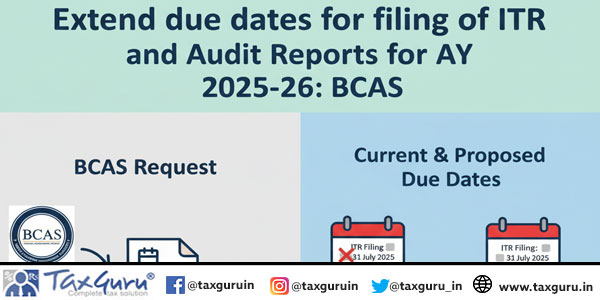
The Bombay Chartered Accountants’ Society has submitted a request to the Central Board of Direct Taxes (CBDT) for additional extensions of the due dates for filing Income Tax Returns and Audit Reports for the Assessment Year 2025-26. While acknowledging a previous extension for non-audit cases, the society argues that taxpayers and professionals subject to audit requirements face significant challenges. The representation points to the delayed release of ITR forms and utilities, which has severely reduced the time available for complex filings. It also highlights persistent technical issues with the e-filing portal, including validation errors and slow performance. Furthermore, the letter notes the heavy overlap of income tax compliance with other statutory deadlines, a reduced number of effective working days due to festivals, and an increased burden from enhanced reporting requirements. The society suggests new due dates for various categories of taxpayers to ensure the accuracy and quality of submissions, enhance administrative efficiency, and support the government’s “Ease of Doing Business” initiative.
Bombay Chartered Accountants’ Society (BCAS)
Date: 01st September 2025
To
Smt. Nirmala Sitharaman
Hon’ble Union Minister for Finance and Corporate Affairs
Government of India
New Delhi 110001
Shri Ravi Agrawal
Chairman, Central Board of Direct Taxes (CBDT)
Ministry of Finance — Department of Revenue
Government of India, New Delhi
Subject: Representation requesting extension of due dates for filing of Income Tax Returns and Audit Reports for AY 2025–26
Respected Sir,
On behalf of the Bombay Chartered Accountants’ Society (BCAS), we wish to place on record our appreciation for the proactive step taken by the Central Board of Direct Taxes (CBDT) through its Circular No. 06/2025 dated 27th May 2025, wherein the statutory due date for filing of Income Tax Returns (ITRs) in respect of non-audit cases was extended from 31st July 2025 to 15th September 2025. This timely announcement has brought significant relief to taxpayers and tax professionals, and it reflects the Board’s sensitivity to genuine difficulties faced by stakeholders.
However, while this relief is welcome, we respectfully submit that further extensions are still warranted for various categories of taxpayers, especially those subject to audit requirements. Through this representation, we wish to highlight the ground realities confronting taxpayers, professionals, and other stakeholders in meeting the statutory requirements of filing Income Tax Returns and Tax Audit Reports for Financial Year 2024–25 (Assessment Year 2025–26). The recent relaxation in timelines has been a welcome step; however, in view of the continuing complexities in reporting and the operational challenges being faced, there remains a pressing need for further extension of the prescribed due dates.
1) Release of ITR Forms and Utilities
The phased and delayed release of ITR utilities has significantly curtailed the effective time available for preparation and filing. A summary of the release timeline is set out below:
Release of ITR Utilities (JSON/ Excel)
| ITR Form / Utility |
Date of Release | Gap from 1st day of Assessment year (01.04.2025) |
Days available for filing the Audit Report within existing due date |
| ITR-1 | 30 May 2025 | 59 | Not Applicable |
| ITR-2 | 11 July 2025 | 101 | Not Applicable |
| ITR-3 | 11 July 2025 | 101 | 81 |
| ITR-4 | 30 May 2025 | 59 | Not Applicable |
| ITR-5 | 08 August 2025 | 129 | 53 |
| ITR-6 | 14 August 2025 | 135 | 47 |
| ITR-7 | 21 August 2025 | 142 | 40 |
| Form 3CA-3CD and 3CB-3CD |
17 July 2025 | 107 | 75 |
| Form 10BB | 21 August 2025 | 142 | 40 |
| Category | Normal Timeframe (if utilities available on 1 April) |
Actual Time Available AY 2025–26 |
| Non-audit taxpayers | 4 months (Apr–Jul) | 3.5 months (utilities in late May) |
| Audit taxpayers | 6–7 months (Apr–Oct) | 2–3 months (utilities released mid-Jul to mid-Aug) |
The above chronology indicates that assessees subject to audits under various laws covering individuals, partnership firms / LLPs, corporates and trusts, who typically require more preparation time due to complexity of reporting, received usable utilities quite late into the compliance cycle. The utilities for ITR-5, ITR-6, ITR-7 and key audit forms were released only in July / August 2025 — well beyond the start of the assessment year.
2) Challenges Being Faced
(i). Compressed Timeframe for Preparation and Audit
The staggered release of utilities has left a substantially shortened compliance window for taxpayers who are subject to audit. For instance, ITR-5, ITR-6 and ITR-7 utilities, which cater to firms, companies and trusts, were released only in August 2025. By this time, more than half of the compliance window had already lapsed.
Taxpayers under audit typically require considerable lead time to compile financial statements, carry out statutory audits, reconcile data across multiple reporting systems (GST, TDS, SFT, etc.), and prepare disclosures mandated under the Income Tax law. The late release of utilities means that instead of having the usual span of three to four months, professionals are now left with only a few weeks to complete these tasks, making it practically impossible to meet statutory deadlines without compromising on quality and accuracy.
(ii). Technical and Systemic Bottlenecks on the Portal
Although the e-filing portal has improved in recent years, systemic issues persist during peak filing seasons. Assessees and tax professionals are facing frequent schema updates, validation errors, and portal downtime. Each schema update requires taxpayers to revalidate and sometimes re-enter information, causing duplication of effort and wastage of already scarce time.
Additionally, users have frequently encountered slow portal responses, error messages while uploading returns, and occasional rejections without adequate diagnostic information. These issues not only disrupt workflow but also cause anxiety among taxpayers who fear penal consequences for delayed compliance.
(iii). Overlap with Other Statutory Deadlines
The compliance calendar for businesses and professionals is heavily crowded during the months of July to October. Alongside Income Tax compliances, taxpayers are required to meet GST filing obligations (monthly and quarterly returns), company law compliances including filing of annual returns and financial statements with MCA, and sector-specific regulatory submissions.
For entities subject to statutory audit, auditors must simultaneously complete tax audits, statutory audits under the Companies Act, and GST audits, often for the same financial year. For most charitable entities, they also need to file applications for renewal of their s.12A and s.80G registration/approval by 30th September 2025. This overlap results in excessive pressure on both taxpayers and professionals, leading to undue stress, errors in filings, and avoidable disputes later.
(iv). Reduced Number of Effective Working Days
The statutory compliance window must be viewed not merely in terms of calendar days, but in terms of actual effective working days available. In the months of August, September, and October 2025, several national and regional festivals, along with public holidays, significantly reduce the number of business days.
For example, in many states, the festive season covering Raksha Bandhan, Janmashtami, Ganesh Chaturthi, and Navratri falls in this period. Moreover, professional firms also face resource constraints during these months because of staff unavailability due to festivals and personal commitments. Consequently, the available time to meet deadlines is further shortened.
(v) Increased Compliance Burden due to Enhanced Reporting Requirements
The latest ITR forms and audit reports require extensive disclosures. While these requirements are welcome from a transparency standpoint, they substantially increase preparation time and require collation of data from multiple systems. They need to be filled in properly, as incorrect filling in can result in unwarranted demands.
For corporates, in particular, the new reporting requirements in ITR-6 and Form 3CD necessitate coordinated efforts between the finance, audit, legal, and compliance teams. With utilities released late, the time available for inter-departmental reconciliation and audit review has become severely constrained.
(vi) Risk of Compromised Quality of Reporting
If taxpayers are compelled to adhere to the existing deadlines despite the compressed timelines and systemic issues, there is a real risk that compliance will be completed in haste, potentially leading to inadvertent errors or omissions. Such errors, though unintentional, could result in penal consequences, notices, and prolonged litigation. Granting reasonable extensions would not only relieve taxpayers but would also reduce the administrative burden on the Department in handling rectification requests and dispute resolution.
3) Request for Extension of Due Dates
In light of the above, we respectfully propose the following extensions:
Suggested Revised Due Dates
| Category | Statutory Due Date |
Already Extended to | Proposed Extended Date |
| Non-audit cases | 31 July 2025 | 15 September 2025 (CBDT Circular dt.27.05.2025) |
No further change suggested |
| Filing of Tax Audit Report and other forms (including Firms, Companies, Trusts) | 30 September 2025 | – | 30 November 2025 |
| Audit cases – ITR Filing | 31 October 2025 | – | 31 December 2025 |
| Assessees subject to Transfer Pricing (Form 3CEB) | 30 November 2025 | – | 31 January 2026 |
4) Justification for the Request
(i). Ensuring Accuracy and Quality of Compliance
Tax returns and audit reports are not mere procedural filings; they form the basis for the Department’s assessments and for taxpayer accountability. When taxpayers and professionals are constrained by inadequate time, the quality of reporting invariably suffers. Errors and omissions increase, leading to:
-
- Filing of defective returns,
- Frequent rectification applications,
- Avoidable scrutiny notices, and
- Prolonged litigation.
By granting an extension, CBDT would provide taxpayers with sufficient time to reconcile third-party information (Form 26AS, AIS/TIS, Form 16/16A), match financial records with GST data, and prepare error-free submissions. This will enhance the accuracy of filings, thereby reducing downstream disputes and administrative burden on the Department.
(ii). Administrative Efficiency and Systemic Stability
When deadlines are unreasonably compressed, the portal faces last-minute rush and overload, often resulting in downtime and errors. Extensions help spread out the filing load more evenly across a longer time window. This reduces pressure on the system, minimises user grievances, and enhances the efficiency of the Department’s IT infrastructure.
From an administrative standpoint, it is preferable to grant a reasonable extension now rather than to deal later with a flood of grievances, rectification requests, and litigation arising from rushed and erroneous filings.
(iii). Stakeholder Welfare and Inclusivity
A very large segment of Indian taxpayers comprises small businesses, professionals, trusts, and salaried individuals who rely heavily on tax professionals for their filings. These assessees often lack in-house compliance infrastructure. Professionals, in turn, are burdened with overlapping obligations — tax audits, company law audits, GST filings — all concentrated within the same period.
An extension would acknowledge these genuine resource constraints and enable equitable participation of all categories of taxpayers in the compliance process. Such a measure is in harmony with the Government’s broader policy of fostering a taxpayer-friendly regime.
(iv). Alignment with Ease of Doing Business Initiatives
The Government of India has consistently emphasised the principle of Ease of Doing Business and reduction of compliance burden. Extending due dates in the current scenario would align with this vision, as it directly reduces taxpayer stress, avoids duplication of effort, and promotes voluntary compliance.
Further, by ensuring that taxpayers file accurate and complete returns without fear of penal consequences, the Board will be furthering the larger policy goal of encouraging compliance through facilitation rather than compulsion.
(v). Balanced Approach – Relief without Revenue Loss
Granting an extension of due dates does not lead to any loss of revenue to the exchequer. Advance tax and TDS mechanisms ensure that the bulk of tax collection has already taken place. Also, delayed payment of self-assessment taxes are already coupled with payment of interest. Extensions merely provide additional time for filing returns and reports, without impacting the flow of government revenues.
Thus, such a measure strikes a balance between safeguarding taxpayer interests and protecting the fiscal interests of the nation.
5) Conclusion
We once again express our gratitude for the extension already granted by the CBDT vide Circular dated 27th May 2025. At the same time, we humbly urge the Board to consider granting the further extensions as requested above, which will go a long way in ensuring timely, accurate, and stress-free compliance, thereby strengthening trust between taxpayers and the administration.
We remain hopeful of a positive consideration.
Yours faithfully,
For Bombay Chartered Accountants’ Society (BCAS)



very nice and nessesary suggestion ,need of hour, thanks to BCA. Mumbai Maharashtra
Dear Finance Minister Mam Please Extend Due Date of Tax Audit for Financial Year 2024-25
a balanced, effective and meaningful representation.
very nice and nessesary suggestion ,need of hour, thanks to BCA. Mumbai Maharashtra