In re DKMS BMST Foundation India (GST AAR Karnataka)
1. The services of HLA Typing received by DKMS BMST Foundation India from the overseas laboratory is covered under the definition of “health care services by a clinical establishment” and thereby is exempted from IGST leviable thereon and accordingly not taxable in the hands of the applicant under reverse charge mechanism.
2. The applicant is not liable to pay Integrated Goods and Services Tax on the testing services performed by the overseas laboratory outside India on the Human Buccal Swabs sent by DKMS BMST from India and is already answered in para 1 above.
FULL TEXT OF ORDER OF BEFORE THE AUTHORITY OF ADVANCE RULING, KARNATAKA
ORDER UNDER SUB-SECTION (4) OF SECTION 98 OF CENTRAL GOODS AND SERVICES TAX ACT. 2017 AND UNDER SUB-SECTION (41 OF SECTION 98 OF KARNATAKA GOODS AND SERVICES TAX ACT. 2017
1. M/s DKMS BMST India Foundation, having GSTIN number 29AAGCB4824Q1Z2, have filed an application for Advance Ruling under Section 97 of the CGST Act, 2017 read with Rule 104 of CGST Rules, 2017 and Section 97 of the KGST Act, 2017 read with Rule 104 of KGST Rules 2017, in FORM GST ARA-01 discharging the fee of Rs.5,000/- each under the CGST Act and the KGST Act.
2. The applicant is a company registered under the provisions of the Goods and Services Act, 2017. The applicant states that they are a not for profit organisation facilitating the treatment of blood cancer and other blood disorders by promoting awareness and encouraging people to register as a potential blood stem cell donors as well as facilitating the process of blood stem cell donations.
3. The applicant has sought advance ruling in respect of the following questions:-
1. Whether in the facts and circumstances of the case, DKMS BMST Foundation India is liable to pay Integrated Goods and Services Tax on the Human Leukocyte Antigen (‘HLA’) testing services performed by the overseas laboratory outside India on the Human Buccal Swabs sent by DKMS-BMST from India?
Later at the time of personal hearing, he has modified the question and sought the advance ruling on the following questions:-
1. from the overseas laboratory falls under the definition of health care services by a clinical establishment, thereby exempt from the tax leviable thereon and accordingly not taxable in the hands of DKMS-BMST/
2. Notwithstanding the outcome of Question 1, whether in the facts and circumstances of the case, DKMS BMST Foundation India (‘DKMS BMST’) is liable to pay Integrated Goods and Services Tax on the testing services performed by the overseas laboratory outside India on the Human Buccal Swabs sent by DKMS BMST from India?
4. The applicant furnishes some facts relevant to the stated activity.-
a. The applicant states that they are a joint venture of two reputed non profit organisations, BMST (Bangalore Medical Services Trust) and DKMS, one of the largest international, not for profit blood stem cell donor centres in the world. DKMS-BMST is a company incorporated under section 8 of the Companies Act, 2013, and has obtained certificate of incorporation (‘COI’) bearing certificate no. U74900KA2015NPL082065 dated 6th of August, 2015.
b. DKMS-BMST is a charitable organisation and has obtained certificate w.r.t. section 12-AA(l)(b) of the Income Tax Act, 1961 and an approval under section 80G(5)(vi) of the Income Tax Act, 1961.
c. A ‘prior permission’ under Foreign Contribution Regulation Act (‘FCRA’), 2010 to receive foreign contribution is provided to a not for profit organisation. DKMS-BMST, being a not for profit organisation, has received a ‘prior permission’ under FCRA,2010 for the receipt of foreign contribution in the nature of cash donations / funding by way of foreign share capital from DKMS, Germany. The permission was granted in August 2017 and is valid for a period of 5 years.
d. DKMS-BMST facilitates the treatment of blood cancer and other blood disorders across the globe by promoting awareness and encouraging people in India to register as potential blood stem cell donors as well as facilitating the process of blood stem cell donations for donors identified in India. Given that DKMS-BMST is a not for profit organisation, it recovers minimal from the patients and thus to continue its operations, it receives cash and kind donations from entities in India and outside.
e. With more than 1300 persons succumbing to cancer every day in India, it has become one of the major causes of death occurring in the country due to communicable and life-style ailments. As per data of the National Cancer Registry Program of the India Council of Medical Research (ICMR), the estimated mortality rate due to cancer saw an increase of six per cent approximately between 2012 and 2014. Every five minutes, someone in India is diagnosed with Blood cancer or other blood related disorders. Blood Cancer accounts for 8% of all new cases of cancer diagnosed in India. For these diagnosed, their lives will be irrevocably changed. Some will need months of intensive therapies and others will need lifelong treatment. Studies suggest that India ranks 3rd highest in reported cases of Blood Cancer, after the US and China and affects more than 70,000 men and women in the country. This growing burden is a serious concern for public health administrators in India.
f. The aim of DKMS-BMST is to improve the situation of patients suffering from blood cancer and other blood disorders in India and throughout the world, by raising awareness about blood stem cell transportation and registering potential blood stem cell donors. Blood cancers (like leukemia, lymphoma, myeloma, myelodysplastic syndrome and myeloproliferative disorders) is one of the most common cancers and affects the production of blood cells and their many functions, such as fighting off infections or preventing serious bleeding. Most of these cancers start in the bone marrow where blood is produced.
g. The stages of blood cancer are divided on the basis of metastasis. There are different scales to determine different stages, according to the symptoms and rate of metastasis. Mainly the stages of blood cancer have been divided into four parts:-
(i) Stage 1: The blood cancer 1st Stage includes the enlargement of the lymph nodes. This happens because of the sudden increase of the number of the lymphocytes. The risk at this stage is very low as the cancer is not yet spread or affected any other physical organ.
(ii) Stage 2: In the blood cancer 2nd Stage, spleen, liver and lymph nodes get enlarged. It is not necessary that all these organs get affected at the same time; however, this stage includes one of these organs for sure. The growth of the lymphocytes is very high in this stage.
(iii) Stage 3: In the blood cancer 3rd Stage, anemia develops in the third stage and above-mentioned organs are still found enlarged. It is sure that more than two organs get affected in this stage.
(iv) Stage 4: The blood cancer 4th Stage is the last stage with the highest risk ratio. The rate of blood platelets starts falling rapidly. The cancerous cells start affecting the lungs including the other organs which already started getting affected in the earlier stages. Anemia, in this stage, is more likely to be acute.
h. Treatment for blood cancer depends on the type of cancer, the patient’s age, how fast the cancer is progressing, where the cancer has spread and other factors. While some of these treatments offer the opportunity to control or cure blood cancer, many of them are associated with shorter and longer term side effects. Some common blood cancer treatments include:-
(i) Intensive treatment / high intensity treatment: Intensive treatment means strong treatments and for blood cancer, this often means using strong drugs to try and kill cancer cells or stop them from spreading. The main types of intensive treatment for blood cancer are:-
(a) Standard dose or high dose chemotherapy: using cell-killing drugs with the aim of killing cancerous cells and stopping them from multiplying;
(b) Stem-cell transplant: having high doses of chemotherapy to kill the abnormal cells in your bone marrow or lymph nodes, then receiving new blood stem cells (either your own or from a donor), through a drip. The aim is for these new stem cells to start producing healthy blood cells;
(c) Some types of biological therapy / immunotherapies / monoclonal antibodies: drugs that encourage the patient’s immune system to fight cancerous cells;
(d) Radiotherapy: using high energy rays to kill cancer cells in a particular area (mostly to treat lymphoma);
(e) Surgery: rarely, the patient may be offered a splenectomy (removing of spleen).
(ii) Non-intensive / low intensity treatment: Non-intensive treatments such as lower-dose chemotherapy are usually gentler and cause fewer side effects. In most cases, these treatments wont cure the cancer but they may help to keep the person in remission or manage his symptoms for a good length of time. These gentler treatments may be used over a longer period of time to keep cancer under control. Types of lower intensity treatment for blood cancer include:-
(a) Low dose chemotherapy: using cell-killing drugs with the aim of killing cancerous cells and stopping them from multiplying;
(b) Some biological therapies / immunotherapies / monoclonal antibodies: drugs that encourage the patient’s immune system to fight cancerous cells.
i. Many patients suffering from blood cancer and other blood disorders need a blood stem cell transplant to survive. For a stem cell transplant, the primary step is finding a matching donor. Only about 30% of the patients in need of a stem cell transplant as life-saving treatment, are able to find a sibling match. The rest 70% depend on finding a matching unrelated donor. Currently, 7 out of 10 blood cancer patients in India are unable to find a compatible donor within the family and are likely to find an unrelated matching blood stem cell donor. The odds are even lower for those with diverse ancestry. This can change by registering more potential blood stem cell donor.
j. In some cancers, such as certain leukemias, multiple myeloma, and some lymphomas, a stem cell transplant can be an important part of treatment and often their only chance of survival. A high dose of chemo works better than standard dose to kill cancer cells but high doses can also kill all the stem cells and cause bone marrow to completely stop making blood cells, which are required to be alive. Given the same, a stem cell transplant is a better way in many cases as the transplanted stem cells replace the body’s stem cells after the bone marrow and its stem cells have been destroyed by treatment. Transplant lets doctors use much higher doses of chemo to try to kill all of the cancer cells. A stem cell transplant from another person can also help treat certain types of cancer in a way other than just replacing stem cells. Donated cells can often find and kill cancer cells better than the immune cells of the person who had the cancer ever could.
k. The need for stem cell transplant depends case wise and the health status of the patient, but mostly doctor recommends stem cell transplant seeing the long-term effects and better quality of life in such patients. Most of the patients living with blood cancer would require a stem-cell transplant in life for a longer survival.
l. A successful blood stem cell transplant needs a perfect HLA tissue match i.e. a 10/10 match which increases the chance that the patient’s body will accept donated cells as its own and not fight them. Patients and donors of Indian origin have unique HLA characteristics that are severely underrepresented in the global database, which makes the probability of finding a suitable donor very difficult.
m. The applicant works on finding a HLA-matched donor for every patient in need of a transplant. As Indian patients mainly require an Indian tissue match, the applicant focusses on increasing the awareness and on encouraging many more people in India to register as a potential blood stem cell donor. It maintains a register or database of donors, including but not limited to HLA typing data required for donor and patient matching.
n. With the help of upsurge in the details of potential donors in the global database, the chances of patients finding a suitable match increases to a large extent, thereby, increasing the chances of blood cancer treatment. It is also pertinent to note than the entire purpose of the said database is assisting in treatment of patient’s blood cancer and other blood disorders.
o. After, a donor has been identified as a match, because, he/she has the same tissue type as a patient in need of a transplant, the applicant facilitates the process leading to blood stem cell donation. It provides comprehensive post donation support and monitors the short- and long-term health of adult unrelated volunteer donors who have provided hematopoietic stem cells.
p. To allow a donor patient matching and facilitate the process leading to blood stem cell donation, the applicant procures certain goods and services from India/ outside India. One such service is the HLA testing service, which is procured by the applicant in India from DKMS Life Science Lab GmbH in Germany (hereinafter referred to as ‘LSL DE’).
q. HLA testing, also known as HLA typing or tissue typing service, is a DNA test that identifies transcriptions of antigens on the surface of cells and tissues. It is used to match a transplant recipient with a compatible donor.
HLA testing Services involve currently the following kinds of testing:-
a. General Testing of HLA-A, -B, -C, -DRB, -DOB, -DPB
b. Blood Group Testing
c. CCR5 Testing
d. KIR Testing
e. CMV IgG Antibody Testing.
The applicant has entered into an agreement with LSL DE to provide the said laboratory testing services to the applicant.
5. Regarding the question for the advance ruling, the applicant states as under:
5.1 On the background of the activities carried out by the applicant:-
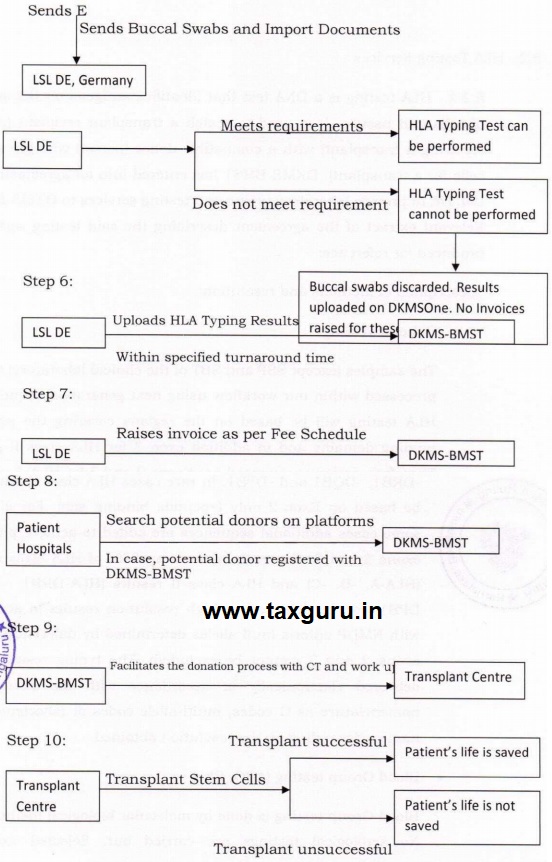
(a) The first and integral step of identifying the HLAs of potential donors by creating a registry/ database of potential donors: DKMS-BMST conducts various programs, campaigns, drives etc. to create awareness about the registry of potential blood stem donors maintained by it and the need for people to register with DKMS-BMST. Thus, in such awareness drives, educational drives etc., DMKS-BMST collects samples of buccal swabs / Human DNA from potential donors in India, marks each swab with a donor ID and sends these samples to LSL DE, Germany. To provide for the required HLA typing services, DKMS-BMST has entered into an agreement with LSL DE to conduct various kinds of HLA testing services. LSL DE performs tests on the samples received from DKMS-BMST. Once the tests are performed on the samples, the results of the same are shared by LSL DE through a software named DKMSOne India. DKMS-BMST shall download the said results from DKMSOne. Further, the results are also transferred to World Marrow Donor Association (‘WMDA’) and to HAP-E Search. While WMDA is a global organisation for anonymized listed donors where physicians can search for a potential match for their patients from a worldwide database of donors maintained by many similar organisations like DKMS-BMST, HAP E Search is a program owned and operated by DKMS for physicians to search for a match for their patients out of the database maintained by DKMS worldwide. On both platforms (WMDA and HAP-E Search), the donors from India are marked as DKMS India donors and linked to DKMS-BMST and the HLA testing conducted by LSL DE, DKMS-BMST maintains a register or database of donors, including but not limited to HLA typing data required for donor and patient matching which proves to be an extremely important database for a patient suffering from blood cancer or any blood disorder.
(b) Facilitating the Blood Stem Cell Donation process: If the tissue type of a potential donor matches with that of a patient, the following services are provided by DKMS-BMST for potential donors:-
a. Confirmatory Typing (CT) and
b. Work-Up (WU) process.
Confirmatory Typing Service: The HLA of the potential donor has to be confirmed again using a blood sample, which is taken from the donor. The donor’s HLA is again tested and re-confirmed. As part of the CT services, DKMS-BMST re-sends the buccal swabs of the said donor to LSL DE to reconfirm the tests before the transplantation and the results of the same are uploaded on DKMSOne along with a doctor signed report, Invoices are raised by LSL DE to DKMS-BMST for such Confirmatory Typing Services as well. Given that DKMS-BMST is a not for profit organisation, it recovers negligible amount towards such HLA typing services received from its overseas laboratory.
Work-Up Service: Additionally, to rule out any infectious diseases, which could potentially put the patient’s health at risk, the donor’s blood is tested for any infectious diseases such as hepatitis etc. After that, once the patient’s treating doctor selects the potential donor, the donor finally decides whether he / she would like to proceed with the blood stem cell donation. This is where the work-up process begins. DKMS-BMST provides work-up services to transplant centres in India and outside. This includes the co-ordination between blood stem cell donor, the collection centre (medical facility where the blood stem cell collection takes place) and the transplant centre (medical facility where a patient receives a transplant from an unrelated donor). A medical assessment of the donor follows to ensure that there are no risks to the donor or to the patient. If there are no risks then the donor is cleared and if he/she still wishes to proceed, the patient shall be prepared to receive the potentially life-saving stem cells. In order to ensure that the donot is able to donate enough blood-forming cells for the transplant, he/she will receive daily G-CSF injections (naturally occurring growth factor) for five consecutive days before the donation. The procedure is as under:

–
5.2. HLA Testing Services
5.2.1. HLA testing is a DNA test that identifies antigens on the surface of cells and tissues. It is used to match a transplant recipient (person receiving a transplant) with a compatible donor (person who gives their cells for a transplant). DKMS-BMST has entered into an agreement with LSL DE to provide laboratory typing and testing services to DKMS-BMST. Relevant extract of the agreement describing the said testing service is produced for reference:
“Description of methods and resolution: