GSTR-09-Guide, Incorporating the Latest Changes and FAQs, Easy to Grasp with Questionnaires and Pictorial Presentation
This guide focuses on clarifying complex and frequently misunderstood parts of GSTR‑9 rather than explaining every table. It compiles practical treatment, FAQs, and reconciliation logic so we can file confidently and defend our position during audit or assessment with robust working papers.
What GSTR‑9 is and why it exists
Understanding this question deepens our grasp of GSTR-9. GSTR-1 is used for reporting outward supplies, while GSTR-3B facilitates the availing of Input Tax Credit (ITC) and payment of tax. However, when filing GSTR-3B, we only report the credit availed—there is no provision for presenting carry-forward balances.
GSTR‑9 goes beyond a single year: it reconciles outward supplies and ITC for the reporting year, prior year spillover, and next year claims, so you often analyze at least three financial years simultaneously.
Tables 6 and 8 of GSTR-9 have been specifically designed for this reconciliation. According to the instructions, these tables should ideally reflect a zero difference for a perfect match. Yet, in practice, this rarely happens. Each year, when the government releases the GSTR-9 format, we are curious to know, whether this year we are able to report a perfect match as the assessing officer or government expects.
Despite several positive and welcome changes introduced over time, this year is also not the exception as we are unable to make the figure zero in this year too and we will find at the end of this article. However, we can significantly reduce the risk of litigation by maintaining robust and well-documented working papers.
If we file accurate particulars and reconcile all the differences that arise, I must say we won’t face any difficulties during audits or assessments. As the saying goes, “Precaution is better than cure.”
Now we move to our main question i.e., what is GSTR-09 and what is the primary document to report the figure in GSTR-09. Is it a sum of all GSTR-1, or 3B or sum of supply and ITC as per Books of Accounts.
Some people can argue that it is GSTR-3B, although data are exported through GSTR-1 but as the tax is discharged through GSTR-3B so it is the document based on GSTR- 9 should prepared then we have GSTR-09C for reconciliation of GSTR-09 and books of account. If the primary source of data is books of account, then there is no relevance of GSTR-09C.
CBIC explained this through Extract of Para (b) of Press Release 3rd July 2019 of CBIC- Primary data source for declaration in annual return: Time and again taxpayers have been requesting as to what should be the primary source of data for filing of the annual return and the reconciliation statement. There has been some confusion over using FORM GSTR-1, FORM GSTR-3B or books of accounts as the primary source of information. It is important to note that both FORM GSTR-1 and FORM GSTR-3B serve different purposes. While FORM GSTR-1 is an account of details of outward supplies, FORM GSTR-3B is where the summaries of all transactions are declared and payments are made. Ideally, information in FORM GSTR-1, FORM GSTR-3B and books of accounts should be synchronous, and the values should match across different forms and the books of accounts. If the same does not match, there can be broadly two scenarios, either tax was not paid to the Government or tax was paid in excess. In the first case, the same shall be declared in the annual return and tax should be paid and in the latter all information may be declared in the annual return and refund (if eligible) may be applied through FORM GST RFD-01A.
So based on the above discussion, we cannot conclude which is the primary source of data to prepare GSTR-09. So different sources of documents are required to report data in different tables. We should try our best to synchronize these three sets of documents and should avoid spillover transactions in outward supplies. Now we can understand reporting requirements in various tables with the help of below questions and answers-
Outward supply and liability
1. During 2023-24 I supplied some goods and forgot to report in the return filed (GSTR-1 and GSTR-3B) for the year. I have shown the supplies and GST in April, 2024 returns (GSTR-1 and GSTR-3B). Should I report these supplies in GSTR-09 of 2024-25?
Missed outward supplies of FY 2023‑24, reported in April 2024
Should they be reported in Table 4 of GSTR‑9 for FY 2024‑25? → NO
Correct treatment:
- Table 4 of GSTR‑9 captures outward supplies pertaining to that financial year, irrespective of when they were reported in GSTR‑1 or GSTR‑3B.
- Since the supplies belong to FY 2023‑24, they must be reported in GSTR‑9 of FY 2023‑24, even though you disclosed them in April 2024.
Where do they appear in GSTR‑9?
- Table 10 → Since you reported them in the next FY (April 2024), the system expects them to be disclosed as “Additions made during April–October of next FY”.
√ Conclusion:
You should NOT report these supplies in GSTR‑9 of FY 2024‑25.
They must be reported in GSTR‑9 of FY 2023‑24 (Tables 10).
Note: As in question no. 01, we got the answer as not to report this transaction in table no. 4 of GSTR-09 of FY 2024-25 but table number 9 of GSTR-09 will capture the data from GSTR-3B with respect to GST liabilities and payment and this table will have the GST payable and paid of this transaction so it will mismatched with liabilities reflected in table 5N of GSTR-09 and table 9 of GSTR-09.
Tax payable in table 9 is an editable field and tax paid is non- editable. We should reduce this tax liability from tax payable and then difference at the end of this table will appear as negative values. This is acceptable as we have already declared this liability in previous year table 10 of GSTR-09. So, we can reconcile the liability by adding table 4 of the current year with table 10”+” and 11 “-“ of the Previous year. This is exactly how the form has been designed.
2. During 2024-25, I supplied some goods and forgot to report in the return filed (GSTR-1 and GSTR-3B) for the year. I have shown the supplies and GST in April 2025 returns (GSTR-1 and GSTR-3B). Should I report these supplies in GSTR-09 of 2024-25?
Based on the principle understood in question no. 01, it is reportable in table no. 10 of the current year GSTR-09.
3. During 2024-25, I supplied some goods and forgot to report in the return filed (GSTR-1 and GSTR-3B) for the year. While reconciling the values at the time of filing the annual return, I have noticed the issue. Should I report these supplies in GSTR- 09 of 2024-25.
If a supply is left to be reported then we can report it in a future period GSTR-1 and GSTR-3B till the 30th November of the following year and this is the most appropriate way to report the supply so our recipient can get the credit through GSTR-1. But if the deadline is over, we can add this liability in our GSTR-09 as well and in this case, we have to report these supplies in table 4 of GSTR-09 of 2024-25 and should discharge the liabilities in cash through DRC-03.
So, if the supply of the current year has been reported freshly in GSTR-9 it would be part of table-4 or if it is reported through GSTR-3B and GSTR-1 in the coming year till 30th November, it would be part of table 10.
Further there is one important principle that we can add liability or reduce ITC through GSTR-09 and pay the difference through DRC-03. But we cannot reduce liability and claim excess credit through GSTR-09. It will only be possible through regular return i.e., GSTR-3B.
Inward Supply and Input Tax Credit
There are few new tables have been inserted from FY 2024-25 onwards and CBIC has issued two FAQs dated 16-10-2025 and 04-12-2025 to understand the reporting requirement of these tables. But before we move to the reporting requirement of these tables of ITC in GSTR-09, we should first understand the important terms related to input tax credit as reversal and reclaim.
Input Tax Credit (ITC) Reversal and Reclaim under GST
1. Permanent Reversal
These reversals are non-reclaimable and arise due to ineligible credits under Section 17(5) of the CGST Act, reversal under Rule 38, reversal under Rule 42 and reversal under Rule 43.
2. Temporary Reversal
These reversals are conditional and may be reclaimed upon fulfilment of certain criteria. They are further divided into two categories:
A. By Law (Statutory Rules)
| Rule | Description | Reclaim Conditions |
|---|---|---|
| Rule 37 | ITC reversal if payment to supplier is not made within 180 days from the invoice date. | ITC can be reclaimed once payment is made to the supplier. |
| Rule 37A | ITC reversal if the supplier fails to file GSTR-3B by 30th September following the financial year. | ITC can be reclaimed once the supplier files GSTR-3B for the relevant period. |
B. By Circular (Clarificatory)
| Circular | Description | Reclaim Conditions |
|---|---|---|
| Circular No. 170/02/2022-GST (Dated 6 July 2022) | Clarifies treatment of ITC in cases where supplier has filed GSTR-1 but due to non-receipt of goods and invoice, recipient reverses the credit. ITC should be reversed and can be re-availed after receiving the goods and invoice. | Reclaim allowed post-receipt of goods and invoice. |
Summary Table
| Type | Legal Reference | Reversal Nature | Reclaimable? | Time Limit of reclaiming |
|---|---|---|---|---|
| Permanent | Section 17(5), Rule 38, Rule 42 and Rule43 | Non-reclaimable | × No | NA |
| Temporary | Rule 37 | Conditional | √ Yes | No restriction, can be claimed anytime |
| Temporary | Rule 37A | Conditional | √ Yes | No restriction, can be claimed anytime |
| Temporary | Circular 170 | Clarificatory | √ Yes | Till the time prescribed under section 16(4) i.e., November of the following year |
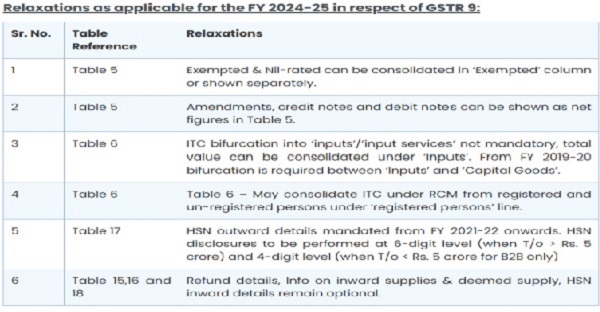
Here’s a comprehensive, breakdown of table related with ITC of GSTR-9. Each section includes:
- What to report
- What not to report
- Examples and clarifications
Table 6A1 – ITC of Preceding FY Availed in Current FY (which is included in 6A above) other than ITC reclaimed under Rule 37 and Rule 37A i.e., ITC of 2023-24 availed in 2024-25
There are three conditions to be satisfied before reporting data in Table 6A1-
1. ITC of Preceding FY Availed in Current FY
2. It must be included in Table 6A
3. Other than ITC reclaimed under Rule 37 and Rule 37A
I have divided the ITC of the preceding financial year, claimed in the current financial year, into four categories for ease of understanding:
1. ITC of the previous FY claimed in the current FY due to late entry of tax invoices in the books,
2. ITC claimed due to Rule 37 and Rule 37A,
3. ITC related to goods in transit as on 31.03.2024, and
4. ITC claimed due to late reporting in GSTR-1 by the supplier.
Due to late entry in books- credit of FY 2023-24 has been recorded in books of accounts after filing return of March 2024. Credit has been taken in GSTR-3B in 2024-25. So, it is part of Table 6A, this is previous year ITC and it is not the ITC of Rule 37 and 37A so report this in table 6A1.
Due to Rule 37 and Rule 37A- excluded apparently and hence not reportable in table 6A1.
Due to goods in transit as on 31‑03‑2024, these figures were first reported in GSTR‑3B of 2023‑24, then reversed in 2023‑24, and subsequently reclaimed in 2024‑25. Accordingly, these figures are included in Table 6A. This represents the previous year’s ITC and does not pertain to ITC under Rule 37 or Rule 37A. Therefore, it should be reported in Table 6A1.
Due to the late filing of the 2023–24 return by the supplier, the supplier reported the invoice dated 25‑03‑2024 in his GSTR‑1 of April 2025. These figures should have been reported for the first time in GSTR‑3B of 2024–25. Since the supplier has reported these figures and credit has been availed in FY 2024-25, they are also included in Table 6A. Accordingly, the same should be reported in Table 6A1.
What to Report
- ITC of FY 2023–24 claimed in FY 2024–25 (excluding Rule 37/37A cases)
What Not to Report
- ITC reclaimed under Rule 37/37A → goes to Table 6H
- ITC of current FY
Table 6B – Inward Supplies (Other Than Imports and RCM)
What to Report
- Original ITC claim for the current FY
- Includes services from SEZs
What Not to Report
- Reclaimed ITC → goes to Table 6H
- Reversed ITC → goes to Table 7
Table 6H – Amount of ITC Reclaimed Under the Provisions of the Act
What to Report
- ITC reclaimed in the same FY after reversal due to:
- Rule 37 (non-payment to supplier within 180 days)
- Rule 37A (similar reversal conditions)
- Circular No. 170/02/2022-GST (e.g., goods not received)
- ITC reclaimed of the previous FY only if the reclaim is due to Rule 37/37A
What Not to Report
- ITC reclaimed in the next FY not due to Rule 37/37A (e.g., missed claim, supplier delay)
- These go to Table 13 (current FY) and Table 6A1 (next FY)
- ITC of the preceding FY reclaimed in the current FY for reasons other than Rule 37/37A → goes to Table 6A1
- ITC already reported in Table 6B (original claim) or Table 7 (reversal)
Examples
- Same FY reclaim:
- Claimed in April 2024, reversed in October 2024 (Rule 37), reclaimed in March 2025 → Report in Table 6H
- Next FY reclaim due to Rule 37/37A:
- Claimed and reversed in FY 2024–25, reclaimed in FY 2025–26 → Report in Table 6H of FY 2025–26
- Next FY reclaim NOT due to Rule 37/37A:
- Claimed and reversed in FY 2024–25, reclaimed in FY 2025–26 → Do NOT report in Table 6H
Table 7 – ITC Reversals
What to Report
- Reversals due to:
- Rule 37 → Table 7A
- Rule 37A → Table 7A1
- Other reasons → Table 7H like Circular no. 170
Table 8A – ITC as per GSTR-2B
Differences between GSTR-2B, Table 8A (Online) of GSTR-9, and Table 8A (Offline/Excel) of GSTR-9 for FY 2024–25-
Comparison Table: GSTR-2B vs Table 8A (Online) vs Table 8A (Offline)
| Feature / Aspect | GSTR-2B | Table 8A (Online) of GSTR-9 | Table 8A (Offline/Excel) of GSTR-9 |
|---|---|---|---|
| Purpose | Static auto-drafted statement for ITC | Auto-populated summary of eligible ITC for GSTR-9 | Invoice-level details supporting Table 8A (Online) |
| Source of Data | Supplier’s GSTR-1/IFF, GSTR-5, GSTR-6 | GSTR-2B of FY 2024–25 + April–Oct 2025 | Same as Online, but includes additional records |
| Time Period Covered | Monthly basis for FY 2024–25 | FY 2024–25 + invoices of 24-25 reported by supplier from Apr–Oct 2025 (next FY) | Same as Online, but includes amendments and edge cases |
| Includes Amendments? | Yes, if reflected in GSTR-2B | Yes, if reflected in GSTR-2B and pertain to FY 2024–25 | Yes, even if amendments shift invoice to another FY |
| Includes RCM (Reverse Charge Mechanism)? | Yes | No | Yes (appears in Excel but excluded from Online) |
| Includes Ineligible ITC? | Yes, with eligibility flags | No (filtered to eligible ITC only) | Yes, with eligibility flags (e.g., POS mismatch) |
| Invoice-Level Details? | Yes | No (summary only) | Yes (invoice-wise with B2B/B2BA sections) |
| Visibility of Supplier Amendments | Reflected if within GSTR-2B window | Reflected if invoice remains in FY 2024–25 | Reflected even if invoice date shifts FY |
| Impact of IMS Dashboard Actions | Indirect (accepted records appear in GSTR-2B) | Reflected via GSTR-2B → Table 8A | Same as Online |
| Availability | Monthly via GST portal | Auto-populated in GSTR-9 | Downloadable Excel from GSTR-9 dashboard |
| Use in GSTR-9 Filing | Basis for ITC reporting | Used for Table 8A auto-population | Reference for verifying Table 8A entries |
Key Insights
- GSTR-2B is the foundational document for ITC claims and drives Table 8A population.
- Table 8A (Online) is a filtered, system-generated summary of eligible ITC from GSTR-2B.
- Table 8A (Offline/Excel) provides granular invoice-level data, including edge cases and amendments not reflected in the Online version.
Notes:- What is the use of offline data of GSTR 8A?
1. It will help to identify transactions entries for reconciling the difference between GSTR 8A and credit actually claimed in GSTR 3B.
2. We will get the figure of GSTR-09 table 8A online figure by removing RCM transactions, amendments, different POS entry from GSTR-09 table 8A offline transactions.
3. At the end after reconciling, we will have the ITC difference of invoices of FY 2023-24 availed in GSTR 3B due to late filing of return by suppliers.
4. Despite of making these changes in GSTR-9, we still have some differences due to this shortcoming not taken care of and will be discussed later part of this article.
What to Report
- Invoices/DN/CN of FY 2024–25 appearing in GSTR-2B of:
- FY 2024–25
- FY 2025–26 (April–October 2025)
What Not to Report
- Invoices of FY 2023–24 appearing in GSTR-2B (April–October 2024)
Table 8B – ITC as per Table 6B
What to Report
- Auto-populated from Table 6B only
What Not to Report
- ITC from Table 6H (reclaimed ITC)
Table 8C – ITC of Current FY availed in Next FY up to the specified period
Table 8 is a reconciliation of GSTR‑2B/8A and ITC as per Table 8B. The purpose of Table 8C is to eliminate differences by removing entries that appear in 8A but not in 8B, i.e., missed credit or excess credit for which ITC has been availed in FY 2025‑26. In other words, certain GSTR‑2B entries of FY 2024‑25 have appeared in FY 2025‑26. We can categorise the ITC here as well as here under:
Due to late reporting in GSTR‑2B – Yes, reportable in 8C. These invoices do not form part of GSTR‑2B of 2024‑25, but since they are included in 8A, they will form part of 8C. Example: invoices of 2024‑25 reported by suppliers in GSTR‑1 of 2025‑26.
Due to late entry in books – Yes, reportable in 8C. For instance, an invoice dated 25‑03‑2025 was reported timely by the supplier in March 2025, but the recipient recorded it late in his books of account (after filing the March 2025 return). This creates a difference, so it must be reported in 8C.
Due to Rule 37 and Rule 37A – No, because these entries do not appear in either 8A or 8B.
Goods in transit as on 31‑03‑2024 – These appeared in FY 2023‑24 GSTR‑2B and Table 6A1, not in Table 6B. Hence, they are not part of 8A or 8B and will not be reported in 8C.
Goods in transit as on 31‑03‑2025 – These appeared in FY 2024‑25 GSTR‑2B and are also part of Table 6B entries (first availed and then reversed). Therefore, they will not be reported in 8C.
Return of invoices of 2024‑25 filed after March 2025 by suppliers – Reportable in 8C, because these entries are included in Table 8A (excessive compared to 2A) but not in Table 8B, as credit was taken at the time of filing by suppliers. These create differences and must be specifically reported in 8C.
What to Report
- Missed ITC of FY 2024–25 claimed in FY 2025–26 (first-time claim)
- Supplier reported invoice in next FY (April–October 2025)
What Not to Report
- ITC claimed and reversed in FY 2024–25 and reclaimed in FY 2025–26 i.e GIT as on 31.03.2025→ goes to Table 13 (This is the major difference between 8C and 13.)
Table 8D – Difference Between 8A and (8B + 8C)
Notes
- Delinking Table 6H from 8B helps avoid mismatches
- Reclaimed ITC not in GSTR-2B → not in 8A or 8C
Table 8D Continue-
Ideally, the value in Table 8D should be positive or zero, since not all inward supplies reported in Form GSTR‑2B may be availed as ITC in Form GSTR‑3B due to non‑compliance with the conditions outlined under Section 16 of the CGST Act, 2017. Therefore, the values in this table should generally reflect a positive or zero figure.
If the differential value in Table 8D is positive or zero, it is considered normal. Conversely, a negative differential value indicates anomalies that require further investigation. To address such discrepancies, it is essential to prepare detailed working sheets based on the inward supply register to identify the exact cause of the difference. This enables appropriate remedial actions either by the registered person or by their suppliers.
It is crucial for the registered person to consider the possible ramifications of a negative value in Table 8D. Tax authorities may initiate inquiries if such discrepancies are observed, but no adverse action will be taken without providing the registered person an opportunity to explain. Hence, it is advisable to maintain proper documentation and a clear explanation for any differences appearing in Table 8D of Form GSTR‑9.
Factors creating differences in Table 8D:
1. Reversal of ITC under Section 17(5):
In cases of reversal under Section 17(5), ITC is first availed and then reversed. There may be instances where ITC has been reported even though the supplier has not filed the return. Such entries should be identified and incorporated in the reconciliation statement.
2. Excess reversal through credit notes compared to GSTR‑2B:
In many cases, the reversal made by the recipient is greater than the amount reported by the supplier in the GST return.
These are the possible reasons for mismatches in Table 8D.
Table 13 – ITC Availed in Next FY
This table description is not as clear as Table 6A1. As per the instructions of Form GSTR‑9, ITC reclaimed under Rule 37/37A is not reportable here. The same concept applicable to Table 6A1 applies to this table as well. Table 13 of the current year will correspond to Table 6A1 of the following year’s GSTR‑9. Accordingly, we will apply the same logic here:
- Due to late reporting in GSTR‑2B – The supplier reported the invoice dated 10‑03‑2025 in GSTR‑1 of April 2025. Yes, this is reportable in Table 13.
- Due to late entry in books – The recipient received an invoice dated 25‑03‑2025 but failed to record it. Later, after filing the GSTR‑3B for March 2025, the invoice was noticed and recorded in FY 2024‑25. This is reportable in Table 13.
- Due to Rule 37 and Rule 37A – Not reportable, as per the instructions of Form GSTR‑9.
- Due to goods in transit as on 31‑03‑2025 – These figures are reportable in Table 13.
What to Report
- ITC of FY 2024–25 claimed in FY 2025–26 (not due to Rule 37/37A)
- This figure will go to table 6A1 of FY 2025-26
What Not to Report
- ITC reclaimed under Rule 37/37A → goes to Table 6H of next FY
ITC on Goods in transit as on 31.03.2025 claimed up to the specified period will reportable here.
Here’s a crisp summary for difference between Table 8C and 13:
- Table 8C → Shows ITC that appeared in GSTR‑2B during the year but was not claimed in GSTR‑3B of the same year (missed credit).
- Table 13 → Shows ITC of the previous year that was actually claimed in the next year as per GST provisions.
In short: 8C = Missed in the year, 13 = Claimed later in the next year.
ITC claimed and reversed in FY 2024–25 and reclaimed in FY 2025–26 i.e GIT as on 31.03.2025→ goes to Table 13 (This is the major difference between 8C and 13.
Pictorial presentation of spill over ITC
ITC Particulars Across Tables
| Particulars | Table6A1 | Table8C | Table13 |
|---|---|---|---|
| ITC of Goods in Transit (GIT) as of the beginning of the year (Reclaim) | ✓ | NA | NA |
| ITC on Return pending of the beginning of the year (Original claim) | ✓ | NA | NA |
| Due to late entry in books (Original claim) | ✓ | ✓ | ✓ |
| Due to Rule 37 and Rule 37A (Reclaim) | ✗ | ✗ | ✗ |
| ITC of GIT as of the ending of the year (Reclaim) | NA | ✗ | ✓ |
| ITC on Return pending of the ending of the year (Original claim) | NA | ✓ | ✓ |
Now let’s revise all the important concept of ITC with the help of below questions and answer-
1. During 2023-24 I forgot to report ineligible credit in the return filed (GSTR-3B) for the year. I reported this reversal in GSTR-3B filed for April, 2024. Should I report this reversal in table 7 of GSTR- 09 of 2024-25.
Ineligible ITC of FY 2023‑24 reversed in April 2024
Should this reversal be reported in Table 7 of GSTR‑9 for FY 2024‑25? → NO
Correct treatment:
- Table 7 of GSTR‑9 captures ITC reversals relating to that financial year, regardless of when the reversal was actually made.
- Since the ineligible ITC pertains to FY 2023‑24, the reversal belongs to GSTR‑9 of FY 2023‑24.
Where do they appear in GSTR‑9?
- Table 12 → Since the reversal was made in April 2024, it is disclosed as ITC reversed after the end of FY but relating to that FY in GSTR-09 of FY 2023-24.
Conclusion:
You should NOT report this reversal in GSTR‑9 of FY 2024‑25.
It must be reported in GSTR‑9 of FY 2023‑24 (Tables 12).
2. Q No 02 of FAQ dated 04-12-2025
Ineligible ITC of 23-24, availed in FY 24-25 (Table 4A5 of GSTR 3B) and same was reversed in FY 24-25 (Table 431 of GSTR 3B). According to instructions of GSTR 9, we have to report ITC availed of last year FY 2023-24 in Table 6A1 of GSTR 9 of FY 202425 i.e. I can report ineligible ITC availed in Table 6A1 but there is no mention of how to show ITC of 23-24 reverse in 24-25 in table 7.
Ans as per FAQ-
“The ITC claimed for FY 2023-24 in the FY 2024-25 needs to be reported in 6A1. However, ITC reversal of FY 2023-24, reported in GSTR 3B of FY 2024-25, need not to report in the Table 7 of GSTR 9 of 2024-25. Table 6B to table 6H and Table 7A to table 7H will contain the details of ITC for the current year only (2024-25).”
It results excess credit in table 7J of FY 2024-25. Which can be reconciled with table 12 of previous year GSTR-09. This is the way form 9 has been designed.
3. Q No 04 of FAQ dated 04-12-2025
Table 7J of GSTR 9 does not consider 6A1 and therefore the amount in Table 7J does not match with the Table 4C of GSTR 3B of FY 2024-25.
Ans as per FAQ-
“Table 4C of GSTR 3B may contain the ITC of FY 2023-24 claimed or reversed in FY 2024-25. However, the Table 7J of GSTR 9 shows the net ITC pertaining to the current FY only (2024-25). Therefore, there it may create differences between Table 4C o GSTR 3B and Table 7J of GSTR 9, in cases where ITC o preceding FY (2023-24) was reported in GSTR 3B of current (i.e. 2024-25).”
So, there is no issue of having this difference and this may also create difference in auto populated ITC in table 9 of GSTR-09. We should have proper reconciliation and documentation for these differences for submission at the time of scrutiny and audit.
4. Q No 03 of FAQ dated 04-12-2025
Table 12B “ITC booked in earlier Financial Years claimed in current Financial Year” of GSTR-9C for FY 2024-25 becomes reductant as Table 7J of GSTR 9 of FY 2024-25 does not consider the ITC of FY 2023-24 claimed or reversed in FY 24-25.
Ans as per FAQ-
“Table 12B capture the ITC booked in earlier FY and claimed in current FY. Therefore, this amount will neither appear in Table 12A nor in Table 12E. Hence it appears that this FY, this may create a mismatch. However, in case of any differences in Table 12F of GSTR 9C, taxpayers may provide the reason for un-reconciled difference in ITC in Table 13 of GSTR 9C.”
Before concluding the answer to this question, it is important to understand that ITC of the previous year claimed in the current year may differ with reference to GSTR‑9 and GSTR‑9C.
For example, suppose I purchased goods on an ex‑factory basis on 31‑03‑2025. Under this arrangement, the buyer bears all expenses and risks from the seller’s premises onward. Although the goods were received at my factory on 01‑04‑2025, I recorded the transaction in my books in FY 2024‑25 as per the applicable accounting standards.
Thus, the invoice was raised in 2024‑25, the purchase was recorded in 2024‑25, but the ITC was availed in 2025‑26 due to the receipt of goods in that year.
- In reference to GSTR‑9, this is treated as ITC of the previous year claimed in the current year and is therefore reportable in Table 6A1 of GSTR‑9 for FY 2024‑25.
- In reference to GSTR‑9C, this is treated as ITC booked in an earlier financial year but claimed in the current financial year.
If this transaction is on an FOR basis, then it will be recorded in FY 2025‑26. In such a case, it is not ITC booked in earlier financial years and claimed in the current financial year, and therefore it is reportable in Table 12A of GSTR‑9C for FY 2025‑26.
Thus, there is no fixed reply to this query. Each transaction must be understood in its proper context, reported accordingly, and reconciled.
Furthermore, in response to this question, it has not been stated that data should not be reported in Table 12B. The CBIC has acknowledged the possibility of differences and suggested that reasons for unreconciled differences be reported in Table 13. Therefore, data should also be reported in Table 12B.
Table 12B refers to “ITC booked in earlier financial years but claimed in the current financial year” in the books of account. The reporting requirement in GSTR‑9 does not alter the method of maintaining books of accounts. Hence, data should be reported here as well, with reconciliation maintained for any differences.
*****
If you have any queries, you can reach the author (CA Aakash Gupta) by email at [email protected].
Disclaimer: The views and opinions expressed in this article are those of the author. This article is intended for general information purposes only and does not constitute professional advice. Readers are strongly advised to consult a qualified professional for guidance specific to their individual situation before making any financial, legal, or tax-red decisions. The author shall not be held liable for any loss or damage of any kind incurred as a result of the use of this information or for any actions taken based on the content of this article.