Evolving the Steel Import NOC Ecosystem: A Partnership Between Business and Policy for a Stronger Tomorrow
The recent developments surrounding India’s Steel Import Monitoring System (SIMS) and the mandatory No Objection Certificate (NOC) process have stirred widespread concern across the steel industry, especially among importers, stockists, project developers, and downstream users. What began as a regulatory mechanism aimed at quality assurance and capacity building has now created layers of procedural complexity, causing operational uncertainty and commercial disruption.
The main issue comes from a system of procedures that, while well-intentioned, appears increasingly detached from operational realities. Under the current regulatory construct, steel importers are obligated to secure either a Bureau of Indian Standards (BIS) certification for their imported grades or, in cases where no Indian Standard exists, obtain a NOC from the Ministry of Steel via the SIMS portal. While theoretically straightforward, this binary compliance model is plagued by delays, duplications, and ambiguity.
The Ministry of Steel mandates that NOC applications must be filed for projected imports covering a six-month horizon, based on specific grades, origins, and end uses. However, under the revised SIMS notification effective 20 June 2025, importers must now submit their registration and initiate the NOC application process no later than seven days before the expected arrival of the consignment at Indian ports. While this amendment ensures that the Ministry has sufficient time for pre-arrival scrutiny, it also requires importers to be far more disciplined in planning, typically starting the process at least 15–20 days in advance. This shift is a welcome move toward regulatory clarity and predictability. However, it also means there is little room for procedural or documentation delays, making it imperative that all stakeholders coordinate efficiently to avoid supply chain disruptions.
Further complicating the process, is the requirement of regret letters from domestic steel manufacturers. These letters serve as documentary evidence to establish that the required steel grade is not available locally, thereby justifying the import. But in practice, most major Indian mills are either unresponsive or unwilling to issue regret letters, citing production feasibility or strategic interests. This results in a regulatory deadlock where the importer is unable to comply through either route—BIS or NOC—leading to shipment holds, demurrage costs, and commercial losses.
The recent merger of SIMS with the BIS Technical Committee QCO Portal has added another layer of complexity. Importers now have to resubmit documentation for previously filed applications, including test reports, mill certificates, and transaction records. This data redundancy not only increases administrative burden but also slows down the approval cycle, defeating the very purpose of creating a seamless digital interface.
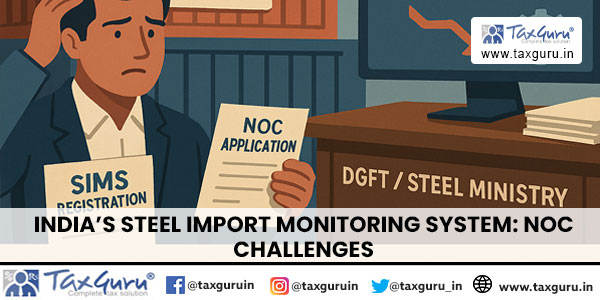
What has truly brought the situation to a tipping point is the lack of system-wide transparency and accountability. There are reports of arbitrary rejections, unexplained delays, and inconsistent application of norms by different evaluating officers. The appeal mechanism that has now been introduced on SIMS, though a welcome development, remains underutilised primarily due to lack of awareness and procedural opacity.
The situation is even more paradoxical when seen from the lens of exporters. Steel imports that are intended for re-export under schemes like Advance Authorisation or EPCG should, in principle, be exempt from the rigorous NOC regime. While the Ministry has now acknowledged this exemption pathway, on-ground enforcement remains patchy and inconsistent.
The regulatory pressure has created a chokepoint. Delays at ports are leading to significant demurrage and detention charges. Supply chain disruptions are becoming a regular feature. Projects that depend on time-bound delivery of imported steel grades—whether in infrastructure, automotive, or energy sectors—are facing schedule slippages and cost overruns. And perhaps most critically, SMEs who lack the legal and administrative bandwidth to navigate this evolving framework are finding themselves locked out of competition altogether.
To its credit, the Ministry of Steel has acknowledged the industry’s grievances and has scheduled an Open House interaction with stakeholders to gather direct inputs. A significant stakeholder meeting was recently convened, bringing together around 20 representatives from various companies, along with senior officials, including the Hon’ble Joint Secretary, Deputy Secretary, and other delegates from the Ministry. An industry colleague, who attended the meeting, shared their firsthand insights on the key discussions and takeaways. Their insights have helped us understand and reflect on the broader observations, expectations, and practical implications now emerging across the regulatory framework. The agenda of the meeting was to openly discuss the challenges related to the Steel Import Monitoring System (SIMS), the procedural aspects of obtaining No Objection Certificates (NOCs), and the wider compliance framework connected to BIS standards.
Insights from the Meeting: Key Takeaways for Industry
Available Compliance Routes: The Ministry reiterated two clear compliance routes—either secure a No Objection Certificate (NOC) specifically for non-BIS certified grades, or source directly from BIS-certified suppliers.
Logistics and Port Clearance Pressures: Stakeholders expressed concern over the rigid requirement to submit SIMS registration and NOC applications at least seven days before shipment arrival. They noted that despite early submission, delays in documentation or Ministry processing could still lead to clearance challenges and shipment detention—particularly for SMEs and EPC contractors.
Planning and Procurement Preparedness: The Ministry advised that procurement planning must include sufficient lead time for regulatory approvals. Businesses were encouraged to treat the NOC and SIMS registration timelines as integral parts of their sourcing process, rather than post-facto formalities.
Challenges in Establishing Non-Availability: One area that drew particular discussion was the insistence on obtaining regret letters from domestic manufacturers. These are used to demonstrate that a particular grade is not available locally, justifying the import request. The Ministry explained that this safeguard ensures NOCs are issued only in genuine cases of non-availability.
Treatment of Export-Oriented Imports: The Ministry acknowledged that for goods intended for re-export under Advance Authorisation or EPCG, supporting documentation may be submitted in lieu of regret letters to seek exemption or fast-track clearance. While this policy direction is welcome, clarity and uniform implementation will be key to avoiding discretion-led delays.
Appeal and Grievance Redressal Provision: The Ministry has enabled a dedicated appeal function on the SIMS portal for rejected applications. Stakeholders welcomed this step, noting that it would be particularly helpful where regret letters are unavailable or a rejection has been issued without adequate justification.
Processing Timelines and Ministry Assurance: The Ministry shared that no application was pending with them for more than 15 days, and committed to maintaining a consistent and transparent processing timeline going forward.
Policy Direction and Institutional Standpoint: The meeting concluded with a strong message—businesses must engage proactively with compliance, explore domestic supply options, and submit documentation that is complete and justified. At the same time, the government is committed to refining the system through consultation and feedback.
These observations made during the meeting were not intended to restrict trade, but to build a robust, responsible import ecosystem.
To understand how the current framework evolved into what many describe as a ‘havoc’ for importers, we must trace the convergence of three key elements: the rising scope of Quality Control Orders (QCOs), the introduction of stricter NOC processes under the SIMS regime, and increasing pressure to demonstrate domestic non-availability through documentation such as regret letters. While each of these initiatives individually aligns with India’s vision of promoting high-quality imports and domestic self-reliance, their simultaneous enforcement—without uniform guidance or transition planning—created compliance strain.
As BIS standards expanded across more steel product categories, importers were required to either switch to BIS-certified supply chains or justify imports of non-standard grades through the NOC route. But the NOC mechanism, introduced to safeguard legitimate imports, soon became weighed down by procedural complexity, documentation bottlenecks, and inconsistencies in interpretation. The requirement of regret letters, while conceptually sound, proved nearly impossible to fulfil in many niche or low-volume use cases, particularly where Indian manufacturers neither confirmed nor clearly denied supply capability. As discussed earlier, the absence of a formal mechanism for regret letter issuance continues to leave importers uncertain and vulnerable.
Moreover, the shift to a firm 7-day advance submission rule for SIMS registration under SIMS 2.0, the revamped monitoring platform introduced by the Ministry, while helpful in establishing a clear compliance boundary, has significantly raised the stakes for timely planning. Even minor delays—whether in documentation readiness or Ministry side processing—can leave consignments stranded at ports. As volumes have increased and expectations from the portal have expanded, the absence of an integrated digital interface for automated decision-making or real-time status tracking has only added to the operational burden for importers.
This convergence of policy ambition and administrative overload gradually led to a slowdown in clearance efficiency, particularly for SMEs and custom fabricators who rely on timely access to specialised inputs. The so-called ‘havoc’ is therefore not the result of a flawed intent, but rather reflects an operational misalignment between ambitious regulatory goals and on-ground administrative preparedness.
It is precisely this context that makes the Ministry’s recent outreach—through stakeholder meetings, appeal mechanisms, and Open House formats—a necessary and welcome correction. Recognising the problem is the first step to solving it. The challenge now lies in translating these acknowledgements into procedural clarity, predictable timelines, and system-wide capacity building. From our perspective, the real challenge lies in the practical ability of businesses—especially small importers and exporters—to comply with some of these conditions.
The requirement to obtain a regret letter, for example, becomes a logistical hurdle when no formal mechanism exists for standardised responses from domestic producers. In some cases, suppliers may indicate theoretical capability to supply, but without committing to quantity, quality, or delivery timelines. This ambiguity—where a regret letter is unavailable and yet the BIS route is not applicable—puts the importer at risk of non-compliance despite genuine intent. The resulting delays in port clearance create financial strain, break trust with overseas suppliers, and disrupt downstream project commitments.
Similarly, while the SIMS portal now allows an appeal route, many importers are still unaware of the mechanism, the documents needed, or the grounds that are considered valid. Capacity-building in this area—through advisory sessions, helpdesks, or industry body collaborations—will go a long way in reducing rejection rates and increasing confidence in the system.
We believe that the policy direction is sound, and the Ministry’s responsiveness is both timely and welcome. However, smoother implementation will depend on: (a) a standard digital template for regret submissions, (b) structured timelines for domestic responses, and (c) auto-processing of repeat NOC requests for the same grade from the same importer where conditions remain unchanged.
It is also important that exporters operating under valid EPCG or Advance Authorisation licences are provided with a predictable exemption route—one that is recognised across regional offices and customs stations. Documentation should be verified upfront but not be subject to interpretative discretion at every step.
Ultimately, the success of the NOC ecosystem depends on mutual empathy. The Ministry has shown openness to consultation and policy evolution. Industry, in turn, must respond with transparency, accountability, and a willingness to engage in structured compliance.
As we move forward, we must shift our collective focus—from procedural friction to productive alignment. Just like steel, systems too must be forged with strength, tempered by flexibility, and shaped through collaboration. If that becomes the foundation of this ecosystem, India’s journey to becoming a global manufacturing powerhouse will only accelerate.
The steel industry has always symbolised strength and resilience. Let us ensure that the regulatory systems supporting it become equally robust—designed not just to control, but to enable responsible and strategic growth.
*****
Disclaimer: The views expressed in this article are personal and intended for general informational purposes only. They do not constitute legal advice. RSA Legal Solutions shall not be held liable for any decision or action taken based on the contents of this article without seeking a formal opinion from a qualified professional. For feedback or clarifications, please write to us at [email protected].