Rasrasna Foods Pvt Ltd Vs C.C.-Mundra (CESTAT Ahmedabad)
ThThe brief facts of the case are that the appellant had imported a consignment of Sajji Khar at Mundra Port under warehousing Bill of entry No.6272028 dated 28.12.2019. On 16.01.2020. The FSSAI authority certified that the appellant holds FSSAI license and the sample conforms to the standards laid down. On filing of Ex-Bond Bill of entry dated 30.06.2020 by the appellant for clearance of the goods of the warehouse, a show cause notice dated 14.08.2020 was issued proposing confiscation of the goods under Section 111(d) on the ground that as per FSSAI letter dated 19.03.2020, Sajji Khar was a non-specified product and approval under Non-Specified Food Regulations of 2017 was required . The adjudicating authority vide Order-in-Original No.MCH/ADC/AK/87/2020-21 dated 11.11.2020 confiscated the goods under Section 111(d) and allowed re-export of the goods on payment of redemption fine of Rs.5 Lacs in lieu of confiscation, healso imposed a penalty of Rs.2.5 Lacs under Section 112(a) on the appellant. Being aggrieved by the Order-in-Original, passed by the learned Additional Commissioner of Customs, Mundra, the appellant preferred an appeal to the Commissioner of Customs (Appeals) Ahmedabad. The learned Commissioner (Appeals) vide Order-in-Appeal No.MUN-CUSTM-000-APP-008-21-22 dated 27.04.2021, rejected the appeal. Being aggrieved by the impugned Order-in Appeal, the appellant preferred the present appeal.
CESTAT observed that CBIC directive issued on 21.05.2020 regarding the compliance of FSS (Approval of non-specified food and food ingredients) Regulations, 2017 whereas the Bill of entry for warehousing of goods was filed on 28.12.2019 and also the import has taken place much before the instruction dated 21.05.2020. In my view the instruction dated 21.05.2020 cannot be applied retrospectively. It is a settled law that any condition is imposed on the import shall not apply to the import already originated from the port of shipping. In the present case also the instruction dated 21.05.2020 was issued much after not only the import of goods but also after filing of warehousing Bill of entry. It is also undisputed fact that the same product i.e. Sajji Khar has been allowed to be imported without the condition as imposed by the department in the present case on the earlier occasions by various importers.
As per my above discussions and findings, I am of the view that the goods are not liable for confiscation. Accordingly, the impugned order is set aside. Appeal is allowed with consequential relief.
FULL TEXT OF THE CESTAT AHMEDABAD ORDER
The brief facts of the case are that the appellant had imported a consignment of Sajji Khar at Mundra Port under warehousing Bill of entry No.6272028 dated 28.12.2019. On 16.01.2020. The FSSAI authority certified that the appellant holds FSSAI license and the sample conforms to the standards laid down. On filing of Ex-Bond Bill of entry dated 30.06.2020 by the appellant for clearance of the goods of the warehouse, a show cause notice dated 14.08.2020 was issued proposing confiscation of the goods under Section 111(d) on the ground that as per FSSAI letter dated 19.03.2020, Sajji Khar was a non-specified product and approval under Non-Specified Food Regulations of 2017 was required . The adjudicating authority vide Order-in-Original No.MCH/ADC/AK/87/2020-21 dated 11.11.2020 confiscated the goods under Section 111(d) and allowed re-export of the goods on payment of redemption fine of Rs.5 Lacs in lieu of confiscation, healso imposed a penalty of Rs.2.5 Lacs under Section 112(a) on the appellant. Being aggrieved by the Order-in-Original, passed by the learned Additional Commissioner of Customs, Mundra, the appellant preferred an appeal to the Commissioner of Customs (Appeals) Ahmedabad. The learned Commissioner (Appeals) vide Order-in-Appeal No.MUN-CUSTM-000-APP-008-21-22 dated 27.04.2021, rejected the appeal. Being aggrieved by the impugned Order-in Appeal, the appellant preferred the present appeal.
2. Shri Anil Balani, learned counsel and Shri Rahul Gajera, Advocate appeared on behalf of the appellant. Shri Anil Balani submits that the learned Commissioner failed to appreciate that in his letter dated 19.03.2020, the Director (Imports) FSSAI had admitted that Sajji Khar is traditionally used in making papad this means that there were long standard practice and tradition to allow import of Sajji Khar into India. Although the FSSAI, Non-Specified Food Regulations were in force and imports were being allowed till that date without any restriction. He further submits that the FSSAI authority had repeatedly granted NOC for clearance of this consignment of Sajji Khar after sampling it and testing it accordingly, the FSSAI authorities under the Regulations issued certificates despite that they were aware about Non-Specified Food Regulations yet they had chosen to permit the import of this consignment of Sajji Khar into India. He submits that the FSSAI certificates in the appellant’s favour had neither been cancelled, withdrawn nor overruled, they were therefore final and binding. He further submits that the import was much prior to the CBIC Instruction of 21.05.2020. The Bill of entry was filed on 28.12.2019 therefore, the CBIC Instruction dated 2 1.05.2020 is not applicable in respect of consignment for which the Bill of entry was filed on 28.12.2019.
2.1 He, without prejudice to his above submission, submits that as per the judgment in the case of BGH EXIM LTD.- 2003 (157) ELT 598 (Tri.) & ROYALEX- 2014 (310) ELT 353 (Tri.) restricted goods could be imported into warehouse and then re-exported from the warehouse. The ratio of the judgments is very clear thus even if, re-export was to be ordered, the fine and penalty were not imposable. Accordingly, the order of the Learned Commissioner (Appeals) is contrary to and in violation of the law laid down by the CESTAT in the above two judgments.
2.2 He further submits that the appellant in any case had suffered detention and demurrage charges, delay in clearance of their goods,
blockage of their funds and other losses. This punishment was sufficient hence, no fine and penalty should be imposed.
3. Shri R.P.Parekh, learned Superintendent (AR) appearing on behalf of the revenue reiterates the finding of the impugned order. He referred to Food Safety and Standards (Approval of non-specified food and food ingredients) Regulations, 2017 to submit that it is mandatory to obtain a prior approval for import of any non-specified food or food ingredients therefore, in the present case import of ‘Sajji Khar’ without approval is in violation of the Regulation 3 of Food Safety and Standards (Approval of Non-specified Food and Food Ingredients) Regulation, 2017 therefore, the goods was rightly confiscated and fine and penalty was correctly imposed.
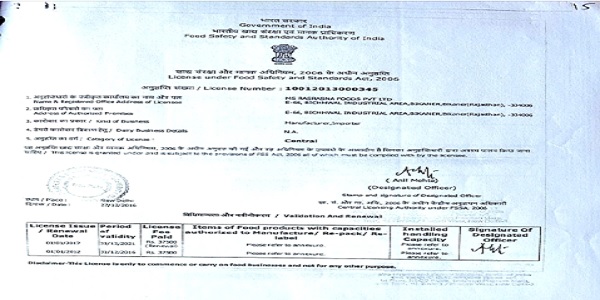
4. I have carefully considered the submissions made by both the sides and perused the records. I find that in the present case, there is no dispute that the appellant have been issued license being a manufacturer/importer for manufacture of sweets and papad. The said license is scanned below: