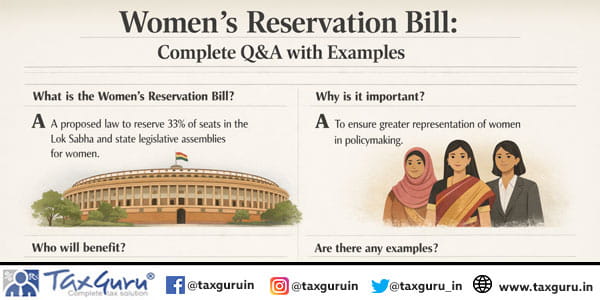
Women’s Reservation under the Constitution (One Hundred and Sixth Amendment) Act, 2023 – Complete Q&A with Examples
Q. What is the purpose and commencement provision of the Constitution (One Hundred and Sixth Amendment) Act, 2023?
Ans. The Constitution (One Hundred and Sixth Amendment) Act, 2023 amends the Constitution of India to provide reservation for women in legislative bodies with the objective of increasing their political representation in Parliament and State Assemblies. It comes into force on such date as the Central Government may appoint by notification in the Official Gazette.
Q. When was the Constitution (One Hundred and Sixth Amendment) Act, 2023 passed in Lok Sabha and Rajya Sabha, and what was the voting percentage?
Ans. The Constitution (One Hundred and Sixth Amendment) Act, 2023 was passed in the Lok Sabha on 20 September 2023 with 454 votes in favour and 2 against (about 99.5% support). It was passed in the Rajya Sabha on 21 September 2023 with 214 votes in favour and no opposition (100% support).
Q. When did the Women’s Reservation Act, 2023 come into force?
Ans. The Constitution (One Hundred and Sixth Amendment) Act, 2023 came into force on 16 April 2026, as notified by the Union Law Ministry through a notification in the Official Gazette.
Q. When will this provision take effect?
Ans. Under the Constitution (One Hundred and Sixth Amendment) Act, 2023, this provision takes effect immediately from the date the Act comes into force (16 April 2026). However, its practical effect is that:
- It protects the existing Lok Sabha and State Assemblies from any change,
- And continues to apply until those Houses are dissolved (i.e., their term ends).
Therefore, no reservation or change will apply to the current Houses; it will apply only to future Houses after dissolution (and after delimitation).
Example: Suppose the Constitution (One Hundred and Sixth Amendment) Act, 2023 came into force on 16 April 2026, and the current Lok Sabha (elected in 2024) is still in office. Then:
- Even after 16 April 2026, no seats will be reserved for women in that Lok Sabha.
- All MPs will continue as they are.
When will it actually apply?
- When that Lok Sabha is dissolved (say in 2029)
- After Census + delimitation is completed
- Then in the next election, women reservation will be implemented.
Even though the Constitution (One Hundred and Sixth Amendment) Act, 2023 is now in force, reservation will start only after two conditions are met:
- Next Census is conducted and published
- Delimitation exercise is completed
Q. When was the last Census conducted in India and when is the next expected?
Ans. The last Census in India was conducted in 2011. The next Census was scheduled for 2021, but it was postponed and has not yet been conducted. The Government is expected to conduct the next Census in the coming years (likely around 2026 or thereafter).
Reservation of seats for women in the House of the People
Q. What does newly inserted Article 330A provide regarding reservation of seats for women in the House of the People?
Ans. Article 330A provides that seats shall be reserved for women, with as nearly as possible one-third of the total seats (including SC/ST women seats), and one-third of SC/ST reserved seats also reserved for women.
Example: Suppose the House of the People has 300 total seats, out of which 90 seats are reserved for SC/ST.
- One-third of total seats = 100 seats → reserved for women.
- One-third of SC/ST seats = 30 seats → reserved for SC/ST women.
So, out of 100 women-reserved seats, 30 will be for SC/ST women, and the remaining 70 will be for other women.
Reservation of seats for women in the Legislative Assemblies of the States.
Q. What does newly inserted Article 332A provide regarding reservation of seats for women in the Legislative Assemblies of the States?
Ans. Article 332A provides that seats shall be reserved for women in the Legislative Assembly of every State, with as nearly as possible one-third of the total seats (including SC/ST women seats), and one-third of SC/ST reserved seats also reserved for women.
Example: Suppose a State Legislative Assembly has 300 total seats, out of which 90 seats are reserved for SC/ST.
- One-third of total seats = 100 seats → reserved for women.
- One-third of SC/ST seats = 30 seats → reserved for SC/ST women.
So, out of 100 women-reserved seats, 30 will be for SC/ST women, and the remaining 70 will be for other women.
Reservation of seats for women in the Legislative Assembly of the National Capital Territory of Delhi.
Q. What do the newly inserted clauses (ba), (bb), and (bc) in Article 239AA(2) provide regarding reservation of seats for women in the Legislative Assembly of the National Capital Territory of Delhi?
Ans. These clauses provide that seats shall be reserved for women in the Legislative Assembly of the National Capital Territory of Delhi, with as nearly as possible one-third of the total seats (including SC women seats), and one-third of the seats reserved for Scheduled Castes also reserved for women, in such manner as Parliament may by law determine.
Example: Suppose the Legislative Assembly of the National Capital Territory of Delhi has 90 total seats, out of which 12 seats are reserved for Scheduled Castes.
- One-third of total seats = 30 seats → reserved for women.
- One-third of SC seats = 4 seats → reserved for SC women.
So, out of 30 women-reserved seats, 4 will be for SC women, and the remaining 26 will be for other women.
Q. What does newly inserted Article 334A provide regarding the commencement and duration of reservation of seats for women?
Ans. Article 334A provides that reservation of seats for women in the House of the People, State Legislative Assemblies, and the Legislative Assembly of the National Capital Territory of Delhi shall come into effect only after delimitation based on the first census conducted after the Constitution (106th Amendment) Act, 2023, and shall cease after 15 years from such commencement. It also provides that such reservation shall continue till a date determined by Parliament, seats shall rotate after each delimitation, and existing Houses will not be affected until their dissolution.
Example: Suppose the first census after the 106th Amendment is conducted in 2028 and delimitation is completed in 2029:
- Reservation for women will start from 2029 (after delimitation).
- It will continue for 15 years, i.e., till 2044 (unless extended by Parliament).
- Seats reserved for women will rotate after each future delimitation exercise.
- The existing Lok Sabha or Assemblies before 2029 will not be affected until they complete their term.