Summary: An RTI application filed with the Ministry of Corporate Affairs in September 2025 sought information on the functioning of the National Company Law Tribunal (NCLT) and the National Company Law Appellate Tribunal (NCLAT). The findings highlight critical governance concerns. As of September 2025, NCLT faced two judicial and three technical member vacancies, while NCLAT had no vacancies, raising concerns over delays in insolvency and corporate dispute resolution. The RTI revealed that consolidated case pendency data is not maintained in certified form, with applicants being directed to multiple online sources instead, undermining transparency and research efforts. Further, requests for selection committee records and recruitment details were denied, with the Ministry pointing only to its recruitment portal, weakening trust in the appointment process. These responses reflect systemic gaps in record-keeping, accountability, and RTI compliance, contrary to Sections 4 and 7 of the RTI Act. Recommendations include filling judicial vacancies promptly through transparent processes, publishing certified real-time case statistics, disclosing selection committee records (with necessary redactions), and improving RTI compliance. The inquiry underscores the urgent need for reforms in NCLT/NCLAT to strengthen transparency, efficiency, and investor confidence in India’s corporate adjudication system.
Background
An RTI application (Reg. No. MOCAF/R/E/25/01140) was filed on 12 September 2025 with the Ministry of Corporate Affairs (MCA), seeking information on the functioning of the National Company Law Tribunal (NCLT) and the National Company Law Appellate Tribunal (NCLAT). The application was transferred to the NCLT and NCLAT under Reg. Nos. NCLTP/R/T/25/00118 and NCLAT/R/T/25/00048, respectively.
Key Information Sought
1. Pendency of cases in NCLT and its regional benches since 2015.
2. Vacancies of Judicial and Technical Members in NCLT and NCLAT.
3. Certified copies of selection committee records, file notes, and recruitment notifications.
Major Findings and Implications
1. Judicial Vacancies Affecting Case Disposal
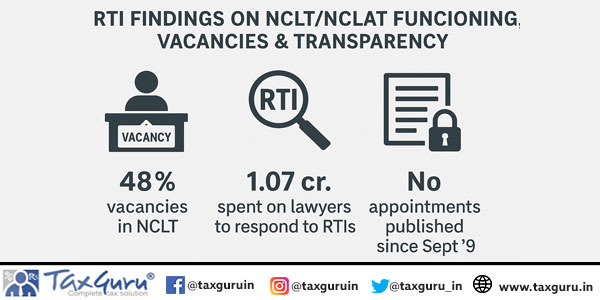
- As of 01.09.2025, NCLT has 2 Judicial and 3 Technical Member vacancies.
- NCLAT reported no current vacancies.
- Implication: Delays in resolving corporate insolvency and governance disputes under the IBC, affecting investor confidence and ease of doing business.
2. Lack of Consolidated Case Data
- NCLT CPIO responded that pendency data is “not maintained in material form” and directed to scattered online links:
- Implication: No certified or consolidated data undermines transparency, hampers academic/legal research, and impedes performance tracking.
3. Non-Disclosure of Appointment Records
- MCA responded that no selection records are available in material form and referred to its recruitment portal:
- Implication: Absence of selection transparency weakens public trust and may compromise the independence of quasi-judicial appointments.
Legal and Institutional Context
- NCLT (Section 408, Companies Act, 2013) and NCLAT (Section 410) are key pillars of India’s corporate adjudication framework.
- Their role includes insolvency resolution, shareholder disputes, and corporate governance enforcement.
Governance and RTI Compliance Issues
- The use of phrases like “information not available” signals systemic gaps in record-keeping and institutional accountability.
- These responses breach Section 4 and Section 7 of the RTI Act, which mandate proactive and substantive disclosure.
Recommendations for Structural Reforms
1. Expedite Judicial Appointments: Fill vacancies through transparent, merit-based processes.
2. Real-Time Case Data: Publish certified pendency statistics by bench and case type.
3. Transparent Selection Process: Disclose committee minutes, redacted for privacy, to build trust.
4. Strengthen RTI Compliance: Train CPIOs to ensure substantive and legally compliant responses.
Conclusion
The RTI has uncovered deep-rooted issues of transparency, data governance, and accountability in India’s corporate tribunals. Without urgent reforms, NCLT/NCLAT risk becoming bureaucratic hurdles rather than effective dispute resolution forums. As India seeks to attract global investment and uphold the rule of commercial law, tribunal reforms are not just necessary—they are imperative.
Download NCLT/NCLAT Functioning RTI copy and replies by CPIO of NCLT, NCLAT and MCA
***
Submitted by: Y. Balachander Reddy, Advocate – Corporate and High Court, Hyderabad, Telangana, India