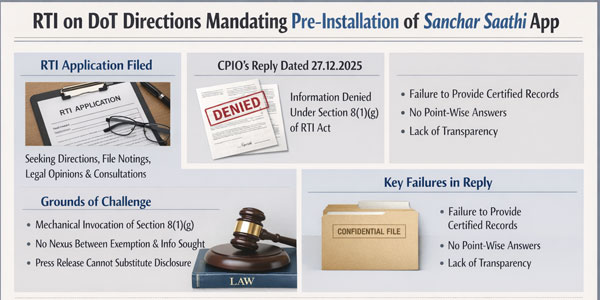
An RTI application has been filed in good faith being an Advocate and RTI activist seeking transparency on the Department of Telecommunications’ (DoT) Direction dated 28 November 2025 vide DOTEL/R/E/25/01250 mandating pre-installation of the Sanchar Saathi App on mobile handsets.
The applicant has sought certified copies of the Directions, all subsequent amendments or clarifications, and a clear statement on whether pre-installation is mandatory, optional or voluntary for handset manufacturers and importers. The RTI also seeks file notings, internal approvals, and legal opinions explaining the statutory authority for issuing the Directions, including under the Telecom Cyber Security Rules.
Further, the application seeks disclosure of industry consultations, stakeholder responses, and any technical, cyber security or impact assessment reports considered before issuing the Directions. Documents prescribing the 90-day implementation timeline, 120-day compliance reporting requirement, and the compliance report format have also been sought.
The RTI additionally seeks clarity on app non-removability requirements, the enforcement date, and the binding nature of the Directions, citing the need for accountability and transparency in executive decision-making.
UNSATISFACTORY, CRYPTIC AND NON-SPEAKING RTI REPLY DATED 27.12.2025 OF CPIO:
“ the information sought in the RTI Application cannot be shared under the provisions of the Section 8(1)(g) of the Right to Information Act, 2005.
2. The copies of the Telecommunications Act, 2023 and Telecom Cyber Security Rules have been published in the public domain. The same are available on the web URL of the Department of Telecommunications website:
https://dot.gov.in/act-rules-content/3296
3. As per press release issued by the Department of Telecommunications on dated 03.12.2025, the Sanchar Saathi app pre-installation is not mandatory. The press release issued by the Department of Telecommunications is available at web link: https://dot.gov.in/press-released “.
However, the CPIO’s reply dated 27.12.2025 is unsatisfactory, cryptic, evasive and non-speaking, for the following reasons:
1. Mechanical Invocation of Section 8(1)(g)
The CPIO has denied the entire information by vaguely invoking Section 8(1)(g) of the RTI Act without demonstrating how disclosure would endanger life or physical safety or reveal confidential sources. No reasoning or application of mind has been shown, rendering the denial illegal.
No 2. Nexus Between Information Sought and Exemption Claimed
The RTI seeks policy documents, file notings, legal vetting, consultations and implementation records—none of which fall within the scope of Section 8(1)(g). The reply fails to establish any proximate or rational nexus between the information sought and the claimed exemption.
3. Press Release Cannot Substitute Statutory Disclosure
Merely referring to a press release dated 03.12.2025 stating that pre-installation is “not mandatory” does not answer the RTI queries seeking certified records, file notings and legal authority. Press releases have no statutory evidentiary value and cannot replace disclosure under the RTI Act.
4. Failure to Address Each Question Separately
The CPIO has failed to give point-wise replies to each item sought, in violation of Section 7(1) of the RTI Act. The reply does not deal with file notings, legal opinions, consultations, impact assessments, timelines or enforcement orders at all.
5. Violation of the Duty to Give Reasons
The impugned reply violates Section 7(8) of the RTI Act, which mandates that reasons for denial and the specific exemption clause be clearly stated with justification.
ABSENCE OF ANY PROXIMATE NEXUS BETWEEN INFORMATION SOUGHT AND SECTION 8(1)(g):
The RTI application seeks:
- Certified copies of DoT Directions
- File notings and internal approvals
- Legal opinions and statutory authority
- Industry consultations and stakeholder responses
- Technical, cybersecurity and impact assessment reports
These are policy, regulatory and administrative records, not intelligence inputs or confidential informants.
OVERRIDING PUBLIC INTEREST – SECTION 8(2)
Even assuming (without admitting) that any exemption applies, Section 8(2) mandates disclosure where public interest outweighs the harm.
Public Interest Involved:
- Pan-India impact on handset manufacturers and importers
- Millions of mobile users affected
- Cybersecurity, privacy and digital governance implications
- Mandatory or coercive executive directions without disclosed statutory backing.
DIRECTIONS AFFECTING PRIVATE RIGHTS REQUIRE HEIGHTENED TRANSPARENCY
Directions mandating or influencing pre-installation and non-removability of a government app on private devices directly affect:
- Right to privacy (Article 21)
- Freedom of trade (Article 19(1)(g))
- Informed consent in digital ecosystems
Settled Legal Position:
- Justice K.S. Puttaswamy v. Union of India, (2017) 10 SCC 1
Any executive action impacting privacy must satisfy legality, necessity and proportionality.
Without disclosure of legal authority and internal deliberations, these tests cannot be met.
- The Supreme Court in CBSE v. Aditya Bandopadhyay (2011) 8 SCC 497 held that disclosure is the rule and exemptions must be strictly construed.
Proposed Action
In view of the above, the applicant intends to file a First Appeal under Section 19(1) of the RTI Act, 2005, challenging the impugned RTI reply dated 27.12.2025, on the ground that it is arbitrary, non-speaking, contrary to settled law, and defeats the very object of transparency and accountability in executive decision-making.
Hence the said issue raises issues of significant public importance and large public interest. The case concerns DoT directions mandating pre-installation of a government app on private mobile devices, the absence of disclosed statutory authority, and a cryptic RTI denial invoking blanket exemptions. Given its pan-India impact on manufacturers and millions of users, and its implications for transparency, executive accountability, digital governance, and the right to information, publication would serve the public interest and contribute to informed legal and constitutional discourse.
CAUTION NOTE:
The views expressed in this article are purely personal and in good faith. The author can be contacted at : [email protected]
Y. Balachander Reddy, B.Com, LL.B, LL.M (IPR), LL.M (Corporate Law), Advocate | Contact: 9959850723