Summary: The Armed Forces (Special Powers) Act, 1958 (AFSPA) grants extraordinary powers to armed forces in areas declared “disturbed,” including use of force, warrantless arrest, and search, along with immunity from prosecution without Central sanction. Originally enacted to address insurgency, it operates at the intersection of national security and constitutional law. However, its provisions raise concerns under fundamental rights such as equality, life, liberty, and access to remedies, particularly due to Section 6 which restricts prosecution. Judicial scrutiny has upheld its validity but imposed safeguards, emphasizing that powers must be exercised with restraint and do not justify unlawful acts. Cases involving alleged fake encounters and human rights violations highlight challenges of accountability. The absence of clear criteria and time limits for “disturbed area” declarations adds to concerns. Reform debates focus on balancing operational necessity with accountability through measures such as periodic review, reduced immunity, and stronger oversight, while partial withdrawal in some regions indicates evolving policy approaches.
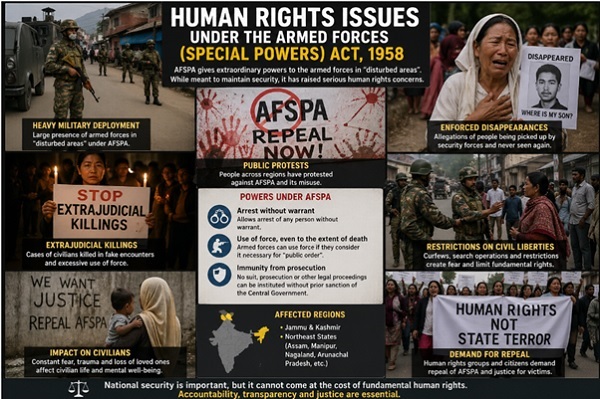
SECTION I — CONCEPTUAL UNDERSTANDING
What is AFSPA, 1958?
The Armed Forces (Special Powers) Act, 1958 is a central legislation of India that grants extraordinary powers to armed forces personnel deployed in areas officially declared as “disturbed” under Section 3 of the Act. It was originally enacted in 1958 to deal with insurgency in the Naga Hills, drawing its lineage from the British colonial-era Armed Forces (Special Powers) Ordinance of 1942, used to suppress the Quit India Movement.
Conceptually, AFSPA operates at the intersection of national security law, constitutional law, and international human rights law. It creates a parallel legal framework within “disturbed areas” that suspends ordinary civilian oversight and grants soldiers near-absolute operational immunity.
Statutory Definition — Section 3, AFSPA 1958
The Central Government or a State Governor may, by notification, declare an area “disturbed” if it is of the opinion that the area is in such a disturbed or dangerous condition that the use of armed forces in aid of civil power is necessary.
The Act has been extended over the decades to cover Jammu & Kashmir (via AFSPA 1990), Manipur, Nagaland, Assam, Arunachal Pradesh, and Meghalaya. Its application in these regions has made it one of the most controversial laws in post-independence India.
Key Powers Granted Under AFSPA
A precise, objective understanding of the powers is essential before analyzing their impact. The Act grants the following powers to a commissioned officer, warrant officer, or even a non-commissioned officer:
1. Power to Open Fire
Sec. 4(a): Use force, even to the extent of causing death, against any person acting in contravention of law or carrying weapons.
2. Destroy Structures
Sec. 4(b): Destroy any arms dump, fortification, or shelter used as a training camp by armed groups.
3. Arrest Without Warrant
Sec. 4(c): Arrest any person without warrant on reasonable suspicion of having committed a cognizable offence.
4. Search Without Warrant
Sec. 4(d): Enter and search any premises without a warrant to make an arrest or recover property.
5. Section 6 – Prosecution Bar: No prosecution, suit, or legal proceeding shall be instituted against any person in respect of anything done under AFSPA except with the prior sanction of the Central Government. This provision is the most contested clause in the entire Act.
SECTION III — ANALYTICAL WRITING
Constitutional Validity — A Deep Analysis
The most pressing analytical challenge of AFSPA lies in its collision with Part III of the Constitution of India — the Fundamental Rights. Each major provision of AFSPA conflicts with one or more of the following constitutional guarantees:
Art. 21- Right to Life
Shoot-to-kill powers challenge the right to life and liberty. Any deprivation must follow fair procedure.
Art. 22- Detention Safeguards
Right to be informed of grounds of arrest, right to consult a lawyer — bypassed under AFSPA.
Art. 14- Right to Equality
Citizens in disturbed areas are treated differently with reduced rights — raising equality concerns.
Art. 19- Freedom of Movement
Search and seizure, arrests, and curfew powers severely curtail free movement and expression.
Art. 32- Right to Remedies
Section 6’s prosecution bar effectively denies victims any judicial remedy — hollowing out Art. 32.
“A law that grants immunity from prosecution is a law that invites impunity — and impunity is the enemy of human rights.”
Analytically, the government’s defence rests on Article 355, which places a duty on the Union to protect states from external aggression and internal disturbance, and on the doctrine of necessity — that extraordinary threats require extraordinary powers. Critics counter that no emergency can justify blanket immunity that extinguishes accountability entirely.
The doctrine of proportionality — now firmly embedded in Indian constitutional law after K.S. Puttaswamy v. Union of India (2017) — demands that any restriction on fundamental rights must be necessary, proportionate, and subject to judicial oversight. AFSPA, by design, excludes judicial scrutiny through Section 6, making it analytically incompatible with the proportionality standard.
SECTION IV — ABILITY TO EXPLAIN AND ANALYZE LEGAL ISSUES
Core Human Rights Issues
1. The Problem of Immunity (Section 6): The prosecution bar is the central legal issue. When a soldier commits an extrajudicial killing, custodial torture, or enforced disappearance, the victim’s family cannot initiate proceedings without Central Government sanction — which is rarely, if ever, granted. This creates a culture of impunity. The legal issue here is the severance of the nexus between wrongful act and legal remedy, which violates the rule of law itself.
2. Extrajudicial Killings & Fake Encounters: In the absence of judicial oversight, “encounters” — where suspects are killed rather than arrested — become difficult to distinguish from sanctioned executions. The Manipur Encounter Cases (2016) before the Supreme Court found 1,528 alleged fake encounters between 1979 and 2012, many in AFSPA areas.
3. Enforced Disappearances: The power of warrantless arrest, combined with detention at any premises, enables enforced disappearances — defined under international law as arrest followed by denial of that deprivation. India has not ratified the International Convention for the Protection of All Persons from Enforced Disappearance, leaving victims with limited international recourse.
Analytical Insight — The “Disturbed Area” Problem: The Act provides no objective, time-bound, or judicially reviewable criteria for what constitutes a “disturbed area.” Declarations are made by executive fiat and routinely renewed for decades. Manipur, for instance, was under AFSPA for over 27 continuous years before partial withdrawal in 2022. The lack of sunset clauses and judicial review of such declarations is a serious constitutional infirmity.
SECTION V — APPLICATION OF LAW
Landmark Cases — Law in Action
Naga People’s Movement of Human Rights v. Union of India (1998) — Supreme Court of India
The Supreme Court upheld the constitutional validity of AFSPA but laid down important guidelines: the “disturbed area” declaration must be reviewed periodically; the power to shoot must be exercised only as a last resort; arrested persons must be handed to the nearest police station within 24 hours. The Court held that the Act does not vest absolute or uncanalized power and must be read with constitutional limitations.
Extra Judicial Execution Victim Families Association (EEVFAM) v. Union of India (2016) — Supreme Court
A landmark judgment ordering a CBI probe into 1,528 alleged fake encounters in Manipur. The Court categorically held that even in disturbed areas, the right to life under Article 21 cannot be suspended. Importantly, it ruled that the defence of AFSPA cannot be raised to justify fake encounters — affirming that the Act does not authorize the commission of crimes.
Manorama Devi Case (2004) — Manipur
Thangjam Manorama was arrested by the Assam Rifles under AFSPA and was later found dead with evidence of torture and sexual assault. No prosecution was sanctioned under Section 6. The case triggered massive protests, including the iconic naked protest by Manipuri women outside Kangla Fort, and became a symbol of AFSPA’s enabling of sexual violence against women.
Irom Sharmila — 16-Year Fast (2000–2016)
Human rights activist Irom Sharmila began a hunger strike in 2000 demanding repeal of AFSPA following the Malom Massacre, where 10 civilians were killed by the Assam Rifles. The state responded by force-feeding her under the Preventive Detention Act for 16 years — itself a use of law to silence a rights defender. Her protest remains one of the longest hunger strikes in history.
SECTION VI — RELEVANT LAWS AND EXAMPLES
Legal Framework — Domestic and International
Understanding AFSPA requires situating it within a broader web of laws and international obligations:
Domestic Laws
Code of Criminal Procedure, 1973 (CrPC): Sections 41 (arrest), 100 (search) — ordinarily govern police powers. AFSPA overrides these in disturbed areas, granting military personnel wider powers than even the police. | Unlawful Activities (Prevention) Act (UAPA): Operates alongside AFSPA for terrorism-related offences but includes more procedural safeguards. | Protection of Human Rights Act, 1993: Established the NHRC, which can investigate AFSPA violations but lacks enforcement powers.
International Human Rights Law
ICCPR (International Covenant on Civil and Political Rights): India ratified in 1979. Article 6 (right to life), Article 7 (prohibition of torture), Article 9 (liberty and security). The UN Human Rights Committee has repeatedly called for AFSPA’s repeal. | UN Basic Principles on Use of Force and Firearms (1990): Require that lethal force be used only as a last resort. AFSPA’s Section 4(a) grants broader authority. | Convention Against Torture (CAT): India has signed but not ratified — creating a protection gap for AFSPA-related torture victims.
The Redress Problem — A Practical Example: Consider a family in Imphal whose son is arrested under AFSPA and dies in custody. Under ordinary law, they could file an FIR, approach the High Court via habeas corpus, and seek NHRC intervention. Under AFSPA, the prosecution bar means no FIR can lead to trial without Central sanction. The NHRC can recommend compensation but cannot compel prosecution. The family’s only effective remedy is a writ petition before the Supreme Court — an option inaccessible to most marginalized victims.
SECTION VII — REFORM DEBATES
The Way Forward — Repeal, Reform, or Retain?
Key Reform Recommendations
- Jeevan Reddy Commission (2005) unanimously recommended repeal of AFSPA, calling it “a symbol of hate and an instrument of high-handedness.” The report was never tabled in Parliament.
- Second Administrative Reforms Commission recommended its repeal and replacement with a more targeted anti-terrorism law with judicial oversight.
- Sunset Clauses: Mandatory review and re-declaration of disturbed areas every 6 months, with judicial review of necessity.
- Military’s Position: Armed forces consistently oppose repeal, arguing that without immunity, soldiers would face frivolous prosecutions and operational paralysis — a legitimate concern requiring a calibrated legislative response.
- Partial Withdrawal (2022–23): The Union Government removed AFSPA from several districts in Nagaland, Assam, and Manipur — signaling a shift in policy, though large swathes of the Northeast and J&K remain covered.
“The challenge is not to dismantle national security, but to rebuild it on a foundation where every soldier’s gun is matched by a court’s gavel.”
The resolution lies not in binary choices but in structural reform: retaining operational powers where genuinely necessary, replacing blanket immunity with a qualified immunity standard (protecting good-faith actions, not abuses), establishing independent oversight bodies with real teeth, and constitutionally mandating periodic judicial review of disturbed area declarations. The goal is a law that secures both the nation and its people.