Comprehensive Analysis of Secondary Discounts, Input Tax Credit Reversal, and Promotional Activity Treatment Under GST
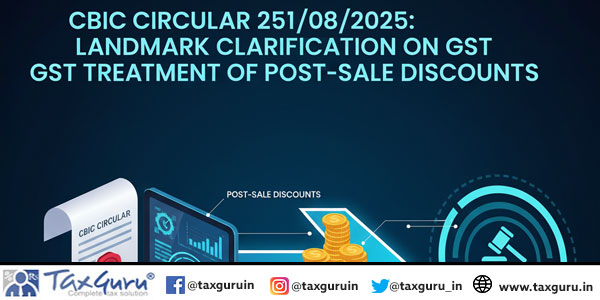
The Central Board of Indirect Taxes and Customs (CBIC) has issued Circular No. 251/08/2025-GST Dated: 12th September, 2025 providing much-needed clarity on the GST treatment of secondary or post-sale discounts. This circular addresses long-standing ambiguities that have plagued businesses and tax officials regarding discount mechanisms, Input Tax Credit (ITC) reversals, and the taxation of promotional activities between manufacturers and dealers.
Background and Context
The circular emerges as a response to multiple representations from trade and industry seeking clarifications on the GST implications of post-sale discounts. These secondary discounts, commonly used in business-to-business transactions, had created compliance confusion and interpretational disputes across various sectors. The Board has exercised its powers under Section 168(1) of the CGST Act, 2017, to ensure uniform implementation across all field formations.
Key Provisions and Clarifications:
1. Input Tax Credit Treatment on Financial/Commercial Credit Notes
Issue Addressed: Whether recipients need to reverse ITC when making discounted payments based on financial or commercial credit notes issued by suppliers.
Legal Framework: The circular relies on Section 16(1) of the CGST Act, 2017, and references Circular No. 92/11/2019-GST dated 7th March 2019.
Clarification Provided:
- When suppliers issue financial or commercial credit notes, they cannot reduce their original tax liability because the credit note is financial/commercial and not a tax credit note.
- Since the original transaction value and corresponding tax liability remain unchanged, recipients are not required to reverse any ITC.
- Full ITC remains available to the recipient despite the discount received.
Practical Impact: This clarification eliminates a significant compliance burden on businesses, ensuring that post-sale discounts through financial credit notes do not trigger ITC reversal requirements.
2. Post-Sale Discounts as Consideration for Supply Inducement
Issue Addressed: Whether post-sale discounts offered by manufacturers to dealers constitute consideration for the dealer’s supply to end customers.
Legal Reference: Section 2(31) of the CGST Act, 2017, which defines consideration to include the monetary value of any act for supply inducement.
Dual Scenario Analysis:
| Scenario Label | Scenario Description | Conclusion |
|---|---|---|
| Scenario 1: Principal-to-Principal Transaction | No Direct Manufacturer-End Customer Agreement exists.
Two independent transactions exist: manufacturer to dealer and dealer to end customer. Discounts are purely for competitive pricing and sales promotion. They are not linked to any independent activity rendered to the manufacturer. |
Discounts cannot be included in consideration as a supply inducement. |
| Scenario 2: Tripartite Arrangement | The manufacturer has a pre-existing agreement with the end customer for discounted supply.
The manufacturer issues commercial/financial credit notes enabling dealers to supply at agreed discounted rates. |
Discounts must be included in the overall consideration as they constitute an inducement for the dealer’s supply to the specific end customer. |
3. Promotional Activities and Service Taxation
Issue Addressed: Whether post-sale discounts can be treated as consideration for promotional activities performed by dealers.
General Rule:
- When dealers receive post-sale discounts and engage in promotional activities, these activities primarily enhance their own revenue from owned goods.
- Discounts merely reduce the sale price and are not linked to independent services rendered to manufacturers.
- Standard promotional activities do not constitute a separate taxable supply.
Exception – GST Applicability (Marketing Support Services): GST becomes leviable when dealers undertake specific promotional services under explicit agreements with clearly defined consideration, including:
- Advertising campaigns
- Co-branding initiatives
- Customization services
- Special sales drives
- Exhibition arrangements
- Customer support services
Critical Requirements for GST Levy:
- Services must be explicitly stated in agreements.
- Clearly defined consideration must be specified.
- Must constitute a distinct service to the supplier.
Comparative Analysis: Before and After Circular 251
| Previous Ambiguities | Post-Circular Clarity |
|---|---|
| Unclear ITC reversal requirements on financial credit notes. | Definitive ITC treatment: No reversal required for financial/commercial credit notes. |
| Confusion regarding post-sale discount treatment as a supply consideration. | Clear demarcation: Principal-to-principal transactions vs. tripartite arrangements. |
| Disputes over promotional activity taxation. | Specific criteria: Promotional services require explicit agreements with defined consideration. |
| Inconsistent interpretations across jurisdictions. | Uniform application: Consistent interpretation across all field formations. |
Industry Impact and Compliance Implications
| Stakeholder | Impact |
|---|---|
| For Manufacturers | Reduced compliance burden in issuing financial credit notes. Clear guidelines for structuring discount schemes. Certainty in tax treatment of promotional payments. |
| For Dealers/Distributors | Retention of full ITC on discounted transactions. No fear of retrospective ITC demands on legitimate discounts. Clear understanding of when promotional activities attract GST. |
| For End Customers | Transparent pricing mechanisms. Reduced litigation and interpretation disputes. Consistent treatment across different business models. |
Documentation and Compliance Requirements
Essential Documentation:
1. Clear distinction between financial credit notes and tax credit notes.
2. Proper maintenance of agreement terms for promotional activities.
3. Explicit definition of consideration for separate services.
4. Regular review of existing discount structures.
5. Consequence of Lack of Documentation: In the absence of explicit agreements for services, it may lead to unnecessary disputes with tax authorities regarding the levy of GST on implied services.
Practical Scenarios and Applications
| Case Study | Scenario Description | Treatment & GST Impact | ITC Impact |
|---|---|---|---|
| Case Study 1:
Volume-Based Discount (Pure Price Reduction) |
The manufacturer offers 5% post-sale discount to a dealer achieving the monthly sales target of ₹10,00,000. | No GST implication; pure price reduction for competitive positioning. | Dealer retains full ITC; no reversal required. |
| Case Study 2:
End-Customer Specific Discount (Supply Inducement/Tripartite) |
The manufacturer agrees to supply goods to a specific customer at a 15% discount through a dealer. (Note 1) | Discount forms part of the overall consideration as a supply inducement.
GST is applicable under Section 2(31) of the CGST Act, 2017, on consideration paid by the manufacturer to the dealer as an inducement. |
NA |
| Case Study 3:
Promotional Service Agreement (Distinct Taxable Supply) |
The manufacturer pays to dealer ₹50,000 for organising the product launch event per the written contract. | Constitutes a separate taxable service supply.
GST Applicability: Yes, on ₹50,000 as a distinct promotional service. |
NA |
Note 1: “This typically occurs in cases where manufacturers have corporate agreements with bulk purchasers (like government entities, large corporates) and appoint dealers as intermediaries for supply execution.”
Strategic Recommendations for Businesses
1. Audit current discount mechanisms for compliance alignment.
2. Restructure agreements to clearly define service considerations.
3. Implement robust documentation systems for discount tracking.
4. Train finance teams on new ITC treatment protocols.
Conclusion and Future Outlook
Circular 251/08/2025 represents a significant milestone in GST jurisprudence, providing definitive clarity on post-sale discount treatment. The clarification ensures that legitimate business practices around post-sale discounts are not unnecessarily burdened with complex tax implications while maintaining appropriate safeguards against potential revenue leakages. Businesses can now structure their discount mechanisms with greater certainty, leading to improved compliance and reduced litigation.
However, the circular also emphasises the importance of proper documentation and explicit agreement terms, particularly for promotional activities. Organisations must invest in robust compliance systems to fully benefit from these clarifications while avoiding potential pitfalls in interpretation and implementation. The circular’s emphasis on uniform application across field formations signals CBIC’s commitment to reducing interpretation disparities and ensuring consistent GST administration.
*****
Disclaimer: This article provides practical insights based on the circular’s implications for various business models and compliance requirements across different industry sectors. Nothing contained in this document is to be construed as a legal opinion or view of the author whatsoever, and the content is to be used strictly for informational and educational purposes. While due care has been taken in preparing this article, certain mistakes and omissions may creep in. The author does not accept any liability for any loss or damage of any kind arising out of any inaccurate or incomplete information in this document, nor for any actions taken in reliance thereon.