#AD
Loan settlement is one of the most misunderstood debt resolution options available to Indian borrowers. The loan settlement myths circulating online, in family group chats, and among friends have kept thousands of people stuck in debt they could have resolved, sometimes for years longer than necessary. This article takes the 7 most persistent myths and puts the facts next to them.
| The Myth | The Truth | |
|---|---|---|
| 1 | Settlement is illegal | Fully legal under RBI guidelines |
| 2 | CIBIL score is ruined forever | Negative but time-bound; repair is possible |
| 3 | Banks will sue you immediately | Legal action is a last resort, not the first response |
| 4 | Only for the completely broke | Genuine hardship, not destitution, is the threshold |
| 5 | You can negotiate just as well yourself | Professional intermediaries handle the process for you |
| 6 | Consolidation and settlement are the same | Two different mechanisms for two different situations |
| 7 | You can never get a loan again after the settlement | Harder in the short term; not permanently closed |
- Myth 1: "Settling a Loan for less than you owe is illegal. Banks Can Take Legal Action Against You for It."
- Myth 2: "If You Settle a Loan, Your Credit Score Is Permanently Destroyed. No Bank Will Ever Lend to You Again."
- Myth 3: "If I Stop Paying My EMIs to Save for a Settlement, the Bank Will Immediately Take Me to Court."
- Myth 4: "Settlement Is for People Who Have Lost Their Jobs or Have Nothing Left. I Still Have Income, So I Don't Qualify."
- Myth 5: "I Can Just Call the Bank Myself and Negotiate. I Don't Need to Pay Anyone to Do It for Me."
- Myth 6: "Consolidation, Settlement, They're Basically the Same. Both Are for People Who Can't Pay Their Debt."
- Myth 7: "Banks Blacklist You After a Settlement. You'll Never Get Approved for a Home Loan or Car Loan."
- How FREED Helps Borrowers Past These Myths
- The Bottom Line
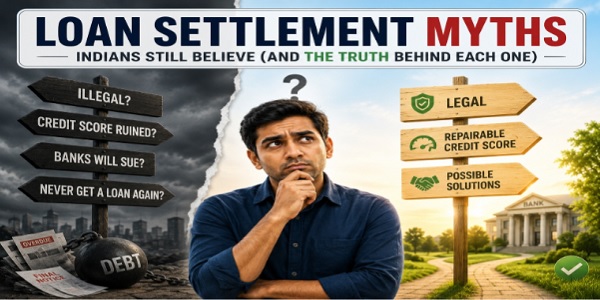
Myth 1: “Settling a Loan for less than you owe is illegal. Banks Can Take Legal Action Against You for It.”
The truth: Loan settlement, also called One-Time Settlement (OTS), is fully legal and explicitly recognised by the Reserve Bank of India. The RBI’s guidelines on Non-Performing Assets (NPAs, loan accounts that have gone 90 days or more without repayment) permit banks to offer and accept OTS from borrowers whose accounts have become delinquent. There is no law in India that prohibits a borrower from negotiating a reduced settlement with their bank.
Once the agreed settlement amount is paid, the bank issues a No Dues Certificate (NDC) confirming the account is resolved, and no further obligation remains. The process is bilateral, documented, and fully above board.
The stigma around settlement is not legal. The process itself is.
Myth 2: “If You Settle a Loan, Your Credit Score Is Permanently Destroyed. No Bank Will Ever Lend to You Again.”
The truth: A settled account does leave a mark. The account status on the CIBIL report changes from “Closed” to “Settled,” and this does have a negative effect on the credit score. That part is accurate.
“Permanent” is not. The settlement notation typically remains on the CIBIL report for up to 7 years from the date of settlement. More importantly, for a borrower already in default, the ongoing damage from continued non-payment, with mounting interest, penalties, and NPA classification, is usually worse than the impact of a clean, documented settlement.
Post-settlement, credit repair is possible through consistent on-time payments on other active accounts, correcting any bureau errors, and responsible credit use over time. The CIBIL impact is real and should go into any decision. It is also manageable and time-bound.
Myth 3: “If I Stop Paying My EMIs to Save for a Settlement, the Bank Will Immediately Take Me to Court.”
The truth: Legal action by a bank is typically a last resort, not an immediate response to missed payments.
Banks and NBFCs go through multiple internal stages before initiating legal proceedings: collections calls, written notices, account restructuring discussions, and internal recovery review. The legal route is also expensive and time-consuming for banks, which is precisely why OTS exists as a mechanism. Banks prefer recovering a negotiated amount over a drawn-out legal battle.
The risk of legal action is not zero, and ignoring bank communication is not advisable. Enrolling in a structured debt resolution program puts a clear plan in place and ensures bank communication is handled formally rather than left to go unanswered.
Myth 4: “Settlement Is for People Who Have Lost Their Jobs or Have Nothing Left. I Still Have Income, So I Don’t Qualify.”
The truth: Settlement is for borrowers in genuine financial hardship. Hardship does not require destitution.
A borrower who is still earning but genuinely unable to service the full outstanding without severely compromising basic living expenses may be a strong candidate. One who is already a few months behind on payments may also qualify. What lenders assess is the realistic likelihood of recovering the full outstanding versus a negotiated portion. That assessment is based on the account’s recoverability, not the borrower’s total wealth.
A structured assessment by a debt counsellor, rather than a self-assessment based on assumptions, is the most accurate way to determine whether settlement is the right path.
Myth 5: “I Can Just Call the Bank Myself and Negotiate. I Don’t Need to Pay Anyone to Do It for Me.”
The truth: A borrower can approach their bank directly. The outcome is usually less favourable than it would be with a professional handling it.
Banks have dedicated settlement and recovery teams that negotiate these accounts regularly. Knowing what a specific bank’s typical OTS ranges look like, which internal teams handle approvals, and how to structure an offer are things that come from having settled multiple accounts with the same bank over time. An intermediary who has done this repeatedly with the same banks handles the negotiation on the borrower’s behalf, with that accumulated context behind it. The difference in settlement terms can meaningfully affect how much is paid and how long the process takes.
Myth 6: “Consolidation, Settlement, They’re Basically the Same. Both Are for People Who Can’t Pay Their Debt.”
The truth: These are two entirely different mechanisms, suited to two different borrower situations.
Loan settlement involves negotiating with the bank to accept a reduced lump sum to resolve a delinquent account. The principal owed is reduced, but the credit score takes a hit and the account is marked “Settled” on the CIBIL report.
A loan consolidation program, by contrast, rolls multiple outstanding loans or credit card dues into a single, lower-interest EMI. It does not reduce the principal owed and generally requires the borrower to still be creditworthy. Consolidation suits borrowers who are managing payments but stretched across multiple dues. Settlement suits borrowers who are already in default and genuinely unable to repay the full amount.
Getting the wrong one for your situation means either unnecessary credit score damage or a plan that does not actually address the problem.
Myth 7: “Banks Blacklist You After a Settlement. You’ll Never Get Approved for a Home Loan or Car Loan.”
The truth: A settled account makes future credit harder to obtain in the short term. It does not make it permanently impossible.
Lenders assess applicants across multiple factors: current income, existing obligations, repayment history after settlement, and how old the settled account is. Borrowers who have settled an account, rebuilt their credit score through consistent repayment, and demonstrated financial discipline over time have successfully obtained credit again. The path is longer, but it is not closed.
How FREED Helps Borrowers Past These Myths
Every myth in this article reflects something real borrowers have said to FREED’s counsellors before starting the process. The fear of illegality. The assumption that their CIBIL score is gone for good. The sense that they could handle it on their own. These are not irrational fears; they are the product of genuinely poor information.
FREED loan management covers the full spectrum of loan settlement (OTS) and loan consolidation. Under managing loans, settlement is the way forward for overdue loans, and the right route is assessed on a case-by-case basis, not applied as a default. FREED’s counsellors work directly with banks and NBFCs on the borrower’s behalf throughout the negotiation, so borrowers are not facing that process alone.
For borrowers dealing with recovery calls that have turned threatening or abusive, FREED provides support through FREED Shield, a dedicated borrower-support service that helps enrolled clients understand their rights and, where necessary, equipping them in preparing and submitting complaints through the appropriate channels.
FREED has counselled 200,000+ customers and has more than ₹1,000 crore in loans enrolled on its platform. The platform is backed by Aavishkaar Capital, Sorin Investments, and Piper Serica. To understand which path is right for your situation, visit freed.care.
The Bottom Line
The loan settlement myths covered here have kept borrowers from a legal, structured option that could have resolved their situation years earlier. Most of what people fear about settlement is either factually wrong or significantly overstated. The actual risks are real but manageable. The first step is accurate information. The second is a clear plan built around the facts of your situation.
Both are available at freed.care.