
The article explains the place of supply provisions under Section 12 of the IGST Act, 2017 relating to services connected with immovable property where both the supplier and recipient are located in India. Section 12(2) provides the general rule that the place of supply for registered recipients is the recipient’s location, while for unregistered recipients it is the recipient’s address on record or otherwise the supplier’s location. However, Section 12(3) overrides this rule for services directly related to immovable property, including architectural, construction, lodging, accommodation, and related ancillary services, where the place of supply becomes the location of the immovable property. Practical examples involving architectural services for a farmhouse in Uttarakhand and hotel accommodation in Uttarakhand clarify that GST liability depends on the location of the property rather than the recipient’s registration status. The article further explains that “Bill-to Ship-to” provisions do not apply to such services. It also discusses cases where immovable property is situated outside India or spread across multiple States and explains the corresponding rules for determining place of supply and apportionment of value.
Question: When Section 12 of the IGST Act is applied for determining place of supply of services?
Answer: Section 12(1) of the IGST Act applies when both the service provider and the service receiver are located in India. It helps determine the place where the service is supplied and whether GST will be charged as CGST+SGST or as IGST.
Question: What is the general rule for determining the place of supply of services under Section 12?
Answer: Section 12(2) provides the general rule for determining the place of supply of services:
- For a Registered Person (B2B): The place of supply is the location of the registered recipient.
- For an Unregistered Person (B2C): The place of supply is the location of the recipient if the address is available on record; otherwise, it is the location of the supplier of services.
Example:
- A company in Delhi provides consultancy services to a registered business in Maharashtra. Since the recipient is registered, the place of supply will be Maharashtra. Therefore, IGST will be charged.
- A beauty salon in Uttar Pradesh provides services to an unregistered customer whose address is available in Uttar Pradesh. The place of supply will be Uttar Pradesh, and CGST + SGST will be charged.
- If the unregistered customer’s address is not available, then the place of supply will be the location of the supplier, i.e., Uttar Pradesh.
Question: What are the specific rules for determining the place of supply of services in respect of immovable property services?
Answer: Under Section 12(3) of the IGST Act, the place of supply of services directly related to an immovable property shall be the location of the immovable property or the intended location of such property.
Question: Which of the services are covered under Section 12(3)?
Answer: The following services are covered under this provision:
a. Services directly related to immovable property, including services provided by architects, interior decorators, surveyors, engineers, estate agents, grant of rights to use immovable property, and services for construction or coordination of construction work.
b. Services by way of lodging or accommodation provided by a hotel, inn, guest house, home stay, club, campsite, houseboat, or similar vessel.
c. Services by way of accommodation in immovable property for organising marriage, reception, official, social, cultural, religious, or business functions, including related services.
d. Any ancillary services related to the services mentioned above.
Therefore, the place of supply shall be the place where the immovable property, boat, or vessel is located or intended to be located.
Query: Mr. A, a resident of Delhi, intends to develop a farmhouse situated in Uttarakhand. For this purpose, he engages Mr. X, an architect based in Mumbai, who is registered under GST in Maharashtra, to prepare the architectural design and layout of the farmhouse.
Mr. A is not registered under GST. Mr. X provides architectural services to Mr. A and intends to raise a GST invoice for the same. In the above facts, determine:
1. What shall be the place of supply of services provided by Mr. X under the provisions of the IGST Act, 2017?
2. Whether the transaction shall attract IGST or CGST and SGST?
3. Whether Mr. X is required to obtain GST registration in Uttarakhand for providing such services?
4. Whether the invoice is required to be raised on a “Bill-to Ship-to” basis or as a normal tax invoice?
5. Whether there shall be any difference in the GST implications if Mr. A is registered under GST?
Answer: Section 12(2) of the IGST Act, 2017 provides the general rule for determining the place of supply of services:
- For a Registered Person (B2B): The place of supply is the location of the registered recipient.
- For an Unregistered Person (B2C): The place of supply is the location of the recipient where the address on record exists; otherwise, it shall be the location of the supplier of services.
However, in the present case, the above general rule shall not apply because the services provided by Mr. X are architectural services directly related to an immovable property, namely the farmhouse situated in Uttarakhand.
Such services are specifically covered under Section 12(3) of the IGST Act, 2017, which is a specific provision overriding the general provision contained in Section 12(2). As per Section 12(3), the place of supply of services directly in relation to an immovable property, including services provided by architects, shall be the location at which the immovable property is situated.
Accordingly, in the present case:
- Location of Supplier: Mumbai
- Location of Recipient: Delhi
- Location of Immovable Property: Uttarakhand
- Place of Supply: Uttarakhand
Since the location of supplier and the place of supply are situated in two different States, the transaction shall qualify as an inter-State supply under Section 7 of the IGST Act, 2017.
Accordingly, the answers to the queries are as follows:
1. Place of Supply of Services
The place of supply shall be Uttarakhand, being the location of the immovable property in terms of Section 12(3) of the IGST Act, 2017.
2. Applicable GST
Since the supplier is located in Maharashtra and the place of supply is in Uttarakhand, the transaction constitutes an inter-State supply. Therefore, Mr. X shall charge IGST on the invoice.
3. Requirement of GST Registration in Uttarakhand
Mr. X is not required to obtain GST registration in Uttarakhand merely because the farmhouse is situated there. The services are being supplied from his registered place of business in Maharashtra and therefore he can issue the invoice under his Maharashtra GST registration while charging IGST.
4. Whether Invoice shall be raised on “Bill-to Ship-to” basis
No, the concept of “Bill-to Ship-to” is generally applicable in case of supply of goods involving movement of goods under Section 10(1)(b) of the IGST Act and does not apply to the present transaction involving supply of architectural services.
Therefore, Mr. X shall issue a normal tax invoice in the name of Mr. A mentioning:
-
- Name and address of Mr. A;
- Description of architectural services relating to the farmhouse situated in Uttarakhand;
- Place of Supply as Uttarakhand; and
- Levy of IGST on the value of services.
5. Difference if Mr. A is registered under GST
There shall be no change in the place of supply or the nature of tax merely because Mr. A is registered under GST. Even if Mr. A is registered, the place of supply shall continue to be Uttarakhand and the transaction shall remain an inter-State supply liable to IGST.
However, in such a case:
-
- The GSTIN of Mr. A shall be mentioned on the invoice; and
- Mr. A may claim input tax credit of the IGST charged, subject to the provisions and restrictions contained in Section 16 and Section 17(5) of the CGST Act, 2017.
Query: Mr. A, a resident of Delhi, visits Uttarakhand for a vacation and books accommodation in a hotel situated in Uttarakhand. The hotel is operated by M/s XYZ Hotels, which is registered under GST in Uttarakhand.
Mr. A is not registered under GST. M/s XYZ Hotels provides hotel lodging and accommodation services to Mr. A and intends to raise a GST invoice for the same. In the above facts, determine:
1. What shall be the place of supply of hotel or lodging accommodation services provided by M/s XYZ Hotels under the provisions of the IGST Act, 2017?
2. Whether the transaction shall attract IGST or CGST and SGST?
3. In what manner shall the invoice be raised by M/s XYZ Hotels?
4. Whether there shall be any difference in the GST implications if Mr. A is registered under GST?
Answer: Section 12(2) of the IGST Act, 2017 provides the general rule for determining the place of supply of services:
- For a Registered Person (B2B): The place of supply is the location of the registered recipient.
- For an Unregistered Person (B2C): The place of supply is the location of the recipient if the address is available on record; otherwise, it is the location of the supplier of services.
However, in the present case, the above general rule shall not apply because hotel lodging and accommodation services are specifically covered under Section 12(3)(b) of the IGST Act, which is a specific provision overriding the general provision contained in Section 12(2).
In the present case, M/s XYZ Hotels is providing hotel lodging and accommodation services in relation to an immovable property situated in Uttarakhand. Therefore, the provisions of Section 12(3)(b) of the IGST Act, 2017 shall apply.
As per Section 12(3)(b) of the IGST Act, the place of supply of services by way of lodging accommodation provided by a hotel, inn, guest house, club, campsite or similar commercial place shall be the location at which the immovable property or hotel accommodation is situated.
Accordingly, in the present case:
- Location of Supplier: Uttarakhand
- Location of Recipient: Delhi
- Location of Hotel Property: Uttarakhand
- Place of Supply: Uttarakhand
Since both the location of supplier and the place of supply are situated in the same State, the transaction shall qualify as an intra-State supply under Section 8 of the IGST Act, 2017.
Accordingly, the answers to the queries are as follows:
1. Place of Supply of Services
The place of supply shall be Uttarakhand, being the location of the hotel accommodation in terms of Section 12(3)(b) of the IGST Act, 2017.
2. Applicable GST
Since both the supplier and the place of supply are situated in Uttarakhand, the transaction constitutes an intra-State supply. Therefore, M/s XYZ Hotels shall charge CGST and Uttarakhand SGST on the invoice.
3. Manner in which Invoice shall be raised
M/s XYZ Hotels shall issue a normal tax invoice in the name of Mr. A mentioning:
-
- Name and address of the guest (Mr. A);
- Address of hotel accommodation situated in Uttarakhand;
- Place of Supply as Uttarakhand; and
- Levy of CGST and Uttarakhand SGST on the accommodation charges.
Since the transaction relates to supply of services, the concept of “Bill-to Ship-to” is not applicable in the present case.
4. Difference if Mr. A is registered under GST
There shall be no change in the place of supply or the nature of tax merely because Mr. A is registered under GST. Even if Mr. A is registered, the place of supply shall continue to be Uttarakhand and the transaction shall remain an intra-State supply liable to CGST and Uttarakhand SGST.
However, in such a case:
-
- The GSTIN of Mr. A shall be mentioned on the invoice; and
- A may claim input tax credit of the GST charged, subject to the provisions and restrictions contained in Section 16 and Section 17(5) of the CGST Act, 2017.
Question: What happens if the immovable property, boat or vessel is located or intended to be located outside India under Section 12(3) of the IGST Act, 2017?
Answer: The proviso to Section 12(3) of the IGST Act, 2017 provides that where the immovable property, boat or vessel is located or intended to be located outside India, the place of supply shall be the location of the recipient of services.
Example: An architect in Mumbai provides architectural design services for a villa proposed to be constructed in Dubai to a client located in Delhi. Since the immovable property is situated outside India, the place of supply shall be Delhi, being the location of the recipient of services.
Question: What shall be the place of supply where the immovable property, boat or vessel is located in more than one State or Union territory under Section 12(3) of the IGST Act, 2017?
Answer: The Explanation to Section 12(3) of the IGST Act, 2017 provides that where the immovable property, boat or vessel is located in more than one State or Union territory, the supply of services shall be treated as having been made in each of such respective States or Union territories.
The value of services attributable to each State or Union territory shall be determined:
- in proportion to the value separately collected or determined as per the contract or agreement entered into between the parties; or
- in the absence of such contract or agreement, on such other basis as may be prescribed.
Example: An architect based in Delhi is engaged for designing a township project spread across Haryana and Rajasthan. The agreement provides that 60% of the value of services relates to Haryana and 40% relates to Rajasthan.
In such a case, the supply of services shall be deemed to have been made:
- to the extent of 60% in Haryana; and
- to the extent of 40% in Rajasthan.
Accordingly, the place of supply shall be apportioned between both States in the prescribed proportion.
FAQs on Place of Supply for Immovable Property Services under GST
Q.1 What is the place of supply for services relating to immovable property under GST?
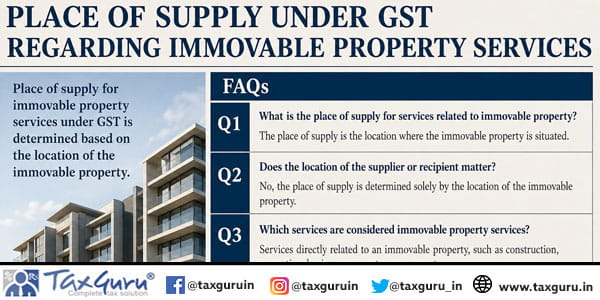
Ans. Under Section 12(3) of the IGST Act, 2017, the place of supply for services directly related to an immovable property is the location of the immovable property or the intended location of such property. This rule applies irrespective of the general place of supply provisions under Section 12(2).
Q.2 Which services are covered under the immovable property provisions of Section 12(3)?
Ans. Section 12(3) covers services such as those provided by architects, interior decorators, surveyors, engineers, estate agents, construction-related services, hotel and lodging accommodation, accommodation for functions, and ancillary services directly connected with immovable property.
Q.3 Does the GST treatment change if the recipient of an immovable property service is registered under GST?
Ans. No. The recipient’s GST registration status does not change the place of supply for services covered under Section 12(3). The place of supply continues to be the location of the immovable property, and the applicable GST is determined accordingly.
Q.4 Is the ‘Bill-to Ship-to’ concept applicable to services relating to immovable property?
Ans. No. The “Bill-to Ship-to” provisions generally apply to the movement of goods under Section 10(1)(b) of the IGST Act and do not apply to services relating to immovable property. Such services are invoiced through a normal tax invoice based on the applicable place of supply provisions.
Q.5 How is the place of supply determined if the immovable property is located outside India or in more than one State?
Ans. Where the immovable property is located outside India, the place of supply is the location of the recipient of services. If the property is situated in more than one State or Union Territory, the supply is treated as made in each such State or Union Territory, with the value apportioned according to the contract or other prescribed basis.
*****
Disclaimer: Nothing contained in this document is to be construed as a legal opinion or view of either of the author whatsoever and the content is to be used strictly for informational and educational purposes. While due care has been taken in preparing this article, certain mistakes and omissions may creep in. the author does not accept any liability for any loss or damage of any kind arising out of any inaccurate or incomplete information in this document nor for any actions taken in reliance thereon.







Thanks for the valuable information