PF Withdrawal for International Workers in India – Why Age 58 Still Matters (SSA vs Non-SSA Explained)
Introduction
India’s Provident Fund (PF) framework for International Workers (IWs) has been a source of sustained confusion for employers, expatriates, and payroll teams alike. One of the most frequently misunderstood aspects is the withdrawal of accumulated PF balances, particularly the continued relevance of the retirement age of 58 years for certain categories of international workers.
Unlike domestic employees, who may withdraw PF accumulations upon cessation of employment subject to prescribed conditions, international workers are governed by distinct and more restrictive rules, shaped by the Employees’ Provident Funds and Miscellaneous Provisions Act, 1952 (“EPF Act”), the Employees’ Provident Fund Scheme, 1952 (“EPF Scheme”), and India’s bilateral Social Security Agreements (SSAs).
This article examines why age of 58 continues to remain a decisive threshold for PF withdrawal by international workers, the statutory basis for this distinction, and the practical implications for both employers and expatriates.
Quick Snapshot – PF Withdrawal for International Workers
- SSA country → Withdrawal allowed after employment (subject to SSA)
- Non-SSA country → Withdrawal only at age 58
- No withdrawal on leaving India (non-SSA)
- No salary cap on contributions
Who Is an “International Worker” Under Indian PF Law?
The concept of an “International Worker” was introduced into the EPF framework through amendments effective 1 October 2008, with the intent of aligning India’s social security regime with international mobility.
Under Paragraph 83 of the EPF Scheme, an International Worker includes:
- A foreign national working for an establishment in India to which the EPF Act applies and holding a non-Indian passport; or
- An Indian national who has worked or is going to work in a country with which India has entered into a Social Security Agreement and is eligible to avail social security benefits under that agreement.
Once classified as an international worker, the individual becomes subject to special contribution and withdrawal rules, irrespective of the duration of assignment or level of remuneration. There is no salary ceiling for international workers, unlike domestic employees, whose PF contributions are capped at the statutory wage threshold.
Mandatory PF Coverage and Contributions for International Workers
Every international worker employed by an EPF covered establishment in India is mandatorily required to participate in the Indian PF system from the first day of employment, unless a specific exemption applies under an SSA.
Key features include:
- 12% employee contribution
- 12% employer contribution
- No wage ceiling
- Applicable even if salary paid offshore
This uncapped contribution regime is one of the primary reasons PF accumulations for international workers can become substantial over relatively short assignments.
Withdrawal of PF by International Workers – Key Determinants
For domestic employees, PF withdrawal is permitted upon:
- Retirement (on or after age 58), or
- Termination of employment followed by a continuous period of unemployment, subject to conditions.
However, international workers are governed by a more restrictive withdrawal framework, which hinges critically on whether India has entered into an SSA with the worker’s home country.
Role of Social Security Agreements (SSAs)
India has entered into bilateral Social Security Agreements with several countries to prevent double social security contributions and to facilitate portability of benefits.
SSAs typically provide for:
1. Detachment – It provides exemption from contribution to social security scheme in host country provided employee’s compliance with social security scheme of their home country and furnishing of Certificate of Coverage (CoC). CoC is a proof of detachment on the basis of which exemption is available from contribution in host country for the period of detachment mentioned in CoC.
2. Exportability – Under exportability benefit, employees can choose to receive social security benefits in their host country or their home country without any reduction in their benefits. This allows employees to get the benefits in the home country or in third country on completion of assignment or retirement.
3. Totalisation – Under totalisation benefit, period of service rendered by the employee in foreign country is counted while determining the eligibility for benefits wherein such benefits are linked to the length of service.
Where an SSA applies, the international worker may be issued a CoC by the home country’s social security authority, exempting the worker from Indian PF contributions for the covered period.
However, where PF contributions have been made in India (either due to absence of a CoC or expiry of detachment), withdrawal rules under the EPF Scheme become relevant.
Withdrawal Rules for International Workers: SSA vs Non SSA Countries
1. International Workers from SSA Countries
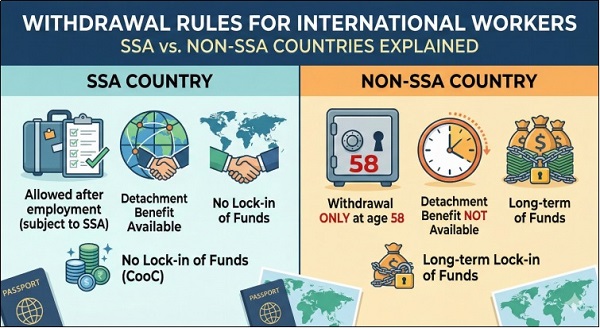
Where an international worker is a national of a country with which India has an operative SSA, PF withdrawal may be permitted upon cessation of Indian employment, subject to the terms of the applicable agreement.
In such cases:
- PF accumulations may be withdrawn immediately after completion of Indian assignment; or
- The service period may be totalised with overseas service for pension eligibility, depending on the SSA.
This provides early access to PF funds and avoids long-term lock-in.
2. International Workers from Non SSA Countries
For international workers whose home country does not have an SSA with India, the withdrawal regime is significantly more restrictive.
Under the EPF Scheme:
- PF withdrawal is permitted only upon retirement, i.e., on or after attaining 58 years of age; or
- In cases of permanent and total incapacity; or
- In the event of death (through nominee or legal heirs).
Importantly, cessation of Indian employment does not, by itself, permit withdrawal for such international workers.
This remains the core reason why age 58 continues to be critical so critically for expatriates from non-SSA countries.
Why Has the Age-58 Rule Been Retained?
The rationale for retaining the age-58 retirement condition for non-SSA international workers is rooted in the social security nature of the EPF scheme.
Key considerations include:
- EPF is designed as a retirement benefit, not a short term savings mechanism
- In the absence of bilateral arrangements, India seeks to prevent premature erosion of retirement corpus
- The framework mirrors the pension centric approach adopted in many jurisdictions
From a policy perspective, the restriction also acts as an incentive for countries to enter into SSAs with India, thereby enabling reciprocal benefit portability.
Practical Challenges Arising from the Age 58 Condition
1. Long Term Lock-In of PF Funds
International workers from non-SSA countries may leave India after a short assignment but remain unable to access PF accumulations for decades, leading to liquidity concerns.
2. Tracking and Administration Issues
Employers often struggle with:
- Maintaining active PF accounts for former employees
- Address changes and KYC updates
- Responding to EPFO queries years after assignment completion
3. Tax and Estate Planning Concerns
Locked in PF balances raise questions around:
- Taxability upon eventual withdrawal
- Nomination and succession planning
- Cross-border estate administration
Common Misconceptions Clarified
Misconception 1: “PF can be withdrawn after leaving India”
Incorrect for non-SSA international workers. Physical departure from India has no bearing on PF withdrawal eligibility.
Misconception 2: “Offshore salary payment avoids PF lock-in”
Incorrect. PF applicability is linked to employment with an Indian establishment, not salary payment location.
Misconception 3: “Short assignments are exempt from PF withdrawal restrictions”
Incorrect. Duration of assignment does not relax withdrawal rules.
Employer Perspective: Compliance and Risk Management
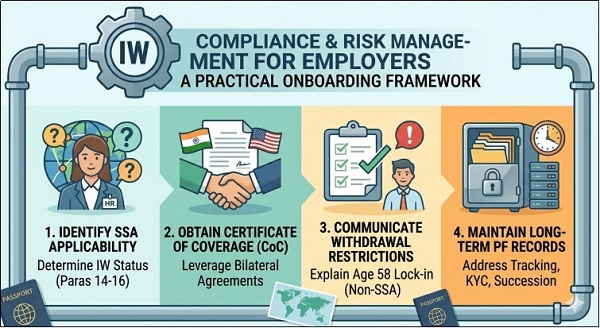
Employers engaging international workers should:
- Identify SSA applicability at onboarding stage
- Obtain Certificates of Coverage wherever available
- Clearly communicate PF withdrawal restrictions to assignees
- Maintain long-term PF records for exited international workers
Failure to manage expectations upfront often results in disputes and reputational risk.
Practical Advisory for Employers and Expatriates
- Evaluate SSA applicability before assignment
- Obtain Certificate of Coverage where possible
- Explain PF withdrawal restrictions during onboarding
- Maintain updated KYC and nominee details
- Plan long-term tax and liquidity implications
Conclusion
The continued relevance of age 58 for PF withdrawal by international workers is not an anomaly but a deliberate design feature of India’s social security framework. In the absence of Social Security Agreements, Indian law treats PF as a retirement-linked benefit, with limited scope for early access.
For expatriates, this underscores the importance of understanding PF implications before accepting Indian assignments. For employers, it reinforces the need for robust onboarding disclosures and SSA planning.
As global mobility continues to expand, clarity on PF withdrawal rules particularly the age-58 threshold remains essential to ensure compliance, manage expectations, and avoid long-term disputes.
********
Author can be reach out for any queries at email ID – [email protected]
Disclaimer: This article serves an educational purpose and should not be considered as professional advice. Consultation with a qualified individual is recommended before making any decisions based on the content provided. The author bears no responsibility for any actions taken based on this article.