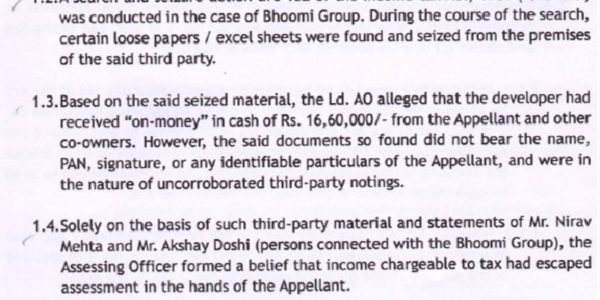
Income Tax : The ruling clarifies that unauthenticated digital chats and screenshots cannot form the sole basis of tax additions without proper...
Income Tax : Judicial rulings clarify that satisfaction for initiating action against other persons in search cases must be recorded promptly. ...
Income Tax : Section 270A penalties must specify the exact misreporting clause. Vague notices invalidate penalties and can restore immunity und...
Income Tax : Understand the three core processes of Indian Income Tax: Rectification of mistakes (Sec 154), the four types of Assessment (Summa...
Income Tax : Understand your legal rights and procedural protections during Income Tax and PMLA raids in India. Learn what to do and what to a...
CA, CS, CMA : Legal opinion sought by NFRA on auditing standards, penalties, and regulatory roles in India. Analysis of NFRA’s powers under th...
Income Tax : Learn about the new block assessment provisions for cases involving searches under section 132 and requisitions under section 132A...
Goods and Services Tax : The Ministry of Finance reports the arrest of a firm's finance head for GST evasion worth Rs 88 crore. Learn about the case and it...
Income Tax : The Central Board of Direct Taxes ( CBDT) has directed re-opening of all cases under the search and seizure label, income-escapin...
Income Tax : The case examined whether compensation paid to exit prior agreements was a sham arrangement. The Tribunal ruled it was a valid bus...
Income Tax : The Tribunal held that an unsigned agreement without corroboration cannot be treated as incriminating material. Proceedings under ...
Income Tax : The Tribunal deleted additions where the Revenue failed to prove actual cash transactions. It emphasized that suspicion and assump...
Income Tax : The Tribunal held that loan repayment cannot be treated as unexplained cash credit under section 68. The addition was deleted as i...
Income Tax : Reassessment proceedings was invalid for a notice issued beyond three years without the sanction of the prescribed higher authorit...
Income Tax : Read the order issued by the Central Board of Direct Taxes (CBDT), Ministry of Finance, specifying the scope of the e-Appeals Sche...
Income Tax : Dispute arose between the Department and the assessees with regard to adjustment of such seized/requisitioned cash against advance...
The ruling clarifies that unauthenticated digital chats and screenshots cannot form the sole basis of tax additions without proper verification and legal compliance.
The Court examined whether reassessment based on search could extend beyond statutory timelines. It held that the notice for AY 2015–16 was issued beyond the permissible ten-year period. The ruling confirms that limitation provisions must be strictly followed.
The case involved reassessment triggered by a search conducted in 2022. The Court ruled that reopening beyond the 10-year statutory limit is not permissible.
ITAT Delhi held that granting of mandatory approval under section 153D of the Income Tax Act by Additional Commissioner of Income Tax in a mechanical manner and without due application of mind is an empty ritual. Thus, order held void-abinitio for want of valid approval u/s. 153D.
The tribunal ruled that unverified claims of cash payments based on third-party material cannot justify tax additions. It emphasized that evidence must directly implicate the taxpayer.
The issue was validity of reopening beyond the limitation period. The Tribunal held the notice issued after the prescribed time was invalid, and quashed the entire reassessment.
The case addressed whether a special audit can be ordered without establishing complexity or defects in accounts. The Court examined whether mechanical invocation of Section 142(2A) without proper justification is legally sustainable.
The Court ruled that the reassessment notice was invalid as it exceeded the statutory 10-year limit under Section 153A. It clarified that the search year must be included in computing the extended limitation period.
The issue involved additions for alleged cash payments based on third-party data and statements. ITAT deleted the additions, holding that no independent evidence or cross-examination opportunity was provided.
The issue was whether reassessment under Section 147 is valid after a search. The ITAT held it invalid, ruling that only Section 153A applies post-search, making the reassessment void.