Income Tax : This highlights the ambiguity in classifying AI-generated income under existing tax provisions. It explains how classification imp...
Corporate Law : Over-reliance on AI tools can lead to errors, data risks, and poor decisions. The key takeaway is to balance AI use with human exp...
Corporate Law : The policy limits AI to administrative and research roles while prohibiting its use in judgments or legal reasoning. It reinforces...
Income Tax : The article explains how AI-driven systems identify complex fraud patterns missed by manual audits. The key takeaway is that autom...
Corporate Law : The issue concerns changing consumer behaviour in food discovery. The article explains that AI-generated videos help restaurants c...
CA, CS, CMA : The message underscores how technological advancements like AI and digital finance are reshaping the profession. It highlights the...
Fema / RBI : The government informed Parliament that mule accounts are increasingly used in cyber frauds. RBI has introduced AI-based tools and...
Income Tax : The Income Tax Department conducted surveys across multiple cities after AI analysis revealed significant discrepancies between tr...
Corporate Law : India expands affordable AI access through subsidised compute, national datasets, and large-scale infrastructure. The initiative a...
Income Tax : The Ministry of Finance details how AI tools are enhancing tax compliance. The use of AI for e-verification and targeted campaigns...
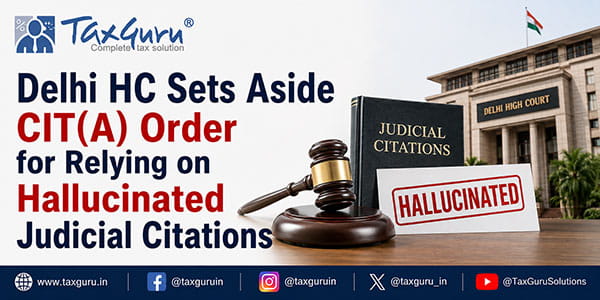
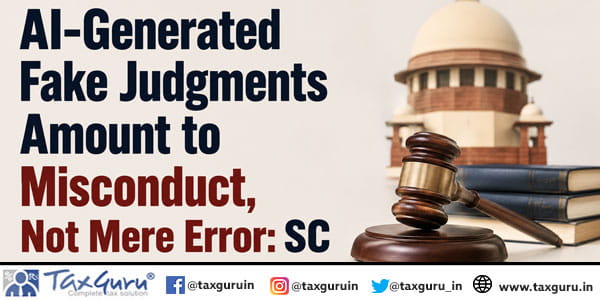
Goods and Services Tax : The High Court flagged serious flaws in a GST adjudication order that cited non-existent and unrelated judgments. It indicated the...
Company Law : Bombay High Court held that revisionary order which set aside eviction order is not sustainable in law. Court also held that using...
Income Tax : Bombay High Court sets aside NFAC’s ₹27.91 crore assessment on KMG Wires Pvt. Ltd., citing non-consideration of key evidence a...
Income Tax : Bombay High Court directs tax revision for an AI-generated invalid return order lacking reasoning, stressing natural justice and h...
Corporate Law : In present facts of the case, the Hon’ble High court observed that ChatGPT cannot be the basis of adjudication of legal or factu...
SEBI : SEBI’s circular enables existing AIFs to convert to AI-only or LVF schemes, enhancing operational flexibility while requiring in...
Fema / RBI : The Reserve Bank of India has released a report outlining the FREE-AI framework, a set of principles and recommendations for the r...
Fema / RBI : RBI sets up a committee to create a framework for responsible AI use in the financial sector, focusing on governance, risks, and a...
Artificial intelligence is enabling faster decision-making, fraud detection, and automated compliance in financial and tax systems. However, issues such as the “black box” nature of AI and regulatory oversight remain critical concerns.
Introduction Artificial Intelligence (AI) enables computers to perform tasks that normally require human intelligence- such as learning from data, recognizing patterns, making decisions, understanding language, and automating complex work. Using technologies like machine learning and natural language processing, AI helps businesses improve accuracy, reduce manual effort, and make smarter decisions. The Audit That Never Slept […]
Discover practical strategies to reduce expenses while maintaining quality and momen-tum. From AI tools to cash flow planning, these cost-cutting tips help protect margins in a tight economy.
Artificial Intelligence is transforming audits by enabling 100% transaction testing, reducing sampling risk, and enhancing fraud detection.
India expands affordable AI access through subsidised compute, national datasets, and large-scale infrastructure. The initiative aims to make AI innovation accessible to startups, researchers, and public institutions.
Bombay High Court held that revisionary order which set aside eviction order is not sustainable in law. Court also held that using AI tool as aid for filing submission without verifying its content is not acceptable.
Examines whether works created using generative AI meet India’s legal standards of originality and authorship under existing copyright law.
Examines AI’s impact on revenue projections, cost structures, and long-term valuation assumptions. Takeaway: AI can enhance analysis but cannot replace professional judgement.
Explains why financial institutions must shift from periodic audits to embedding continuous controls in AI systems. Key takeaway: Effective governance reduces operational, regulatory, and systemic risks from autonomous AI agents.
This explains how AI allows auditors to examine entire transaction populations instead of samples. The key takeaway is improved audit accuracy and risk coverage.