1. A New Chapter in Customer Protection for NBFCs
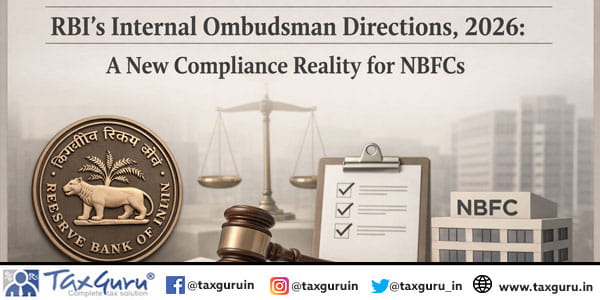
On January 14, 2026, the Reserve Bank of India (RBI) issued the Reserve Bank of India (Non-Banking Financial Companies – Internal Ombudsman) Directions, 2026, marking a significant shift in how customer grievances must be handled within NBFCs. These Directions replace the earlier Internal Ombudsman Directions, 2023 and reflect RBI’s sharper focus on speed, accountability, fairness, and governance in customer complaint resolution.
The new framework aims to ensure that no customer complaint is rejected without an independent, apex-level review within the NBFC itself.
2. Why the New Directions Matter
NBFCs have rapidly expanded their footprint, touching millions of customers through digital lending, payments, and credit products. With scale comes responsibility.
The 2026 Directions are designed to:
- Strengthen internal grievance redressal
- Reduce customer dependence on external ombudsman mechanisms
- Ensure natural justice before complaint rejection
- Improve Board-level oversight of customer service failures
3. Who Must Comply? – Applicability at a Glance
The Directions apply to:
- Deposit-taking NBFCs (NBFC-D) with 10 or more branches
- Non-deposit taking NBFCs (NBFC-ND) with asset size ≥ ₹5,000 crore and public customer interface
Excluded entities include:
- Housing Finance Companies
- Core Investment Companies
- IDF-NBFCs, IFCs, NOFHCs
- Primary Dealers and Mortgage Guarantee Companies
NBFCs crossing the threshold after March 31, 2025 must comply within six months.
4. The Internal Ombudsman: The Apex Gatekeeper
a) Who Can Be an Internal Ombudsman (IO)?
An IO must:
- Be a retired or serving senior officer (GM-level or equivalent)
- Have a minimum of 7 years’ experience in banking, NBFCs, regulation, payments, credit information, or consumer protection
- Not have any past or present association with the NBFC or its group entities
- Be below 70 years of age at the end of tenure
The IO is positioned as an independent authority, not a management functionary.
b) Deputy Internal Ombudsman: Strengthening Capacity
The 2026 Directions formally strengthen the role of the Deputy Internal Ombudsman (Dy. IO):
- DGM-level or equivalent
- Minimum 5 years’ relevant experience
- Can decide complaints as delegated by Board-approved policy
- Reports functionally to the IO
This reflects RBI’s recognition of growing complaint volumes and complexity.
c) Fixed Tenure, Strong Safeguards
Key tenure safeguards include:
- Minimum tenure: 3 years
- Maximum total tenure: 5 years (including extensions)
- No premature removal without Board approval
- Mandatory overlap between outgoing and incoming IO
- Emoluments cannot be reduced during tenure
These measures reinforce independence and continuity.
d) What Complaints Go to the IO?
The IO does not accept complaints directly from customers.
The IO reviews only:
- Partially resolved complaints
- Wholly rejected complaints
After internal handling but before final closure, such complaints must be auto-escalated to the IO through a fully automated Complaint Management System (CMS).
e) Time Is of the Essence: Strict Timelines
- Complaints must be escalated:
√ Within 20 days in normal cases
√ Earlier, where RBI / NPCI / card-network timelines apply
- Final communication to the complainant:
- Within 30 days of receipt of the complaint
The IO must be given at least 10 days to review time-sensitive complaints.
f) Reasoned Decisions & Compensation
Every IO / Dy. IO decision must be a “reasoned decision”, clearly explaining:
√ Why the NBFC’s decision is upheld or overturned
√ Whether compensation is warranted
Compensation may include:
√ Regulatory compensation as prescribed by RBI
√ Consequential loss
√ Harassment or mental agony (aligned with RBI Integrated Ombudsman Scheme)
g) Boardroom Accountability: No More Blind Spots
The Directions significantly elevate Board oversight:
- IO is a permanent invitee to Board meetings
- Quarterly or half-yearly IO reports to the Board
- Any overruling of IO decisions requires:
√ Approval of the Competent Authority (MD/CEO/ED)
√Mandatory placement before the Board
- RBI Ombudsman decisions against the NBFC must be analysed quarterly
h) Technology, Audit & Supervision
NBFCs must ensure:
√ Fully automated CMS with IO access
√ Read-only access for IOs to RBI’s Complaint Management System
√ Annual internal audit of the IO framework (excluding merit of decisions)
√ Quarterly regulatory reporting to RBI in the prescribed format
5. What’s New?
Key Differences: 2023 vs 2026 Directions
| Aspect | 2023 Directions | 2026 Directions |
|---|---|---|
| Entity coverage | All Regulated Entities | Dedicated, NBFC-specific framework |
| Complaint categorization | Multiple classifications | Only 3: Fully Resolved, Partially Resolved, Wholly Rejected |
| Deputy IO role | Limited clarity | Clearly defined powers & reporting |
| Auto-escalation | Broad guidance | Mandatory system-driven auto-escalation |
| Timelines | Less granular | Defined IO review & closure timelines |
| Board oversight | General | Explicit approval & review obligations |
| Compensation | Limited reference | Expanded scope, including mental agony |
| Performance assessment | Not specified | Comparison with RBI Ombudsman outcomes |
| Training & awareness | Not emphasized | Mandatory use of IO insights in staff training |
6. The Bigger Picture: Culture Over Compliance
The 2026 Directions go beyond procedural compliance. They push NBFCs to:
√ Treat complaints as early warning signals
√ Embed customer fairness into governance
√ Reduce regulatory friction by resolving issues internally
In essence, RBI expects NBFCs to move from a defensive complaint-handling approach to a customer-centric resolution culture.
7. Conclusion: A Stronger Safety Net for Customers
The Reserve Bank of India’s Internal Ombudsman Directions, 2026 represent far more than a routine regulatory update. They signal a decisive recalibration of expectations from the NBFC sector—one in which customer fairness, institutional independence, and Board accountability are no longer aspirational ideals but enforceable standards.
By mandating an independent, apex-level review of every partially resolved or rejected complaint, RBI has closed a long-standing gap in grievance redressal frameworks. The era of silent closures, procedural rejections, and opaque decision-making is drawing to a close. In its place, the regulator has embedded the principles of natural justice, reasoned decision-making, and accountability directly into the internal architecture of NBFCs.
Perhaps the most significant shift lies in the movement of customer grievances into the Boardroom. The Internal Ombudsman is no longer a peripheral function; it is now an institutional conscience—one that reports to the Board, challenges management decisions, and surfaces systemic weaknesses. By requiring Board visibility into overruled IO decisions, adverse RBI Ombudsman outcomes, and root-cause analyses, the Directions ensure that customer harm is treated as a governance risk, not merely an operational lapse.
For NBFC managements, the message is equally clear. Complaint redress can no longer be reduced to turnaround times and closure metrics. The focus must shift toward quality of resolution, consistency of outcomes, and fairness of reasoning. Systems must be redesigned, frontline staff retrained, and internal cultures recalibrated to view complaints as early warning signals—indicators of process gaps, product design flaws, or communication failures.
For customers, the 2026 Directions offer something that regulations often promise but rarely deliver: a meaningful second look. The assurance that a rejected complaint has been independently reviewed by a senior, experienced authority within the institution itself strengthens confidence in the system and reduces the asymmetry of power between large financial entities and individual borrowers.
Importantly, even NBFCs outside the mandatory ambit—such as Base Layer, non-deposit taking, non-systemic entities—cannot afford to be complacent. While the formal requirement to appoint an Internal Ombudsman may not apply to them, the regulatory tone is unmistakable. Expectations around fair conduct, grievance handling, and customer respect now cut across the entire sector, irrespective of size or systemic importance.
Ultimately, the Internal Ombudsman Directions, 2026 challenge NBFCs to make a strategic choice. They can treat the framework as a compliance checklist—meeting minimum requirements while resisting its spirit. Or they can embrace it as an opportunity to strengthen governance, reduce regulatory friction, and build long-term customer trust in an increasingly competitive financial marketplace.
RBI has drawn the line clearly: fairness must precede finality, and accountability must precede convenience. How NBFCs respond to this challenge will not only shape their regulatory standing but also define their credibility in the eyes of customers, Boards, and the market at large.
****
Disclaimer: The information provided is for educational purposes and should not be considered as professional advice. The author shall not be liable for any direct, indirect, special, or incidental damage resulting from, arising out of, or in connection with the use of the information.