The Reserve Bank of India issued the “Commercial Banks – Capital Charge for Credit Risk (Standardised Approach) Directions, 2026” to implement the Basel III framework for calculating risk-weighted assets in a more consistent and risk-sensitive manner. Applicable from April 1, 2027, the Directions mandate the Standardised Approach for assessing credit risk across banking book exposures, covering sovereigns, banks, corporates, MSMEs, retail, real estate, and off-balance sheet items. The framework prescribes detailed risk weights based on external credit ratings, exposure types, and collateral, while emphasizing due diligence, alignment with internal risk assessment, and prudent valuation norms. It also introduces refined treatment for specialised lending, NPAs, unhedged foreign currency exposures, and credit risk mitigation techniques. Overall, the Directions aim to strengthen capital adequacy, enhance risk management practices, and ensure greater transparency and comparability in banking regulation.
RESERVE BANK OF INDIA
RBI/DOR/2026-27/397
DOR.CRE.REC 5/21.06.201/2026-27 | Dated: April 27, 2026
Reserve Bank of India (Commercial Banks – Capital Charge for Credit Risk – Standardised Approach) Directions, 2026
1. Introduction
The Basel Committee on Banking Supervision had issued the final ‘Basel III framework (Basel III: Finalising post-crisis reforms) in December 2017 with a view to ensuring prudent and credible calculation of risk-weighted assets for arriving at capital ratios for banks in a comparable and risk-sensitive manner. The framework has permitted two broad approaches for calculating risk-based capital requirements for credit risk, viz., the Standardised Approach (SA) and the Internal Ratings Based approach (IRB). The Reserve Bank of India has decided to implement the Standardised Approach (SA) for credit risk for banks under its jurisdiction, as prescribed in these Directions.
2. Powers Exercised and Commencement
1. In exercise of the powers conferred by the Sections 21 and 35A of the Banking Regulation Act, 1949, the Reserve Bank of India (hereinafter called the ‘Reserve Bank’ or RBI) being satisfied that it is necessary and expedient in the public interest and in the interest of depositors so to do, hereby, issues these instructions hereinafter specified.
2. These instructions shall come into effect from April 01, 2027.
3. Scope
1. These instructions shall apply, unless specified otherwise, to the banking book exposures of Commercial Banks (hereinafter collectively referred to as ‘banks’ and individually as a ‘bank’).
2. For the purpose of these Directions, ‘Commercial Banks’ means banking companies (other than Small Finance Banks, Payments Banks, and Local Area Banks), corresponding new banks, and the State Bank of India, as defined respectively under clauses (c), (da), and (nc) of Section 5 of the Banking Regulation Act, 1949.
4. Definitions
(1) In these instructions, unless the context otherwise requires, the terms herein shall bear the meanings assigned to them below:
(i) “Capital market exposure” shall have the same meaning as defined in ‘Reserve Bank of India (Commercial Banks – Concentration Risk Management) Directions, 2025, as amended from time to time.
ii. “Commercial Real Estate exposure” means an exposure secured by real estate and which is not a residential real estate
iii. “Commitment” with reference to a bank’s off-balance sheet exposures shall mean any contractual arrangement that has been offered by the bank and accepted by its counterparty to extend credit, purchase assets or issue credit substitutes. It includes any such arrangement that can be unconditionally cancelled by the bank at any time without prior notice to the obligor. It also includes any such arrangement that can be cancelled by the bank if the obligor fails to meet conditions set out in the facility documentation, including conditions that must be met by the obligor prior to any initial or subsequent drawdown under the arrangement.
iv. “Consumer Credit” shall have the same meaning as defined in Banking Statistics I (Harmonised Definitions) on the RBI’s website.
v. “Counterparty banks” shall mean other Commercial Banks, Small Finance Banks, Payments Banks, Regional Rural Banks, Local Area Banks, Urban Cooperative banks, Rural Co-operative Banks and All India Financial Institutions (AIFIs) on which a bank takes exposures.
Explanation: Rural Co-operative Banks shall mean State Co-operative Banks and Central Co-operative Banks, unless specified otherwise, as defined in the National Bank for Agriculture and Rural Development Act, 1981.
vi. “Equity exposures” shall mean exposures of a commercial bank to equity of an investee counterparty as also any exposure as defined in Appendix 1 to these Directions.
vii. “Issue” for the purpose of Chapter IV of these Directions shall mean a specific liability – either a credit facility or a debt instrument – of the issuer.
viii. “Issuer” for the purpose of Chapter IV of these Directions shall mean a counterparty to whom a bank has an exposure.
ix. “Local Government Bodies” shall mean institutions of the local self-governance, which look after the local planning, development and administration of a specified area or community such as villages, towns, or cities.
x. “Member lending Institutions (MLIs)” shall have the same meaning as defined in relevant credit guarantee schemes of the Government of India.
xi. “Micro, Small and Medium Enterprises (MSMEs)” shall mean the enterprises as defined in the MSMED Act, 2006 as amended from time to time.
xii. “Multilateral Development Bank (MDB)” shall mean an institution, created by a group of countries that provides financing and professional advice for economic and social development projects. MDBs have large sovereign memberships and may include both developed countries and/or developing countries. Each MDB has its own independent legal and operational status, but with a similar mandate and a considerable number of joint owners.
xiii. “Non-performing assets (NPAs)” and “Stage 3 assets” shall be as defined in the Reserve Bank of India (Commercial Banks – Asset Classification, Provisioning and Income Recognition) Directions, 2026, as amended from time to time.
xiv. “Object finance” is a form of Specialised Lending under Corporate Exposures, and shall mean the method of funding the acquisition of an equipment (eg ships, aircraft, satellites, railcars, and fleets) where the repayment of the loan is dependent on the cash flows generated by the specific asset(s) that have been financed and pledged or assigned to the lender.
xv. “Operational phase” shall have the same meaning as defined in the Reserve Bank of India (Commercial Banks – Credit Facilities) Directions, 2025.
xvi. “Other Capital Instruments” shall mean capital instruments issued by the investee entity which are not included in Equity exposures as defined in sl. no. (vi) above.
xvii. “Personal loans” shall be as defined in Banking Statistics I (Harmonised Definitions) on the RBI’s website.
xviii. “Pre-operational phase” of a project shall mean the phase before the operational phase.
xix. “Project finance” is a form of Specialised Lending under Corporate Exposures, and shall have the same meaning as defined in the Reserve Bank of India (Commercial Banks – Credit Facilities) Directions, 2025.. In addition, for the purpose of these Directions, a project finance shall also include refinancing of an existing installation, with or without improvements.
xx. “Real Estate” means an immovable property that is land, including agricultural land 5 and forest, or anything treated as attached to land, in particular buildings, in contrast to being treated as movable property.
(xxi) “Residential Real Estate exposure” means an exposure that is secured by a property that has the nature of a dwelling and satisfies all applicable laws and regulations enabling the property to be occupied for housing purposes. Indicative examples of such exposures are exposures secured by houses, apartments, etc.
(xxii) “Specialised lending exposure” for the purpose of risk weights shall mean a lending which possesses some or all of the following characteristics, either in legal form or economic substance:
a. The exposure is not related to real estate and is either a project finance or an object finance.
b. The exposure is typically to an entity (often a special purpose vehicle (SPV)) that was created specifically to finance and/or operate physical assets;
c. The borrowing entity has few or no other significant assets or activities, and therefore little or no independent capacity to repay the obligation, apart from the income that it receives from the asset(s) being financed. The primary source of repayment of the obligation is the income generated by the asset(s), rather than the independent capacity of the borrowing entity; and
d. The terms of the obligation give the lender a substantial degree of control over the asset(s) and the income that it generates.
(xxiii) “Speculative unlisted equity exposures” shall mean equity investments in unlisted companies that are invested for short-term resale purposes (ie. up to one year) or are considered venture capital or similar investments which are subject to price volatility and are acquired in anticipation of significant future capital gains.
Provided that a bank’s investments in unlisted equities of corporate clients arising from debt-equity swaps for restructuring purpose would not be treated as speculative unlisted equity exposures.
(xxiv) “Subordinate Debt” shall mean debt instruments of the issuer which are subordinate in claim to the senior debt.
(xxv) “Transactors” shall mean obligors in relation to facilities such as credit cards and charge cards where the balance has been repaid in full at each scheduled repayment date (including the grace period of three days) for the previous 12 months.
(2) All other expressions, unless defined herein, shall have the same meaning as have been assigned to them under the Banking Regulation Act,1949 or the Reserve Bank of India Act, 1934 or any statutory modification or re-enactment thereto or as used in commercial parlance, as the case may be.
CHAPTER II – GENERAL INSTRUCTIONS
5. General
1. Under the standardised approach (SA), banking book exposures shall be risk weighted either as per the risk weights prescribed for specific categories of exposures or as per the ratings assigned by eligible credit rating agencies (ECRAs), as stipulated in these Directions.
2. Risk weighted assets (RWAs) shall be calculated as the product of the standardised risk weights and the exposure amount. The exposures shall be risk-weighted net of specific provisions (including partial write-offs).
3. Risk weights prescribed under these Directions shall be without prejudice to any action that the Reserve Bank may take relating to specific exposures on account of macroprudential considerations, if any.
4. Mere prescription of risk weights for any exposure shall not be construed as regulatory approval for a specific type of activity, which is otherwise not permitted.
5. The requirements covering the use of external ratings are set out in Chapter IV of these Directions. The credit risk mitigation techniques that are permitted to be recognised under the standardised approach are set out in Chapter V of these Directions.
6. Due diligence requirements
1. The banks shall put in place a system of due diligence to ensure that, (i) they have an adequate understanding, at origination and thereafter on a regular basis (at least annually), of the risk profile and characteristics of the counterparty; and (ii) the risk weights assigned to counterparty is broadly aligned with the bank’s internal credit assessment.
Provided that the due diligence requirements do not apply to exposures to Sovereigns and Central Banks covered under paragraphs 7 and 8 below.
Provided further that, due diligence analysis must never result in the application of a risk weight lower than the applicable base risk weight as per the external credit rating.
2. The sophistication of the due diligence shall be appropriate to the size and complexity of banks’ activities. Banks may give proper consideration to the climate-related financial risks as part of the counterparty due diligence.
(3) For exposures to entities belonging to consolidated groups, due diligence shall be performed at the solo level to which there is a credit exposure. In evaluating the repayment capacity of the solo entity, banks shall take into account the support of the group and the potential for it to be adversely impacted by problems in the group.
(4) Banks shall demonstrate to the supervisor that due diligence has been performed as per the policy approved by the Board.
CHAPTER III – EXPOSURE CLASSES AND RISK WEIGHTS
7. Exposures to Domestic Sovereigns
1. Both fund based and non-fund-based claims on the Central Government shall attract a zero per cent (0%) risk weight. Central Government guaranteed claims shall also attract a zero per cent (0%) risk weight.
2. Direct loan / credit / overdraft exposure, if any, of banks to the State Governments and investments in State Government securities shall attract zero per cent (0%) risk weight. However, claims guaranteed by the State Governments shall attract 20 per cent risk weight.
3. The risk weight applicable to claims on Central Government exposures shall also apply to the claims on the Reserve Bank of India and DICGC.
4. For credit facilities extended under schemes guaranteed by Credit Guarantee Fund Trust for Micro and Small Enterprises (CGTMSE), Credit Risk Guarantee Fund Trust for Low Income Housing (CRGFTLIH) and individual schemes under National Credit Guarantee Trustee Company Ltd. (NCGTC) which are backed by an unconditional and irrevocable guarantee provided by Government of India, a zero percent (0%) risk weight shall be applicable to the extent of guarantee coverage subject to the following conditions:
i. Prudential Aspects: The guarantees provided under the respective schemes should comply with the requirements for credit risk mitigation framework covered under Chapter V of these Directions.
ii. Restrictions on permissible claims: Where the terms of the guarantee schemes restrict the maximum permissible claims through features like specified extent of guarantee coverage, clause on first loss absorption by member lending institutions (MLI), payout cap, etc., the zero per cent (0%) risk weight shall be restricted to the maximum permissible claim and the residual exposure shall be subjected to risk weight as applicable to the counterparty in terms of these Directions.
iii. In case of a portfolio-level guarantee, the extent of exposure subjected to first loss absorption by the MLI, if any, shall be subjected to full capital deduction and the residual exposure shall be subjected to risk weight as applicable to the counterparty, on a pro rata basis. The maximum capital charge shall be capped at a notional level arrived at by treating the entire exposure as unguaranteed.
Provided that, any scheme launched on or after September 7, 2022 under any of the aforementioned Trust Funds shall be eligible for zero percent (0%) risk weight only if, (a) it qualifies all the conditions prescribed in paragraph 7(4) (i) to (iii) above; (b) the scheme provides for settlement of the eligible guaranteed claims within thirty days from the date of lodgment; and, (c) the lodgment of claim under such scheme is permitted within sixty days from the date of default.
Some illustrative examples of risk weights applicable on claims guaranteed under specific existing schemes are as follows:
| Scheme name | Guarantee Cover | Risk Weight |
|---|---|---|
| 1. Credit Guarantee Fund Scheme for Factoring (CGFSF) | The first loss of 10% of the amount in default to be borne by Factors. The remaining 90% (i.e., second loss) of the amount in default will be borne by NCGTC and Factors in the ratio of 2:1 respectively | First loss of 10% amount in default – Full capital deduction
60% amount in default borne by NCGTC- 0% RW. Balance 30% amount in default Counterparty / Regulatory Retail Portfolio (RRP) RW as Applicable Note – The maximum capital charge shall be capped at a notional level arrived by treating the entire exposure as unguaranteed. |
| 2. Credit Guarantee Fund Scheme for Skill Development (CGFSD) | 75% of the amount in default. 100% of the guaranteed claims shall be paid by the Trust after all avenues for recovery have been exhausted and there is no scope for recovering the default amount | Entire amount in default – Counterparty / Regulatory Retail
Portfolio (RRP) RW as applicable. |
| 3. Credit Guarantee Fund for Micro Units (CGFMU) | Micro Loans
The first loss to the extent of 3% of amount in default. Out of the balance, guarantee will be to a maximum extent of 75% of the amount in default in the crystallized portfolio |
First loss of 3% amount in default – Full capital deduction
72.75% of the amount in default – 0% RW, subject to maximum of ({15%∗CP}−C)∗ SLACP Where- CP = Crystallized Portfolio (sanctioned amount) • C = Claims received in previous years, if any, in the crystallized portfolio • SLA = Sanctioned limit of each account in the crystallized portfolio • 15 per cent represents the payout cap Balance amount in default – Counterparty / RRP RW as applicable. Note – The maximum capital charge shall be capped at a notional level arrived by treating the entire exposure as unguaranteed. |
| 4.CGTMSE guarantee coverage for Micro-Enterprises | Up to ₹5 lakh
85% of the amount in default subject to a maximum of ₹4.25 lakh Above ₹5 lakh & up to ₹50 lakh 75% of the amount in default subject to a maximum of ₹37.50 lakh Above ₹50 lakh & up to ₹200 lakh 75% of the amount in default subject to a maximum of ₹150 lakh |
Guaranteed amount in default – 0% RW*
Balance amount in default – Counterparty / RRP RW asapplicable. |
| *In terms of the payout cap stipulations of CGTMSE, claims of the member lending institutions will be settled to the extent of 2 times of the fee including recovery remitted during the previous financial year. However, since the balance claims will be settled in subsequent year / s as the position is remedied, the entire extent of guaranteed portion may be assigned zero percent risk weight. | ||
Note: The regulatory stipulation in paragraph 7(4) above shall be applicable to a bank to the extent it is recognised as an eligible MLI under the respective schemes.
5. The claims on Export Credit Guarantee Corporation of India (ECGC) shall attract a risk weight of 20 per cent.
6. The above risk weights for both direct claims and guaranteed claims shall be applicable as long as they are classified as ‘standard’ / performing assets. Where such Central Government guaranteed exposures are classified as non-performing and / or Stage 3, they shall attract risk weights as prescribed in paragraph 17.
(7) The risk weights prescribed under paragraphs 7(1) to 7(5) shall be applied only if such exposures are denominated in Indian Rupees and also funded in Indian Rupees.
8. Exposures to Foreign Sovereigns and Foreign Central Banks
1. Exposures to foreign sovereigns and foreign central banks shall attract risk weights as per the ratings assigned to those sovereigns / sovereign claims and Central Banks / Central Bank claims by international credit rating agencies as follows:
Table 1: Risk weight table for sovereigns and central banks
| S&P*/ Fitch rating category |
AAA to AA |
A | BBB | BB to B |
Below B |
Unrated |
|---|---|---|---|---|---|---|
| Moody’s rating category |
Aaa to Aa3 |
A1 to A3 | Baa1 toBaa3 |
Ba1 to B3 |
Below B3 |
Unrated |
| Risk weight
(%) |
0 | 20 | 50 | 100 | 150 | 100 |
* Standard & Poor’s
Note: The modifiers “+” or “-” have been subsumed with the main rating category.
Illustration: The risk weight assigned to an investment in US Treasury Bills by overseas branch of an Indian bank in Paris, irrespective of the currency of funding, shall be determined by the rating assigned to the Treasury Bills, as indicated in Table 1 above.
2. If a foreign jurisdiction has exercised its national discretion to allow its banks to risk weight their domestic currency exposures to their sovereign and central bank lower than what is accorded as per the external ratings in Table 1, then Indian banks can also use the same risk weight for similar exposures in those jurisdictions, provided that such exposures are funded in the same currency. However, in case a Host Supervisor requires a more conservative treatment to such claims in the books of the Indian banks, they shall adopt the requirements prescribed by the Host Country supervisors for computing capital adequacy.
Provided that in cases where a foreign jurisdiction has exercised its discretion to treat its regional governments as equivalent to sovereign for capital adequacy purposes, the risk weights assigned to exposures of banks to such regional governments shall be subject to a floor as follows:
i. In case such regional governments have revenue raising powers and have specific institutional arrangements the effect of which is to reduce their risk of default, the risk weights shall not be less than the risk weights as per the rating of the foreign sovereign as per Table 1.
ii. In case such regional governments do not have revenue raising powers, the risk weights shall not be less than the risk weights as per the rating of the foreign sovereign as per Table 2:
Table 2: Risk weight floors for foreign regional governments, which do not have revenue raising powers, and treated as sovereign by the foreign jurisdiction
| External | AAA to | A to | BBB to | BB to | Below | Unrated |
|---|---|---|---|---|---|---|
| rating category of the sovereign |
AA | A | BBB | B | B | |
| Risk weight (%) | 20 | 50 | 100 | 100 | 150 | 100 |
9. Exposures to Public Sector Entities (PSEs)
Exposures to public sector entities and local government bodies – both domestic and foreign – shall be risk weighted in a manner similar to claims on Corporates as per paragraph 12.
10. Exposures to MDBs, BIS and IMF
(1) Exposures to the Bank for International Settlements (BIS), the International Monetary Fund (IMF) and the following eligible Multilateral Development Banks (MDBs), as updated from time to time, shall be assigned a uniform zero percent (0%) risk weight:
i. World Bank Group: IBRD and IFC, MIGA and IDA,
ii. Asian Development Bank,
iii. African Development Bank,
iv. European Bank for Reconstruction and Development,
v. Inter-American Development Bank,
vi. European Investment Bank,
vii. European Investment Fund,
viii. Nordic Investment Bank,
ix. Caribbean Development Bank,
x. Islamic Development Bank,
xi. Council of Europe Development Bank,
xii. International Finance Facility for Immunization (IFFIm), and
xiii. Asian Infrastructure Investment Bank (AIIB)
(2) Exposures to all other MDBs shall be risk weighted as per the rating assigned by the international credit rating agencies as under:
Table 3: Exposures to other MDBs
| S&P/ Fitch rating category |
AAA to AA |
A | BBB | BB to B | Below B | Unrated |
|---|---|---|---|---|---|---|
| Moody’s rating category |
Aaa to Aa3 |
A1 to A3 |
Baa1 to Baa3 |
Ba1 to B3 |
Below B3 | Unrated |
| Risk weight (%) | 20 | 30 | 50 | 100 | 150 | 50 |
11. Exposures to Banks
(1) Exposures covered under this paragraph include all exposures of banks to their counterparty banks, excluding exposures in equity, capital instruments and subordinated debt instruments which are covered in paragraph 13 of these Directions. Banks shall assign to their rated bank exposures, the “base” risk weights based on the external ratings according to Table 4.
Explanation: As specified in paragraph 4(1)(v) above, “Counterparty banks” shall also include All India Financial Institutions (AIFIs).
Table 4: Exposures to Banks (Incorporated in India or outside), Foreign Bank branches in India and WOS of foreign banks in India
| External ratingcategory of counterparty |
AAA to AA |
A | BBB | BB to B | Below B |
Unrated |
|---|---|---|---|---|---|---|
| “Base”risk weight (%) | 20 | 30 | 50 | 100 | 150 | 100 |
| Risk weight for short-term exposures (%) | 20 | 20 | 20 | 50 | 150 | 50 |
Explanation: External ratings of the parent bank may be considered as rating of foreign bank operating in branch mode for risk weight purposes.
2. Exposures to banks with an original maturity of three months or less, as well as exposures to banks that arise from the movement of goods across national borders with an original maturity of six months or less, can be assigned a risk weight that correspond to the risk weights for short term exposures in Table 4. Other short-term claims shall be risk weighted as given in Table 23 or 24, as the case may be.
Explanation: The exposures to banks that arise from the movement of goods across national borders may include on-balance sheet exposures such as loans and off-balance sheet exposures such as self-liquidating trade-related contingent items.
3. Such exposures of the Indian branches of foreign banks, which are guaranteed / counter-guaranteed by their overseas Head Offices (HO) or the bank’s branch in another country, shall amount to a claim on the parent foreign bank, and shall also attract the risk weights as per Table 4. However, if the bank branch having such exposure decides to reckon the exposure on the original counterparty instead of on its HO, then the exposure shall attract the risk weight as applicable to the counterparty as per these Directions.
4. To reflect transfer and convertibility risk under unrated exposures, a risk-weight floor based on the risk weight applicable to exposures to the sovereign of the country where the bank counterparty is incorporated shall be applied to the risk weight assigned to bank exposures. The sovereign floor applies when: (i) the exposure is not in the local currency of the jurisdiction of incorporation of the debtor bank; and (ii) for a borrowing booked in a branch of the debtor bank in a foreign jurisdiction, when the exposure is not in the local currency of the jurisdiction in which the branch operates. The sovereign floor shall not apply to short-term (i.e. with a maturity below one year) self-liquidating, trade-related contingent items that arise from the movement of goods.
12. Exposures to Corporates
(1) Scope
i. Exposures to corporates include exposures (loans, bonds, receivables, etc.) to incorporated entities, associations, partnerships, Limited Liability Partnerships (LLPs), proprietorships, trusts, funds and other entities with similar characteristics.
Explanation: Exposures include all fund based and non-fund based exposures other than those which qualify for inclusion under ‘sovereign’, ‘bank/AIFIs’, ‘regulatory retail’, ‘real estate’, ‘non-performing assets / Stage 3 assets’, or any other specified category addressed separately in these Directions.
ii. This exposure class also includes exposures to securities firms, primary dealers, NBFCs, insurance companies and other financial institutions not covered under paragraph 11. The corporate exposure class shall not include exposures to individuals and exposures to micro, small and medium enterprises (MSMEs) meeting the criteria prescribed under paragraphs 14 and 15.
iii. Notwithstanding above, exposures to corporates classified as capital market exposure shall be risk weighted as prescribed in paragraph 19 of these Directions.
iv. Exposures to Subordinate debt, equity and other capital instruments of corporates are covered under paragraph 13 of these Directions.
v. Exposures to Corporates fully secured by real estate, either as primary security or collateral or both, shall be risk weighted as prescribed for real estate exposure class in paragraph 16 of these Directions.
(2) The corporate exposure class differentiates between the following subcategories:
i. General Corporate Exposures
ii. Specialised Lending Exposures
(3) General Corporate Exposures
Exposures to corporates shall be assigned risk weights as per the “base” risk weights in Tables 5 and 6 below, adjusted for the average one-year ODR for each rating category published by the respective ECRAs, as specified in Chapter IV of these Directions.
Table 5: Long Term Claims on Corporates – Base Risk Weights
| External rating category of counterparty |
AAA and AA | A | BBB | BB | Below BB |
Unrated |
|---|---|---|---|---|---|---|
| Base risk weight (%) | 20 | 50 | 75 | 100 | 150 | 100 |
Table 6: Short Term Claims on Corporates – Risk Weights
| External rating category of counterparty |
A1+ | A1 | A2 | A3 | A4 & D | Unrated |
|---|---|---|---|---|---|---|
| Base risk weight (%) | 20 | 20 | 50 | 100 | 150 | 100 |
Note:
a. No claim on an unrated corporate may be given a risk weight preferential to that assigned to its sovereign of incorporation.
b. All unrated claims on corporates (including those categorized as MSMEs) and NBFCs, except specialized lending exposures in terms of paragraph 12 (4) below, having aggregate exposure from banking system of more than ₹500 crore, will attract a risk weight of 150 per cent.
c. Notwithstanding (b) above, banks may assign risk weights to such unrated exposures based on the issuer rating or another issue-specific rating of the same counterparty (excluding NBFC-CIC), in terms of Chapter IV of these Directions.
d. NBFC-CICs shall always be risk weighted at 100 per cent.
(4) Specialised Lending Exposures
(i) Corporate exposures in the form of Specialised Lending, i.e., either a Project Finance or an Object Finance, and where issue-specific ratings are not available, shall be risk-weighted according to this sub-paragraph.
ii. For the purpose of risk-weighting, projects shall be classified under: (a) Preoperational phase, or (b) Operational phase.
iii. Specialised lending exposures, where issue-specific external ratings are available, shall be assigned risk weights according to paragraph 12(3), i.e., as per the “base” risk weights in Tables 5-6, adjusted for the one-year ODR for each rating category published by the respective ECRAs, as specified in Chapter IV of these Directions.
iv. Specialised lending exposures where the activity is related to real estate shall be treated like a real estate exposure class for the purpose of risk weights.
v. Issuer ratings or rating of an issue of a counterparty in which the bank does not have an exposure shall not be used in the case of specialised lending exposures. Specialised lending exposures for which an issue-specific external rating is not available shall be risk weighted as per the Table 7 below:
Table 7: Corporate exposures classified as Specialised Lending (not related to real estate) – Risk Weights
| Specialised lending subcategory → |
Object finance | Project Finance | ||
|---|---|---|---|---|
| Pre- operational phase |
Operational phase | |||
| Non-High Quality Projects |
High Quality Projects |
|||
| Risk weight (%) | 100 | 130 | 100 | 80 |
vi. Operational Phase of Project Finance: The risk weights of 100 per cent or 80 per cent, as the case may be, as per Table 7 shall be applicable for operational phase only if the borrower entity has (a) a positive net cash flow that is sufficient to cover any remaining contractual obligation, and (b) started repayment of interest and principal dues. Till both the conditions are achieved, the risk weight shall continue at 130 per cent even under operational phase.
vii. During the operational phase, a project that is able to meet its financial commitments in a timely manner and its ability to do so is assessed to be robust against adverse changes in the economic cycle and business conditions will be classified as High Quality Projects. Such projects, on meeting the following criteria
in addition to the conditions specified in the paragraph 12(4)(vi), shall attract a favourable risk weight of 80 per cent as per Table 7:
a. The infrastructure project has completed at least one year of operations post achievement of the date of completion of commercial operations, without breach of any material covenants stipulated by the lenders;
b. The borrower entity is restricted from acting to the detriment of the creditors through suitable covenants, e.g., being restricted from issuing additional debt without the consent of existing creditors;
c. The borrower entity has sufficient reserve funds or other financial arrangements to cover the contingency funding and working capital requirements of the project;
d. The revenues are availability-based or subject to a rate-of-return regulation or take-or-pay contract. For instance, annuities under build-operate-transfer (BOT) model in respect of road/ highway projects and toll collection rights, where there are provisions to compensate the project sponsor if a certain level of traffic is not achieved, and banks’ right to receive annuities and toll collection rights is legally enforceable and irrevocable;
e. The borrower’s revenue depends on rights granted under concession / contract by the Central Government, a State Government, a public sector entity, or a statutory or regulatory body, or a corporate entity with a risk weight of 80 per cent or lower and the contractual provisions provide for protection of these rights for the entire period of concession/ contract as long as the borrower fulfils its obligations under the contract;
f. The concession / contractual provisions provide for a high degree of protection for a lender, which shall, at a minimum, include: (i) provisions of an escrow / Trust and Retention Account mechanism for ringfencing the cash flows; (ii) pari-passu charge in favour of the lender over all movable and immovable assets; and (iii) mitigation of risk for lenders in case of early termination (eg. step-in rights for the lenders, minimum termination payments etc).
Explanation:
I. Availability-based revenues mean that once construction is completed, the project finance entity is entitled to payments from its contractual counterparties (eg the government), as long as contract conditions are fulfilled.
II. Rate of return regulation is a form of price setting regulation where government
or an authority determines the fair price allowed to be charged by a public utility.
III. Take or pay contracts between a buyer and a seller of good and/or services mandate buyers to either accept the pre-determined quantity of goods/services at a pre-determined price or pay a penalty, ensuring risk-sharing between suppliers and buyers.
13. Exposures to Subordinated Debt, Equity and Other Capital Instruments
(1) Scope
i. Exposures for which this paragraph would apply shall include subordinate debt, equity and other regulatory capital instrument issued by counterparty banks and corporates. Corporates for this purpose are as defined in paragraph 12.
ii. Exposures shall exclude instruments deducted from the regulatory capital of the investing bank or investments which are required to be risk weighted at 250 per cent as per Chapter III of the Reserve Bank of India (Commercial Banks – Prudential Norms on Capital Adequacy) Directions, 2025, as amended from time to time, and banks’ equity investment in funds as prescribed in paragraph 18 of these Directions.
(2) The following risk weights shall be applicable for such exposures:
Table 8 – Exposures to Subordinated debt, equity and other capital instruments – Risk Wights
| Exposure Type → | Equity Exposures | Speculative Unlisted Equity |
Subordinate debt and other Capital Instruments |
|---|---|---|---|
| Risk Weight (%) | 250 | 400 | 150 |
(3) All investments in the paid-up equity of non-financial entities (other than subsidiaries) which exceed 10 per cent of the issued common share capital of the issuing entity or where the entity is an unconsolidated affiliate as defined in paragraph 28(8)(ii)(c)(i) of the Reserve Bank of India (Commercial Banks – Prudential Norms on Capital Adequacy) Directions, 2025shall receive a risk weight of 1250 per cent. Equity investments equal to or below 10 per cent paid-up equity of such investee companies shall be assigned a risk weight as per Table 8 above.
14. Retail Exposures
1. Claims (including both fund-based and non-fund based) that meet all the four criteria listed below in paragraph 14(3) shall be considered as retail claims for regulatory capital purposes and included in a regulatory retail portfolio.
2. Claims included in regulatory retail portfolio shall be assigned a risk weight of 75 per cent.
3. Qualifying Criteria for regulatory retail portfolio:
i. Orientation Criterion: The exposure (both fund based and non-fund based) is to an individual person or persons or to small business. A person under this clause shall mean any non-commercial entity capable of entering into contracts and shall include but not be restricted to individual and HUF.
Explanation: Small business for this purpose would include an MSME or any other business entity having a turnover equal to or less than ₹500 crore. If such MSME or business entity is affiliated to another business entity, then the turnover criteria of equal to or less than ₹500 crore shall be qualified at the Group level.
ii. Product criterion: The exposure (both fund and non-fund based) takes the form of any of the following: revolving credits and lines of credit (including credit cards which qualify as transactors), term loans and leases (e.g. instalment loans and leases), commitments and facilities for small businesses and student and educational loans.
iii. Low value of individual exposures: The maximum aggregated exposure to one counterparty cannot exceed an absolute threshold of ₹10 crore.
iv. Granularity criterion: Banks must ensure that the regulatory retail portfolio is sufficiently diversified to a degree that reduces the risks in the portfolio, warranting the 75 per cent risk weight. No aggregated exposure to one counterparty can exceed 0.2 per cent of the overall regulatory retail portfolio. While banks may appropriately use the group exposure concept for computing aggregated exposures, they should evolve adequate systems to ensure strict adherence with this criterion. NPAs under retail loans are to be excluded from the overall regulatory retail portfolio when assessing the granularity criterion for risk weighting purposes.
Explanation:
I. ‘Aggregated exposure’ in this context means gross amount (i.e. not taking any benefit for credit risk mitigation into account) of all forms of retail exposures excluding residential real estate exposures.
II. ‘One counterpart’ means one or several entities that may be considered as a single beneficiary (e.g. in the case of a MSME that is affiliated to another MSME, the limit shall apply to the bank’s aggregated exposure on both businesses).
III. To apply the 0.2 per cent threshold of the granularity criterion, banks must: first, identify the full set of exposures in the retail exposure class (as defined by the orientation criterion in paragraph 14(3)(i)); second, identify the subset of exposure that meet product criterion and do not exceed the threshold for the value of aggregated exposures to one counterparty; and third, exclude any exposures that have a value greater than 0.2 per cent of the subset before exclusions.
(4) The following claims, both fund-based and non-fund-based, shall be excluded from the regulatory retail portfolio:
i. Personal Loans (excluding education loans meeting regulatory retail criteria);
ii. Credit card receivables other than those which qualify as transactors;
iii. Capital Market Exposures;
iv. Derivative exposures;
v. Real Estate Exposures as per paragraph 16 of these Directions;
vi. Loans and Advances to bank’s own staff which are fully covered by superannuation benefits and / or mortgage of flat/ house.
(5) For the purpose of ascertaining compliance with the absolute threshold, exposure shall mean sanctioned limit or the actual outstanding, whichever is higher, for all fund based and non-fund based facilities, including all forms of off-balance sheet exposures. In the case of term loans and EMI based facilities, where there is no scope for redrawing any portion of the repaid amount, exposure shall mean the actual outstanding.
6. The risk weight assigned to the retail portfolio would be evaluated with reference to the default experience for these exposures. As part of the supervisory review process, an assessment would be made on whether the credit quality of regulatory retail claims held by individual banks should warrant a standard risk weight higher than 75 per cent.
7. “Other retail” exposures to individuals not meeting the criteria of regulatory retail portfolio in paragraph 14(3) shall be risk-weighted as follows:
i. Personal loans (other than education loans meeting the regulatory retail criteria and transactor credit card receivables, loans fully secured by real estate, vehicle loans, and microfinance loans), shall attract a risk weight of 125 per cent;
ii. Loans to individuals that are fully secured by real estate, either as primary security or collateral or both, shall be risk weighted as prescribed in real estate asset class under paragraph 16.
iii. Credit card receivables other than those which qualify as transactors under regulatory retail portfolio asset class shall attract a risk weight of 125 per cent;
iv. Exposures to individuals that are classified as ‘capital market exposures’ shall attract a 125 per cent risk weight;
v. Exposures in respect of personal loans secured by gold and gold jewellery shall be worked out under the comprehensive approach as per Chapter V. The ‘exposure value after risk mitigation’ shall attract the risk weight of 125 per cent.
vi. Microfinance loans that are in the nature of consumer credit and are not eligible for classification under ‘regulatory retail’ shall attract a risk weight of 100 per cent.
vii. All other credit exposure to individuals shall attract a risk weight of 100 per cent, unless specified otherwise.
15. Exposure to Micro, Small and Medium Enterprises (MSMEs)
(1) Exposures to MSMEs shall be risk weighted as follows:
(i) Exposures to MSMEs fully secured by real estate, either as primary security or collateral or both, shall be risk weighted as prescribed in real estate asset class under paragraph 16.
ii. Exposures to MSMEs that are classified as capital market exposure shall be risk weighted as per paragraph 19(1).
iii. Rated exposures to MSMEs shall be risk weighted as per paragraph 12(3) of these Directions.
iv. Unrated exposures to MSMEs shall be risk weighted as follows:
v. Unrated exposure to MSMEs that meet the criteria of regulatory retail portfolio given in paragraph 14(3) shall be risk weighted at 75 per cent.
vi. Other unrated exposures to MSMEs not meeting the regulatory retail criteria exposures shall be risk weighted at 85 per cent.
Provided that unrated capital market exposures and specialised lending exposures to MSMEs shall be risk weighted as per paragraphs 19(1) and 12(4), respectively.
Provided further that unrated exposures to MSMEs (excluding specialised lending exposures under Corporate Exposures) having aggregate exposure from banking system of more than ₹500 crore shall attract a risk weight of 150 per cent.
(2) The Reserve Bank may increase the standard risk weight for unrated MSME claims where a higher risk weight is warranted by the overall default experience. As part of the supervisory review process, the Reserve Bank would also consider whether the credit quality of unrated MSME claims held by individual banks should warrant a standard risk weight higher than 85 per cent.
16. Real Estate Exposures
(1) General Conditions: Real estate exposures of a bank shall be subject to the following general conditions:
(i) Underwriting Policies: For exposures that qualify for real estate exposure asset class, banks shall put in place underwriting policies with respect to the granting of mortgage loans that include the assessment of the ability of the borrower to repay. Underwriting policies must define metric(s) (such as the loan’s debt service coverage ratio, debt service-to-income ratio) and specify its (their) corresponding relevant level(s) to conduct such assessment. Underwriting policies must also be appropriate when the repayment of the mortgage loan depends materially on the cash flows generated by the property, including relevant metrics (such as an occupancy rate of the property and likely income).
(ii) Value of the property: Banks shall put in place a policy for valuation of properties accepted as security for their exposures. The valuation shall be appraised independently using prudently conservative valuation criteria. To ensure that the value of the property is appraised in a prudently conservative manner, the valuation must exclude expectations on price increases and must be adjusted to take into account the potential for the current market price to be significantly above the value that shall be sustainable over the life of the loan. Valuations shall be made as specified in the Reserve Bank of India (Commercial Banks – Credit Risk Management) Directions, 2025, taking into account inter alia the valuation standards notified by Central Government (viz. Companies (Registered Valuers and Valuation) Rules, 2017). If a market value can be determined, the valuation should not be higher than the market value.
Explanation:
a. The valuation must be done independently from the bank’s mortgage acquisition, loan processing and loan decision process. The valuation done by a bank’s empanelled independent valuer in terms of the Reserve Bank of India (Commercial Banks – Credit Risk Management) Directions, 2025 shall deem to comply with this requirement.
b. In the case where the mortgage loan is financing the purchase of the property, the value of the property for LTV purposes shall not be higher than the effective purchase price. The effective purchase price for this purpose shall be the cost of housing property as per the Chapter VIII of the Reserve Bank of India (Commercial Banks – Credit Facilities) Directions, 2025.
(iii) The bank is expected to monitor the value of the collateral at least once in three years. More frequent monitoring is suggested where the market is subject to significant changes in conditions. Statistical methods of evaluation may be used to update estimates or to identify collateral that may have declined in value and that may need re-appraisal. A qualified professional valuer must evaluate the property when information indicates that the value of the collateral may have declined materially relative to general market prices or when exposures are classified as NPA and / or Stage 3.
(iv) LTV ratio: LTV ratio shall be computed as a percentage of ‘total loan outstanding’ in the numerator and the ‘realisable value’ of the residential property mortgaged to the bank in the denominator. For this purpose:
a. ‘total loan outstanding’ shall include the funded outstanding and any undrawn committed amount in the account (viz. “principal + accrued interest + other charges pertaining to the loan”) gross of any provisions and other risk mitigants, except for pledged deposit accounts with the lending bank that meet all requirements for on-balance sheet netting and have been unconditionally and irrevocably lien-marked for the sole purposes of redemption of the mortgage loan.
Explanation: If a bank grants multiple loans secured by the same property and they are sequential in ranking order (i.e. there is no intermediate lien from another bank), the multiple loans should be considered as a single exposure for risk-weighting purposes, and the amount of the loans should be added to calculate the LTV.
b. Value of the property shall be reckoned at the value measured at origination unless the value of the property has been revised downwards (as per the bank’s policy on periodic valuation of the property). These downward valuations need to be considered for LTV computation. If the value has been adjusted downwards, a subsequent upwards adjustment can be made but not to a higher value than the value at origination. The value of the property should be adjusted if an extraordinary event occurs resulting in permanent reduction of the property value. Modifications made to the property that unequivocally increase its value could also be considered in the LTV. Moreover, the value of the property must not depend materially on the performance of the borrower.
c. Notwithstanding the requirements in Sl. No. iv(b) above, upward revision in the value of property shall be permitted for the purpose of LTV after at least five years from the date of start of the loan repayment or the date of possession of the finished property by the borrower, whichever is later, based on a fresh valuation obtained by the bank for the purpose of extending a new or additional loan secured by the same property. Subsequent upward re- valuation of the property as a part of additional loan applications shall be after at least five years from the date of any previous revaluation.
(2) Qualifying conditions: Real estate exposure shall also meet the following criteria:
i. Legal enforceability: Bank’s claim on the mortgaged property must be legally enforceable. The loan agreement and the legal process underpinning it must be such that they provide for the bank to realise the value of the property within a reasonable time frame.
ii. Claims over the property: A single bank has an absolute claim or multiple banks have first pari-passu claims over the property, subject to the condition that: (a) there is an inter-creditor agreement or any other arrangements among the banks detailing the sequence of claims of individual banks over the property, (b) each bank’s loan should be fully secured by the current value of the property, either as primary security or as collateral or both, and is within the permissible LTV limit, failing which risk weights under Table 16 or 17, as applicable, shall apply.
iii. Ability of the borrower to repay: Repayment capacity of the borrower shall invariably be assessed irrespective of the value of the property and the borrower must meet the requirements set according to paragraph 16(1)(i).
iv. Prudent value of property: The property must be valued according to the criteria in paragraphs 16(1)(ii) and 16(1)(iii) for determining the value in the LTV ratio. Moreover, the valuation of the property must not depend on the credit worthiness of the borrower.
v. Required documentation: All the information required at loan origination and for monitoring purposes must be properly documented, including information on the ability of the borrower to repay and on the valuation of the property.
(3) Application of credit risk mitigation: A guarantee or financial collateral may be recognised as a credit risk mitigant in relation to exposures secured by real estate if it qualifies as eligible collateral under the credit risk mitigation framework as detailed in Chapter V of these Directions. This may include mortgage guarantee if it meets the operational requirements of the credit risk mitigation framework for a guarantee. Banks may recognise these risk mitigants in calculating the exposure amount; however, the LTV bucket and risk weight to be applied to the exposure amount must be determined before the application of the appropriate credit risk mitigation technique.
Explanation: A bank’s use of mortgage guarantee should mirror the FSB Principles for sound residential mortgage underwriting (April 2012).
(4) Categories of Real Estate Exposures
The real estate exposure asset class shall consist of:
i. Housing Loans to Individuals
ii. Commercial Real Estate – Acquisition, Development and Construction Exposures – CRE(ADC)
iii. Other Claims secured by Real Estate
(5) Housing Loans to Individuals
(i) Housing loans to individuals shall be for construction or acquisition of housing units and shall consist of the following exposures:
a. loans to individuals for purchase of a plot of land for construction of residential property;
b. loans to individuals secured by under-construction residential property on their existing plot of land for completion of construction;
c. loans to the individual members of registered associations or co-operative housing societies for construction of residential houses for the members as per the bye-laws of the society under the relevant Act;
d. loans to individuals for purchase of under-construction dwelling units in: projects registered with a relevant Real Estate Regulatory Authority (RERA) under the Real Estate (Regulation and Development) Act 2016, or other projects where registration with a RERA is not mandatory under the Act.
e. loans to individuals for acquisition of ready-built dwelling units.
Provided that:
i. in above cases (a) to (c), the construction shall start within a year and shall finish in maximum five years from the date of first disbursement as per the loan agreement with the bank, and wherever applicable, bye-laws of the Society.
ii. In case of (d), the construction shall be completed as per the terms and conditions of registration granted by the RERA in projects having mandatory registration with RERA. In cases of projects not requiring mandatory registration with RERA, the construction shall start within a year and shall finish in maximum five years from the date of first disbursement as per the loan agreement with the bank.
iii. In all the above cases, the property shall satisfy all the applicable laws and regulations enabling the property to be occupied for housing purposes upon completion
Explanation: Housing loans to individuals shall also include loans for carrying out alterations, additions, or repairs to a residential unit. Such loans must be supported by an estimate of the proposed work, stage wise disbursement based on the progress of construction, and periodic review of the construction progress by the bank.
(ii) Risk weights for housing loans to individuals:
a. Housing loans to individuals for up to two housing loans (shall include all existing as well as fresh loans, but shall exclude fully repaid loans), which shall be treated as their primary residences, shall attract the following risk weights as per the ceilings of LTV ratio prescribed subject to compliance of qualifying conditions mentioned at paragraph 16(2):
Table 9 – Housing Loans to Individuals – Up to two loans
| LTV | ≤ 50% | >50% to ≤ 60% | > 60% to ≤ 80% | > 80% to ≤ 90% |
|---|---|---|---|---|
| Risk weight (%) | 20 | 25 | 30 | 40 |
b. Risk weights on the third housing loan onward to individuals (excluding fully repaid loans) shall be as per the ceilings of LTV ratios given in the following Table subject to compliance of qualifying conditions mentioned at paragraph 16(2):
Table 10 – Housing Loans to Individuals – Third loan onward
| LTV | ≤ 50% | >50% to ≤ 60% | > 60% to ≤ 80% | > 80% to ≤ 90% |
|---|---|---|---|---|
| Risk weight (%) | 30 | 35 | 45 | 60 |
Explanation:
1. Co-applicant(s) shall also be included while counting the number of housing loans.
2. Number of housing loans shall be computed at the banking system level.
c. In both the above cases, an additional five percentage points of risk weight would be applicable if ‘total loan outstanding’ computed in terms of paragraph 16(1)(iv)(a) is ₹3 crore or above.
d. If the timelines specified in proviso i. to paragraph 16(5)(i) are not met, a risk weight of 150 per cent shall apply till the exposure remains in breach of the prescribed covenants.
(6) Commercial Real Estate Exposures – Acquisition, Development and Construction – CRE (ADC)
i. Loans to commercial entities (including proprietorship firms and HUFs) for acquisition (wherever permitted) and development of land, and / or construction of commercial or residential real estate projects where the repayment is dependent on the underlying property such as renting, leasing the units or; selling the units of the project; selling the complete, or part of, the project, etc. shall be classified as CRE(ADC) exposures.
ii. Such loans for construction of residential complexes or integrated projects (residential plus commercial) having at least 90 per cent Floor Space Index for residential real estate, and which meet all the following criteria, shall be sub-classified as CRE-RH (ADC) (Commercial Real Estate – Residential Housing (ADC)):
a. All conditions stipulated in paragraph 16(2);
b. The project should be registered with the relevant RERA, wherever the registration is mandatory under the Real Estate (Regulation and Development) Act;
c. The upfront contribution by the borrower, excluding any payment received from prospective homebuyers, shall be not less than 25 per cent of the total cost of the project. Without prejudice to the restrictions contained in Chapter VIII of the Reserve Bank of India (Commercial Banks – Credit Facilities) Directions, 2025, it is clarified that the cost of project shall be inclusive of the cost of the land, which shall be reckoned at higher of Purchase price or Circle rate.
d. Risk Weights: The following RWs shall be applicable on CRE(ADC) exposures: 31
Table 11 – Commercial Real Estate Exposures (ADC)
| Category | CRE-RH (ADC) | Other CRE (ADC) |
|---|---|---|
| Risk weight (%) | 100 | 150 |
(7) Other Claims secured by Real Estate
i. All other loans not categorised as either housing loans to individuals or CRE-ADC shall be classified under this category, including loans to commercial entities (including proprietorship firms and HUFs) against the security of existing real estate assets or for acquisition of real estate properties for business and other permissible purposes; loans against semi-finished or unfinished properties; and personal loans to individuals against their existing properties. Further, exposures classified under Capital Market Exposure but secured by existing real estate assets shall attract a risk weight treatment provided under paragraph 19(1).
ii. An exposure with multiple items of collateral can be split, according to the ratio of the values of the residential property and the commercial property, into separate exposures secured by residential real estate and commercial real estate, with the applicable risk weights as per the source of repayment. Both on- and off-balance sheet elements of such exposure should be split according to the same ratio.
iii. Apart from qualifying the General Conditions for real estate exposures as in paragraph 16(1), such loans shall also be underwritten for the purposes for which they are granted.
iv. Risk weights: The following RWs shall be applicable on such loans:
(a) Loans against, and for acquisition of, finished residential properties which qualify the conditions given in paragraph 16(2), and where the repayment is envisaged from the cash flow generated from the economic activity for which loan is taken, shall qualify for the following RWs:
Table 12 – Claims secured by residential properties – Repayment from economic activity
| LTV | ≤ 50% | >50% to ≤ 60% | > 60% to ≤ 80% | > 80% to ≤ 90% |
|---|---|---|---|---|
| Risk Weight
(%) |
20
|
25
|
30
|
40
|
b. Loans against, and for acquisition of, finished residential properties which qualify the conditions given in paragraph 16(2), and where the repayment is primarily envisaged from the rent / lease / prospective sale of the underlying property and not from cash flow generated from the economic activity for which the loan is taken, shall qualify for the following RWs:
Table 13 – Claims secured by residential properties – Repayment primarily from underlying property
| LTV | ≤ 50% | >50% to ≤ 60% | > 60% to ≤ 80% | > 80% to ≤ 90% | > 90% to ≤ 100% |
|---|---|---|---|---|---|
| Risk Weight (%) | 30 | 35 | 45 | 60 | 75 |
Explanation: The condition that repayment is primarily from the rent / lease / prospective sale of the underlying property shall mean that such cash flows from the property securing the loan is more than 50 per cent of the periodic loan servicing amount.
c. Loans against, and for acquisition of, finished commercial properties which qualify the conditions given in paragraph 16(2), and where the repayment is envisaged from the cash flow generated from the economic activity for which the loan is taken, shall qualify for the following RWs:
Table 14 – Claims secured by commercial properties – Repayment from economic activity
| LTV | ≤ 60% | > 60% |
|---|---|---|
| Risk Weight (%) | Lower of 60% or RW for the Counterparty |
RW for the Counterparty |
d. Loans against, and for acquisition of, finished commercial properties which qualify the conditions given in paragraph 16(2), and where the repayment is primarily envisaged from the rent / lease / prospective sale of the underlying property and not from the cash flow generated from the economic activity for which the loan is taken, shall qualify for the following RWs:
Table 15 – Claims secured by commercial properties – Repayment primarily from underlying property
| LTV | ≤ 60% | > 60% to ≤ 80% | > 80% to ≤ 100% |
|---|---|---|---|
| Risk Weight (%) | 70
|
90
|
110
|
e. Loans against semi-finished/unfinished residential or commercial properties, plots of land, and/or which do not qualify all the conditions given in paragraph 16(2), which are already owned by the borrower, and where the repayment is envisaged from the cash flow generated from the economic activity for which loan is taken, shall qualify for the following RWs:
Table 16 –Claims secured by Other Real Estate – Repayment from economic activity
| Counterparty Type → | Individuals | MSME | Others |
|---|---|---|---|
| Risk Weight (%)
|
75 (for loans meeting qualifying criteria for regulatory retail as per paragraph 14(3)) or 125 (for other loans) | Lower of 85 or Risk Weight applicable to counterparty |
Risk Weight applicable to the counterparty |
f. Loans against semi-finished residential or commercial properties, plots of land, and/or properties which do not qualify all the conditions given in paragraph 16(2), which are already owned by the borrower, and where the repayment is primarily envisaged from the rent / lease / prospective sale of the underlying property and not from cash flow generated from the economic activity for which the loan is taken, shall qualify for the following RWs:
Table 17 – Claims secured by Other Real Estate – Repayment primarily from underlying property
| Risk Weight (%) | 150 |
(g) Loans for construction on existing land for business purposes, where the repayment arises from cash flows of the business, shall attract risk weights as per Table 16.
Explanation: The above categories (a) to (f) above will also include personal loans to individuals against their existing properties. In cases of personal loans where repayment is not envisaged from the rent / lease / prospective sale of the underlying property but from other sources, shall attract the RWs as per Tables 12, 14 or 16, as the case may be. In cases where repayment of such personal loans would depend on rent / lease / prospective sale of the underlying property, RWs would be as per Tables 13, 15 or 17, as the case may be.
(8) Investments in mortgage backed securities (MBS) backed by exposures secured by residential property or commercial real estate shall be governed by the Reserve Bank of India (Commercial Banks – Securitisation Transactions) Directions, 2025.
17. Non-Performing Assets (NPAs)
(1) The unsecured portion of NPA / Stage 3 assets (other than qualifying residential real estate exposure which is addressed in paragraph 17 (2)), net of specific provisions (including partial write-offs), shall be risk-weighted as follows:
i. 150 per cent risk weight when specific provisions are less than 20 per cent of the outstanding amount of the NPA / Stage 3 asset
ii. 100 per cent risk weight when specific provisions are at least 20 per cent of the outstanding amount of the NPA / Stage 3 asset
iii. 50 per cent risk weight when specific provisions are at least 50 per cent of the outstanding amount of the NPA / Stage 3 asset
Explanation: Outstanding amount for this purpose includes any outstanding exposure as well as credit-equivalent amount of undrawn/non-funded exposures.
(2) The residential real estate exposures meeting the qualifying conditions specified in paragraph 16(2) and where repayments do not materially depend on cash flows generated by the property securing the loan which are NPA / Stage 3 assets, shall be risk weighted at 100 per cent net of specific provisions and partial write-offs.
(3) For the purpose of defining the secured portion of the NPA / Stage 3 assets, eligible collateral shall be the same as recognised for credit risk mitigation purposes (paragraph 37(6)). Hence, other forms of collateral like land, buildings, plant, machinery, current assets, etc. shall not be reckoned while computing the secured portion of NPAs / Stage 3 assets for calculating RWAs.
18. Equity Investments in Funds
1. This paragraph prescribes computation of RWAs for a bank’s investments in pooled funds such as Mutual Funds, Alternative Investment Fund (AIF), Hedge Fund, Fund of Funds, Real Estate Investment Trusts (REITs), Infrastructure Investment Trusts (InvITs), etc., where such investments are allowed to be held in the banking book of the investing bank. RWAs for such exposures shall be computed under one or more of the following three approaches, which vary in their risk sensitivity and conservatism: the “look-through approach” (LTA), the “mandate-based approach” (MBA), and the “fall-back approach” (FBA).
2. The requirements set out in this paragraph shall also apply to banks’ off-balance sheet exposures (e.g., unfunded commitments to subscribe to a fund’s future capital calls) in such funds. However, such exposures of banks, including underlying exposures held by the investee funds, that are required to be deducted from capital of investing banks are excluded from provisions contained in paragraphs 18(3) to 18(8).
3. The look-through approach (LTA)
(i) This is the most granular and risk-sensitive approach. It requires a bank to identify the underlying exposures of the investee fund and risk weight those exposures by notionally treating them in its own books. This approach must be used when the following conditions are met:
a. The investee fund is registered with and regulated by a financial sector regulator.
b. The investee fund makes adequate and frequent disclosures about its underlying exposures at equal or higher periodicity than that of the investing bank, and such disclosures must be granular enough to enable the investing bank to identify each distinct underlying exposure and calculate the corresponding risk weights; and
c. Such disclosures are verified and certified by an independent third party, which may include a depository, a custodian bank, or an external auditor.
ii. Under the LTA, investing banks must risk weight all underlying exposures of the investee fund as if those exposures were directly held by it in its own books. This prescription shall be applicable, inter alia, on any underlying exposure of the investee fund, such as its derivative activities, which require risk weighting treatment for the underlying asset of the derivative under minimum risk-based capital requirements as well as the associated counterparty credit risk (CCR) exposure. In such cases, instead of determining a credit valuation adjustment (CVA) charge associated with the fund’s derivatives exposures in accordance with the CVA framework (as per paragraph 85 of the Reserve Bank of India (Commercial Banks – Prudential Norms on Capital Adequacy) Directions, 2025, as amended from time to time), banks shall multiply the CCR exposure by a factor of 1.5 before applying the risk weight associated with the counterparty.
Explanation: A bank is required to apply the 1.5 factor only for transactions that are within the scope of the CVA framework.
iii. Banks may rely on third-party calculations for determining the risk weights associated with their equity investments in funds (i.e., the underlying risk weights of the exposures of the fund) if they do not have adequate data or information to perform the calculations themselves. In such cases, the applicable risk weight shall be 1.2 times higher than the one that would be applicable if the exposure were held directly by the bank.
Illustration: For instance, any exposure that is subject to a 20 per cent risk weight under the standardized approach would be weighted at 24 per cent (1.2 * 20%) when the look through is performed by a third party.
(4) The mandate-based approach (MBA)
i. The second approach, the MBA, provides a method for calculating regulatory capital that can be used when the conditions (b) and (c) of paragraph 18(3)(i) for applying the LTA are not met.
ii. Under the MBA, investing banks may use the information contained in an investee fund’s mandate or in the regulations issued by the concerned financial sector regulator governing such investment funds.
Explanation: Information used for this purpose is not strictly limited to a fund’s mandate or national regulations governing like funds. It may also be drawn from other disclosures of the fund.
(iii) To ensure that all underlying risks are taken into account (including CCR) and that the MBA renders capital requirements no less than the LTA, the risk-weighted assets for the fund’s exposures are calculated as the sum of the following three items:
a. Balance sheet exposures (i.e., the funds’ assets) shall be risk weighted assuming the underlying portfolios are invested to the maximum extent allowed under the fund’s mandate in those assets attracting the highest capital requirements, and then progressively in those other assets implying lower capital requirements. If more than one risk weight can be applied to a given exposure, the maximum risk weight applicable must be used.
Illustration: For instance, for investments in corporate bonds with no ratings restrictions, a risk weight of 150 per cent must be applied
b. Whenever the underlying risk of a derivative exposure or an off-balance-sheet item receives a risk weighting treatment under the risk based capital requirements standard, the notional amount of the derivative position or of the off-balance sheet exposure is risk weighted accordingly.
Explanation: If the underlying is unknown, the full notional amount of derivative positions must be used for the calculation. If the notional amount of derivatives is unknown, it shall be estimated conservatively using the maximum notional amount of derivatives allowed under the mandate.
c. CCR associated with the fund’s derivative exposures. Till SA-CCR is implemented, the CCR associated with the fund’s derivative exposures shall be computed in terms of paragraph (18)(3)(iv) above.
5. The fall-back approach (FBA)
Where neither the LTA nor the MBA is feasible, banks shall apply the FBA. Under FBA the bank’s equity investment in the investee fund shall be subject to full capital deduction from CET1 capital.
6. Equity exposure to funds that invest in other funds (Fund of Funds) 38
When a bank has equity exposure to Fund of Funds (FoF), then it shall first identify the underlying exposures of its own investee fund to different other funds, either using the LTA or the MBA. In the second step, it can determine the risk weights for the investee fund’s exposures by using any of the three approaches prescribed above. However, if the investee fund’s investee(s) have further investments in other funds, i.e., the investee fund has also invested in a FoF, then it shall apply only the LTA for determining the RWAs. If the necessary conditions for applying LTA are not met, then the bank must apply FBA.
(7) Computation of RWA for Equity Exposures in Fund
i. For determining the capital requirement for its equity exposures in funds under the LTA and MBA, a bank shall apply a leverage adjustment to the average risk weight of the fund (Avg RWfund). In this context, Leverage (Lvg) is defined as the ratio of total assets of the investee fund to its total equity, and Avg RWfund is obtained by dividing the total risk-weighted assets of the fund as calculated under either LTA or MBA by the total assets of the fund. In cases where the bank uses MBA, Leverage shall be the maximum financial leverage permitted in the fund’s mandate or in the SEBI regulations or regulations of the relevant financial sector regulator governing the fund.
ii. The leverage adjustment, i.e., the product of Lvg and Avg RWfund, is subject to a cap of risk weight equivalent to full capital deduction.
iii. Using Avg RWfund and taking into account the leverage of a fund (Lvg), the risk-weighted assets for a bank’s equity investment in a fund can be represented as follows:
RWAinvestment = Avg RWfd * Lvg * equity investment of the bank in the investee fund
(8) Partial use of an approach
A bank may use a combination of the three approaches when determining the capital requirements for an equity investment in an individual fund, provided that the conditions set out in paragraphs 18(1) to 18(7) are met.
(9) An illustration of the calculation of RWAs using the LTA and MBA as well as the calculation of the leverage adjustment are provided in Appendix 2.
19. Specified Categories
1. Advances classified as ‘Capital market exposures’ other than direct equity exposures as specified under paragraph 13 above, shall attract a 125 per cent risk weight or risk weight as applicable to the counterparty, whichever is higher.
2. A bank’s investment in security receipts shall be risk weighted at 150 per cent.
20. Unhedged Foreign Currency Exposure
1. Bank exposures to entities with unhedged foreign currency exposures shall attract incremental capital requirements, i.e. over and above the present capital requirements as per the instructions contained in Chapter VII of the Reserve Bank of India (Commercial Banks – Credit Risk Management) Directions, 2025, as under:
Table 18: Incremental capital for unhedged exposure
| Potential Loss/EBID (%) | Incremental Capital Requirement |
|---|---|
| Upto to 75 per cent | 0 |
| More than 75 per cent | 25 per cent increase in the risk weight |
2. For unhedged ‘retail and residential real estate exposures’ to individuals where the lending currency differs from the currency of the borrower’s source of income, banks shall apply a 1.5 times multiplier to the applicable risk weight, subject to a maximum risk weight of 150 per cent. Natural and financial hedges are considered sufficient only if they cover at least 90 per cent of the loan instalment.
Explanation:
i. The risk weight treatment at paragraph 20(2) above shall be applicable for exposures to individuals in cases where a bank, in terms of paragraph 61(1) of the Reserve Bank of India (Commercial Banks – Credit Risk Management) Directions, 2025, has exercised the option of exempting exposures to individuals from calculation of UFCE.
ii. For the purpose of risk weight treatment at paragraph 20(2) above, ‘retail and residential real estate exposures’ shall include exposures to individuals that are classified under paragraph 14 or 16.
iii. Natural Hedge: An exposure shall be considered as naturally hedged only if the offsetting exposure has the maturity / cash flow within the same accounting year. For instance, export revenues (booked as receivable) may offset the exchange risk arising out of repayment obligations of an external commercial borrowing if both the exposures have cash flows / maturity within the same accounting year.
(iv) Financial Hedge: Financial hedge shall be considered only where the entity/individual has documented the purpose and the strategy for hedging at inception of the derivative contract and assessed its effectiveness as a hedging instrument at periodic intervals. For the purpose of assessing the effectiveness of hedge, guidance may be taken from the applicable accounting standards and the relevant guidance notes of the Institute of Chartered Accountants of India on the matter.
21. Other Assets
(1) Loans and advances to bank’s own staff which are fully covered by superannuation benefits and/or mortgage of flat/ house shall attract a 20 per cent risk weight. Since flat / house is not an eligible collateral and since banks normally recover the dues by adjusting the superannuation benefits only at the time of cessation from service, the concessional risk weight shall be applied without any adjustment of the outstanding amount. In case a bank is holding eligible collateral in respect of amounts due from a staff member, the outstanding amount in respect of that staff member may be adjusted to the extent permissible under CRM mechanism.
(2) Other loans and advances to bank’s own staff shall be eligible for inclusion under regulatory retail portfolio and shall therefore attract a 75 per cent risk weight.
(3) A 20 per cent risk weight shall apply to cash items in the process of collection.
(4) A zero per cent risk weight shall apply to:
i. Cash owned and held at the bank or in transit; and
ii. Gold bullion, held if any, at the bank or held in another bank on an allocated basis, to the extent the gold bullion assets are backed by the gold bullion liabilities.
(5) All other assets shall attract a uniform risk weight of 100 per cent.
22. Off-Balance Sheet Items
(1) General
(i) The risk-weighted amount of an off-balance sheet item that gives rise to credit exposure is generally calculated by means of a two-step process:
a. the notional amount of the transaction is converted into a credit equivalent amount (CEA), by multiplying the amount with the specified credit conversion factor (CCF); and
b. the resulting CEA is multiplied by the risk weight applicable to the counterparty or to the purpose for which the bank has extended finance or the type of asset, whichever is higher.
(ii) Where the off-balance sheet item is secured by eligible collateral or guarantee, the credit risk mitigation (CRM) as detailed in Chapter V may be applied.
(2) The credit conversion factors for non-market related off-balance sheet transactions are as under:
Table 19: Credit Conversion Factors – Non-market related Off-Balance Sheet Items
| Sr. No. | Instruments | Credit Conversion Factor (%) |
|---|---|---|
| 1. | Direct credit substitutes e.g. general guarantees of indebtedness (including standby L/Cs serving as financial guarantees for loans and securities, credit enhancements, liquidity facilities for securitisation transactions),and acceptances (including endorsements with the character of acceptance). (i.e., the risk of loss depends on the credit worthiness of the counterparty or the party against whom a potential claim is acquired)
Explanation: The aggregate capital required to be maintained by the banks providing Partial Credit Enhancement will be computed as per paragraph 84(8) of the Reserve Bank of India (Commercial Banks – Prudential Norms on Capital Adequacy) Directions, 2025. |
100 |
| 2. | Sale and repurchase agreement and asset sales with recourse, where the credit risk remains with the bank.
(These items are to be risk weighted according to the type of asset and not according to the type of counterparty with whom the transaction has been entered into.) |
100 |
| 3. | Forward asset purchases, forward deposits and partly paid shares and securities, which represent commitments with certain drawdown.
(These items are to be risk weighted according to the type of asset and not according to the type of counterparty with whom the transaction has been entered into.) |
100 |
| 4. | Lending of banks’ securities or posting of securities as collateral by banks, including instances where these arise out of repo style transactions (i.e., repurchase / reverse repurchase and securities lending / securities borrowing transactions) | 100 |
| 5. | Note issuance facilities and revolving / non-revolving underwriting facilities. | 50 |
| 6. | Certain transaction-related contingent items (e.g. performance bonds, bid bonds, warranties, indemnities and standby letters of credit related to particular transaction). | 50 |
| 7. | Short-term self-liquidating trade letters of credit (with maturity below one year) arising from the movement of goods (e.g. documentary credits collateralised by the underlying shipment) for both issuing bank and confirming bank. | 20 |
| 8. | Take-out Finance in the books of taking-over institution | |
| (ix) Unconditional take-out finance | 100 | |
| (x)Conditional take-out finance | 50 | |
| 9. | Other commitments (e.g., formal standby facilities and credit lines) regardless of the maturity of the underlying facility, unless they qualify for a lower CCF.
Similar commitments as above that are unconditionally cancellable at any time by the bank without prior notice or that effectively provide for automatic cancellation due to deterioration in a borrower’s credit worthiness. |
40&
10& |
| 10. | Undrawn portion of cash credit / overdraft limits sanctioned to borrowers having aggregate fund based working capital limit of ₹150 crore and above from the banking system, irrespective of whether unconditionally cancellable or not. | 20 |
& CCF at sl. no. 9 in Table 19 above shall be staggered in two stages, as follows:
| Instruments | CCF (till 3 years from the date of implementationof these Directions) |
CCF (after 3 years from the date of implementation of these Directions) |
|---|---|---|
| Other commitments (e.g., formal standby facilities and credit lines) with an original maturity of up to one | 30% | 40% |
| year which attract 20% CCF as per extant instructions till March 31, 2027 |
||
| Other commitments (e.g., formal standby facilities and credit lines) with an original maturity of over one | 40% | 40% |
| year which attract 50% CCF as per extant instructions till March 31, 2027 |
||
| Unconditionally Cancellable Commitments (UCC) which attract 0% CCF as per extant instructions till March 31, 2027. | 5% | 10% |
Explanation:
i. Where the non-market related off-balance sheet item is an undrawn or partially
undrawn fund-based facility, the amount of undrawn commitment to be included in calculating the off-balance sheet non-market related credit exposures is the maximum unused portion of the commitment that could be drawn during the remaining period to maturity. Any drawn portion of a commitment forms a part of bank’s on-balance sheet credit exposure.
ii. Irrevocable commitments to provide off-balance sheet facilities should be assigned the lower of the CCFs as applicable on either the irrevocable commitment or on the off-balance sheet facility as stipulated in Table 19. For example, an irrevocable commitment with an original maturity of 15 months (40 per cent – CCF) to issue a six month documentary letter of credit (20 per cent – CCF) shall attract the lower of the CCF i.e., the CCF applicable to the documentary letter of credit viz. 20 per cent.
(iii) The risk-weighting treatment for counterparty credit risk must be applied in addition to the credit risk charge on the securities or posted collateral (sl. no. 4 in Table 19). This provision does not apply to posted collateral related to derivative transactions that is treated in accordance with the counterparty credit risk standards.
(3) In cases of non-market related off-balance sheet items, the following transactions with non-bank counterparties shall be treated as claims on banks:
i. Guarantees issued by banks in favour of non-banks against the counter guarantees of other banks.
ii. Rediscounting of documentary bills discounted by other banks and bills discounted by banks which have been accepted by another bank shall be treated as a funded claim on a bank.
(4) In all the above cases in paragraph 22(3), banks should be fully satisfied that the risk exposure is in fact on the other bank. If they are satisfied that the exposure is on the other bank they may assign these exposures the risk weight applicable to banks as detailed in paragraph 11. It is clarified that any CRM instrument issued by a bank (e.g. SBLC/BG from Head Office/other overseas branch) from which CRM benefits like shifting of exposure/ risk weights etc are not derived, may not be counted as an exposure on the CRM provider. In cases where the exposure is reckoned on the counterparty, risk weight of the counterparty shall apply.
(5) Issue of Irrevocable Payment Commitment by a bank to clearing corporations of Stock Exchanges on behalf of its clients is a financial guarantee with a CCF of 100 per cent. However, capital shall be maintained only on the exposure reckoned as capital market exposure (CME) in terms of the Reserve Bank of India (Commercial Banks – Concentration Risk Management) Directions, 2025. Thus, capital is to be maintained on the amount taken for CME and the risk weight shall be 125 per cent thereon.
(6) For classification of bank guarantees viz. direct credit substitutes and transaction-related contingent items etc. (sl. no. 1 and 6 of Table 19 above), the following principles should be kept in view for the application of CCFs:
(i) Financial guarantees are direct credit substitutes wherein a bank irrevocably undertakes to guarantee the repayment of a contractual financial obligation. Financial guarantees essentially carry the same credit risk as a direct extension of credit i.e., the risk of loss is directly linked to the creditworthiness of the counterparty against whom a potential claim is acquired. An indicative list of financial guarantees, attracting a CCF of 100 per cent is as under:
a. Guarantees for credit facilities;
b. Guarantees in lieu of repayment of financial securities;
c. Guarantees in lieu of margin requirements of exchanges;
d. Guarantees for mobilisation advance, advance money before the commencement of a project and for money to be received in various stages of project implementation;
e. Guarantees towards revenue dues, taxes, duties, levies etc. in favour of Tax/ Customs / Port / Excise Authorities and for disputed liabilities for litigation pending at courts;
f. Credit Enhancements;
g. Liquidity facilities for securitisation transactions;
h. Acceptances (including endorsements with the character of acceptance);
i. Deferred payment guarantees.
(ii) Performance guarantees are essentially transaction-related contingencies that involve an irrevocable undertaking to pay a third party in the event the counterparty fails to fulfil or perform a contractual non-financial obligation. In such transactions, the risk of loss depends on the event which need not necessarily be related to the creditworthiness of the counterparty involved. An indicative list of performance guarantees, attracting a CCF of 50 per cent is as under:
a. Bid bonds;
b. Performance bonds and export performance guarantees;
c. Guarantees in lieu of security deposits / earnest money deposits (EMD) for participating in tenders;
d. Retention money guarantees;
e. Warranties, indemnities and standby letters of credit related to particular transaction.
23. Capital Adequacy Requirement for Securitisation Exposures
The treatment of securitisation exposures for capital adequacy has been specified in paragraphs 88-126 of the Reserve Bank of India (Commercial Banks – Prudential Norms on Capital Adequacy) Directions, 2025.
CHAPTER IV – EXTERNAL CREDIT ASSESSMENTS
24. Eligible Credit Rating Agencies (ECRA)
(1) Reserve Bank undertakes periodic review of accreditation for identifying the eligible credit rating agencies, whose ratings shall be used by banks for assigning risk weights for credit risk. Wherever the facility provided by the bank possesses rating assigned by a chosen ECRA, the risk weight of the claim shall be based on this rating.
(2) Banks are permitted to use the ratings of the following domestic credit rating agencies (arranged in alphabetical order), subject to periodic review by the Reserve Bank, for the purposes of risk weighting their claims for capital adequacy purposes:
i. Acuité Ratings and Research Limited (Acuite);
ii. Brickwork Ratings India Private Limited;
iii. CARE Ratings Limited;
iv. CRISIL Ratings Limited;
v. ICRA Limited;
vi. India Ratings and Research Private Limited (India Ratings); and
vii. INFOMERICS Valuation and Rating Ltd. (INFOMERICS)
(3) Banks may use the ratings of the following international credit rating agencies (arranged in alphabetical order) for the purposes of risk weighting their claims on nonresident entities for capital adequacy purposes:
i. CareEdge Global IFSC Limited (only for non-resident corporates);
ii. Fitch;
iii. Moody’s; and
iv. Standard & Poor’s
25. Scope of Application of External Ratings
(1) Banks should use the chosen credit rating agencies and their ratings consistently for each type of claim, for both risk weighting and risk management purposes. Banks will not be allowed to “cherry pick” the assessments provided by different credit rating agencies and to arbitrarily change the use of credit rating agencies. If a bank has decided to use the ratings of some of the chosen credit rating agencies for a given type of claim, it can use only the ratings of those credit rating agencies, despite the fact that some of these claims may be rated by other chosen credit rating agencies whose ratings the bank has decided not to use. Banks shall not use one agency’s rating for one corporate bond, while using another agency’s rating for another exposure to the same counterparty, unless the respective exposures are rated by only one of the chosen credit rating agencies, whose ratings the bank has decided to use.
2. Banks must disclose the names of the credit rating agencies that they use for the risk weighting of their assets, the risk weights associated with the particular rating grades as determined by Reserve Bank through the mapping process for each eligible credit rating agency as well as the aggregated RWAs in the relevant template of Pillar 3 disclosures.
3. To be eligible for risk-weighting purposes, the external credit assessment must take into account and reflect the entire amount of credit risk exposure the bank has with regard to all payments owed to it. For example, if a bank is owed both principal and interest, the assessment must fully take into account and reflect the credit risk associated with timely repayment of both principal and interest.
4. To be eligible for risk weighting purposes, the rating should be in force and confirmed from the monthly bulletin of the concerned rating agency. The rating agency should have reviewed the rating at least once during the previous 15 months.
5. An eligible credit assessment must be publicly available. In other words, a rating must be published in an accessible form. Consequently, ratings that are made available only to the parties to a transaction do not satisfy this requirement.
6. A loan rating in respect of which the press release issued on rating actions by the ECRA does not disclose the name of the bank/s, and the corresponding credit facilities rated by them, shall not be eligible for being reckoned for capital computation by a bank. A bank shall treat such exposures as unrated and assign applicable risk weights in terms of paragraph 12 or 15, as applicable.
Illustration: A scenario may be assumed, where a borrower has availed credit facilities from banks A, B and C and external rating from an ECRA is obtained only in respect of the credit facility extended by the bank A. If the ECRA has disclosed the name of bank A and the corresponding credit facility rated by it, then bank A can reckon the said rating for risk weighting purpose. Banks B and C are permitted to derive risk weights for their respective unrated credit facilities subject to conditions stated in paragraph 32(2)(i), as permitted hitherto. In the event of ECRA not making the above disclosure, none of the banks shall reckon the said rating, and therefore shall apply risk weights as applicable to unrated exposures.
7. For assets in the bank’s portfolio that have contractual maturity of less than or equal to one year, short term ratings accorded by the chosen credit rating agencies would be relevant. For other assets which have a contractual maturity of more than one year, long term ratings accorded by the chosen credit rating agencies would be relevant.
8. Cash credit/overdraft exposures tend to be generally rolled over and also tend to be drawn on an average for a major portion of the sanctioned limits. Hence, even though such exposures may be sanctioned for a period of one year or less, these should be reckoned as long term exposures and accordingly the long term ratings accorded by the chosen credit rating agencies will be relevant.
9. A bank may use long-term ratings of a counterparty as a proxy for an unrated short- term exposure on the same counterparty subject to strict compliance with the requirements for use of multiple rating assessments and applicability of issue rating to issuer / other claims as indicated in subsequent paragraphs.
10. External ratings for one entity within a corporate group cannot be used to risk-weight other entities within the same group.
26. Mapping Process
A mapping of the credit ratings awarded by the chosen domestic credit rating agencies has been furnished below in paragraphs 27 and 28, which should be used by banks in assigning risk weights to the various exposures.
27. Long Term Ratings
(1) On the basis of the above factors, the ratings issued by the chosen domestic credit rating agencies have been mapped to the appropriate risk weights applicable as per the Standardised approach under the Revised Framework. The rating-risk weight mapping furnished in the Table below shall be adopted by all banks in India, subject to the adjustment detailed in paragraph 27(2) below.
Table 20: Base Risk Weight Mapping of Long Term Ratings of the chosen Domestic Rating Agencies
CARE |
CRISIL |
India
|
ICRA |
Brickwork |
Acuité
|
Infomeri cs |
Standardised
|
|---|---|---|---|---|---|---|---|
CARE AAA |
CRISIL AAA |
IND AAA |
ICRAAAA |
BrickworkAAA |
Acuité AAA |
IVR AAA |
20 |
CARE AA |
CRISIL AA |
IND AA |
ICRA AA |
BrickworkAA |
Acuité AA |
IVR AA |
20 |
CARE A |
CRISILA |
IND A |
ICRA A |
Brickwork A |
Acuité A |
IVR A |
50 |
CARE BBB |
CRISIL BBB |
IND BBB |
ICRA BBB |
Brickwork BBB |
Acuité BBB |
IVR BBB |
75 |
CARE BB |
CRISIL BB |
IND BB |
ICRA BB |
BrickworkBB |
Acuité BB |
IVR BB |
100 |
CARE B, |
CRISIL B, |
IND B, |
ICRA B, |
Brickwork B, |
Acuité B, |
IVR B, |
150 |
CARE C & CARE D |
CRISIL C & CRISIL D |
IND C &IND D |
ICRA C & ICRA D |
Brickwork C & Brickwork D |
Acuité C & Acuité D |
IVR C & IVR D |
150 |
Explanation:
Where “+” or “-” notation is attached to the rating, the corresponding main rating category risk weight should be used. For example, A+ or A- shall be considered to be in the A rating category and assigned 50 per cent risk weight
(2) Adjustment: A bank shall adjust the risk weights, as specified in Table 20 above, based on the latest available average one-year Observed Default Rate (ODR) for each rating category published by the respective domestic ECRAs and compare the same with the ODR ranges given in the Table 21. Such ODRs shall form the basis for determining the applicable risk weights to be assigned by banks.
Table 21: Reference ODR Range for Rating Categories
| External Rating by Domestic ECRA |
AAA | AA | A | BBB | BB | B and Below |
|---|---|---|---|---|---|---|
| ODR range | ODR ≤
0.05% |
0.05%< ODR ≤0.10% |
0.10%< ODR
≤ 0.20% |
0.20%< ODR
≤ 0.40% |
0.40%< ODR ≤1% |
ODR
>1% |
i. In cases where an exposure has ratings from multiple ECRAs having different reported ODRs; the external rating and its corresponding reported ODR to be used for comparison with the reference ODR shall be decided as per paragraph 30.
ii. If the reported ODR by the ECRA for a rating category is at or below the ODR range specified in Table 21, the rating category may be assigned the Base RW provided in Table 20.
iii. However, if the reported ODR for a rating category exceeds the range specified in Table 21, a RW of one bucket higher than the corresponding Base RW provided in Table 20 shall be applied.
Provided that in the case of AAA rating category, if the reported ODR exceeds the range specified in Table 21, a RW of 30 per cent shall be applied.
(3) The mapping of risk weights with long term ratings assigned by international ECRAs to non-resident corporates shall be as under:
Table 22: Risk Weight Mapping of specific Long Term Ratings of International Rating Agencies
| CareEdge Global IFSC Limited | Fitch Ratings |
Moody’s ratings |
S&P Ratings | Standardised approach risk weights(in per cent) |
|---|---|---|---|---|
| AAA | AAA | Aaa | AAA | 20 |
| AA | AA | Aa | AA | 20 |
| A | A | A | A | 50 |
| BBB | BBB | Baa | BBB | 75 |
| BB | BB | Ba | BB | 100 |
| Below BB | Below BB | Below Ba | Below BB | 150 |
28. Short Term Ratings
(1) For risk-weighting purposes, short-term ratings are deemed to be issue- specific. They can only be used to derive risk weights for exposures arising from the rated facility. They cannot be generalised to other short-term exposures, except under the conditions prescribed in paragraph 28(5). In no event can a short-term rating be used to support a risk weight for an unrated long-term claim. Short-term assessments may only be used for short-term claims against banks and corporates.
(2) Notwithstanding the above restriction on using an issue specific short-term rating for other short-term exposures, the following broad principles shall apply:
i. If a short-term rated facility to counterparty attracts a 20 per cent or a 50 per cent risk-weight, unrated short-term claims to the same counter-party cannot attract a risk weight lower than 50 per cent or 100 per cent respectively.
ii. Similarly, if an issuer has a short-term exposure with an external short term rating that warrants a risk weight of 150 per cent, all unrated claims on the same counter-party, whether long-term or short-term, should also receive a 150 per cent risk weight, unless the bank uses recognised credit risk mitigation techniques for such claims.
(3) In respect of the issue specific short term ratings the following risk weight mapping shall be adopted by banks:
Table 23: Base Risk Weight Mapping of Specific Short Term Ratings of Domestic Rating Agencies
CARE |
CRISIL |
India Ratings and
|
ICRA |
Brickwork |
Acuité
|
Infomerics |
Standardised
|
|---|---|---|---|---|---|---|---|
CARE A1+ |
CRISIL A1+ |
IND A1+ |
ICRA A1+ |
Brickwork A1+ |
Acuité A1+ |
IVR A1+ |
20 |
CARE A1 |
CRISIL A1 |
IND A1 |
ICRAA1 |
Brickwork A1 |
Acuité A1 |
IVR A1 |
20 |
CARE A2 |
CRISIL A2 |
IND A2 |
ICRAA2 |
Brickwork A2 |
Acuité A2 |
IVR A2 |
50 |
CARE A3 |
CRISIL A3 |
IND A3 |
ICRA A3 |
Brickwork A3 |
Acuité A3 |
IVR A3 |
100 |
CARE A4 & D |
CRISIL A4 & D |
IND A4 & D |
ICRA A4 & D |
Brickwork A4 & D |
Acuité A4 & D |
IVR A4 and D |
150 |
(4) Where “+” or “-” notation is attached to the rating, the corresponding main rating category risk weight should be used for A2 and below, unless specified otherwise. For example, A2+ or A2- shall be considered to be in the A2 rating category and assigned 50 per cent risk weight.
(5) In cases where short-term ratings are available, the following interaction with the general preferential treatment for short-term exposures to banks as described in paragraph 11(2) shall apply:
i. The general preferential treatment for short-term exposures applies to all exposures to banks of up to three months original maturity when there is no specific short-term claim assessment.
ii. When there is a short-term rating and such a rating maps into a risk weight that is more favourable (ie lower) or identical to that derived from the general preferential treatment, the short-term rating should be used for the specific exposure only. Other short-term exposures shall benefit from the general preferential treatment.
iii. When a specific short-term rating for a short term exposure to a bank maps into a less favourable (higher) risk weight, the general short-term preferential treatment for interbank exposures cannot be used. All unrated short-term exposures should receive the same risk weighting as that implied by the specific short-term rating.
(6) The above risk weight mapping of both long term and short term ratings of the chosen domestic rating agencies shall be reviewed annually by the Reserve Bank.
(7) The mapping of risk weights with short term ratings assigned by international ECRAs to non-resident corporates shall be as under:
Table 24: Risk Weight Mapping of specific Short Term Ratings of International Rating Agencies
| External rating | A-1/ P-1/ F-1 | A-2/ P-2/ F-2 | A-3/ P-3/ F-3 | Others |
|---|---|---|---|---|
| Risk weight (%) | 20 | 50 | 100 | 150 |
29. Use of Unsolicited Ratings
A rating would be treated as solicited only if the issuer of the instrument has requested the credit rating agency for the rating and has accepted the rating assigned by the agency. As a general rule, banks should use only solicited rating from the chosen credit rating agencies. No ratings issued by the credit rating agencies on an unsolicited basis should be considered for risk weight calculation as per the Standardised Approach.
Provided that unsolicited ratings accorded to sovereigns by international ECRAs identified under paragraph 24(3) can be used for risk weighting purposes of exposures to foreign sovereigns.
30. Use of Multiple Rating Assessments
Banks shall apply the following principles in respect of exposures / obligors having multiple ratings from the credit rating agencies chosen by the bank for the purpose of risk weight calculation:
i. Where there is only one rating by a chosen ECRA for a particular claim, such rating would be used to determine the risk weight of the claim after carrying out ODR adjustment.
ii. Where ratings are available from two of the chosen ECRAs, ODR adjustment shall be carried out on both the ratings and the higher of resultant risk weight shall be applied.
iii. Where ratings are available from three or more of the chosen ECRAs, ODR adjustment shall be carried out on the two most favourable ratings, and the higher of the resultant risk weights should be applied.
31. Norms for ‘Issuer Not Cooperating (INC)’ cases
(i) Where any rating assigned to a particular claim is classified as “Issuer Not Cooperating” (INC), banks shall determine the applicable risk weight based on all other available ratings, subject to a minimum risk weight floor of 100 per cent, during the first six months from the date of such INC classification.
ii. Where the INC classification continues beyond six months, the exposure shall attract a risk weight of 150 per cent until such time the INC rating is withdrawn by the ECRA.
iii. Upon withdrawal of the INC rating by the ECRA, banks may apply risk weights as per the applicable rating mapping criteria, based on other available ratings, as provided in the preceding paragraphs or unrated, as the case may be.
32. Applicability of ‘Issue Rating’ to the ‘Issuer’/ ‘Other exposures to the Issuer’
1. Where a bank has an exposure to a particular issue for which a issue-specific rating by a chosen credit rating agency is available, the risk weight of the exposure shall be based on this rating.
2. Where an issuer, i.e., a counterparty of a bank, has an issuer-rating and/or a rated long-term issue, but the bank has exposure to an unrated short-term or long-term issue of the issuer, then the following general principles shall apply for rating substitution of both the long-term and short-term unrated issues:
(i) Where the issuer has a long-term rated issue , and the corresponding risk weight for this specific long-term rating is lower than the corresponding risk weight for an unrated long-term issue, the specific long-term rating may be applied to the bank’s exposures to both the long-term and short-term unrated issues of this issuer, provided that:
a. the unrated issue ranks pari passu or senior to the rated long-term issue in all respects; and
b. the maturity of the unrated issue is either equal to or shorter than the maturity of the long-term rated issue.
If these conditions are not satisfied, then the unrated issue shall receive the risk weight for unrated exposures.
Illustration: In a case where a long-term issue of an issuer is rated as AAA and the issuer also has unrated short-term and long-term issues, then a bank shall assign a 20 per cent risk weight to the unrated short-term issue as well as unrated long-term issue of that issuer provided that the seniority of both the unrated issues rank pari-passu with the rated long-term issue and the maturity of the unrated issues is either equal to or shorter than the rated long-term issue.
ii. If the counterparty has an issuer rating, which maps into a risk-weight better (i.e., lower) than the applicable risk-weights for unrated exposure, then this rating may be applied to senior unsecured long-term as well as short-term unrated issues of that issuer or any unrated issue which is senior to such exposures. All other unrated issues of such issuer shall be risk-weighted as ‘unrated’.
iii. If either the issuer or a rated issue of the issuer has an external credit rating that maps into a risk weight equal to or worse (i.e., higher) than the risk weight corresponding to unrated exposures, then any unrated issue of the issuer ranking pari-passu or subordinate – either to such worse-rated issue or to unrated issues of the issuer qualifying for issuer rating, shall be assigned the risk weight corresponding to such external credit rating.
iv. If the issuer has a specific rating that only applies to a limited class of liabilities (such as a deposit assessment or a counterparty risk assessment), and if such rating corresponds to a risk weight that is lower than the risk weight for unrated exposures, then the rating may only be used in respect of exposures that fall within that class.
v. Where a bank intends to extend an issuer or an issue specific rating assigned by a chosen credit rating agency to any other exposure on the same counterparty and which meets the criterion prescribed at sub-paragraphs 32(2)(i) (a) & (b) above, it should be extended to the entire amount of credit risk exposure the bank has with regard to that exposure i.e., both principal and interest.
3. With a view to avoiding any double counting of credit enhancement factors, no recognition of credit risk mitigation techniques should be taken into account if the credit enhancement is already reflected in the issue specific rating accorded by a chosen credit rating agency relied upon by the bank.
4. If the conditions indicated in paragraph 32(2) above are not satisfied, the rating applicable to the specific issue cannot be used. This also applies to the exposures to NABARD / SIDBI / NHB / MUDRA on account of deposits placed in lieu of shortfall in achievement of priority sector lending targets / sub-targets. All such exposures shall be risk weighted as unrated exposures.
5. If an issuer has a long-term issue with an external long term rating that warrants a risk weight of 150 per cent, all unrated exposures to this issuer, whether short-term or long-term, shall also receive a 150 per cent risk weight.
6. Where unrated exposures are risk weighted based on the rating of an equivalent issue of that counterparty, the general rule is that foreign currency ratings shall be used only for exposures in foreign currency. Domestic currency ratings, if separate, shall only be used to risk weight exposures denominated in the domestic currency.
Provided that, when an exposure arises through a bank’s participation in a loan that has been extended, or has been guaranteed against convertibility and transfer risk, by certain MDBs, its convertibility and transfer risk is considered to be effectively mitigated. To qualify, MDBs must have preferred creditor status recognised in the market and be included in paragraph 10(1). In such cases, for risk-weighting purposes, the counterparty’s domestic currency rating may be used instead of its foreign currency rating. In the case of a guarantee against convertibility and transfer risk, the local currency rating can be used only for the portion that has been guaranteed. The portion of the loan not benefiting from such a guarantee shall be risk-weighted based on the foreign currency rating.
CHAPTER V – CREDIT RISK MITIGATION
33. General Principles
1. Banks use a number of techniques to mitigate the credit risks to which they are exposed. For example, exposures may be collateralised in whole or in part by cash or securities, deposits from the same counterparty, guarantee of a third party, etc. For credit risk mitigants to be recognised for regulatory capital purposes these techniques should meet the requirements for legal certainty as described in paragraph 34 below. Credit risk mitigation approach as detailed in this paragraph is applicable to the banking book exposures.
2. The general principles applicable to use of credit risk mitigation techniques are as under:
i. No transaction in which Credit Risk Mitigation (CRM) techniques are used should receive a higher capital requirement than an otherwise identical transaction where such techniques are not used.
ii. The effects of CRM shall not be double counted. Therefore, no additional supervisory recognition of CRM for regulatory capital purposes shall be granted on claims for which an issue-specific rating is used that already reflects that CRM.
iii. Principal-only ratings shall not be allowed within the CRM framework.
iv. While the use of CRM techniques reduces or transfers credit risk, it simultaneously may increase other risks (residual risks). Residual risks include legal, operational, liquidity and market risks. Therefore, it is imperative that banks employ robust procedures and processes to control these risks, including strategy; consideration of the underlying credit; valuation; policies and procedures; systems; control of roll-off risks; and management of concentration risk arising from the bank’s use of CRM techniques and its interaction with the bank’s overall credit risk profile. Where these risks are not adequately controlled, Reserve Bank may impose additional capital charges or take other supervisory actions.
v. The disclosure requirements prescribed in relevant template on CRM under the Pillar 3 disclosures shall be adhered to.
vi. In order for CRM techniques to provide protection, the credit quality of the counterparty must not have a material positive correlation with the employed CRM technique or with the resulting residual risks mentioned above.
Illustration: Securities issued by the counterparty or by any related group entity would provide little protection and so would be ineligible as CRM instrument.
vii. In the case where a bank has multiple CRM techniques covering a single exposure (eg a bank has both collateral and a guarantee partially covering an exposure), the bank must subdivide the exposure into portions covered by each type of CRM technique (eg portion covered by collateral, portion covered by guarantee) and the risk-weighted assets of each portion must be calculated separately. When credit protection provided by a single protection provider has differing maturities, they must be subdivided into separate protection as well.
34. Legal Certainty
In order for banks to obtain capital relief for any use of CRM techniques, all documentation used in collateralised transactions, on-balance sheet netting agreements and guarantees must be binding on all parties and legally enforceable in all relevant jurisdictions. Banks must have conducted sufficient legal review, which should be well documented, to verify this requirement. Such verification should have a well-founded legal basis for reaching the conclusion about the binding nature and enforceability of the documents. Banks should also undertake such further review as necessary to ensure continuing enforceability.
35. Maturity Mismatch
1. For the purpose of calculating risk-weighted assets, a maturity mismatch occurs when the residual maturity of collateral is less than that of the underlying exposure. Where there is a maturity mismatch and the CRM has an original maturity of less than one year, the CRM is not recognised for capital purposes. In other cases where there is a maturity mismatch, partial recognition is given to the CRM for regulatory capital purposes as detailed below in paragraphs 35(3) to 34(4).
2. In case of loans collateralised by the bank’s own deposits, even if the tenor of such deposits is less than three months or deposits have maturity mismatch vis-à-vis the tenor of the loan, the provisions of paragraph 35(1) regarding derecognition of collateral would not be attracted provided an explicit consent has been obtained from the depositor (i.e. borrower) for adjusting the maturity proceeds of such deposits against the outstanding loan or for renewal of such deposits till the full repayment of the underlying loan.
3. Definition of Maturity
The maturity of the underlying exposure and the maturity of the collateral should both be defined conservatively. The effective maturity of the underlying should be gauged as the longest possible remaining time before the counterparty is scheduled to fulfil its obligation, taking into account any applicable grace period. For the collateral, embedded options which may reduce the term of the collateral should be taken into account so that the shortest possible effective maturity is used. The maturity relevant here is the residual maturity.
4. Risk Weights for Maturity Mismatches
i. As outlined in paragraph 35(1), collateral with maturity mismatches are only recognised when their original maturities are greater than or equal to one year. As a result, the maturity of collateral for exposures with original maturities of less than one year must be matched to be recognised. In all cases, collateral with maturity mismatches will no longer be recognised when they have a residual maturity of three months or less.
ii. When there is a maturity mismatch with recognised credit risk mitigants (collateral, on-balance sheet netting and guarantees) the following adjustment will be applied:
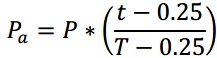
where:
Pa = value of the credit protection adjusted for maturity mismatch
P = credit protection (e.g. collateral amount, guarantee amount) adjusted for any haircuts
t = min (T, residual maturity of the credit protection arrangement) expressed in years
T = min (5, residual maturity of the exposure) expressed in years
36. Currency Mismatches
1. Where the credit protection is denominated in a currency different from that in which the exposure is denominated – i.e., there is a currency mismatch – the amount of the exposure deemed to be protected will be reduced by the application of a haircut HFX using the following formula:
GA = G * (1 − HFX)
where;
G = nominal amount of the credit protection
HFX = haircut appropriate for currency mismatch between the credit protection and underlying obligation.
2. Banks using the supervisory haircuts shall apply a haircut for a 10-business day holding period (assuming daily marking to market) of eight per cent for currency mismatch. This haircut must be scaled up using the square root of time formula, depending on the frequency of revaluation of the credit protection as described in paragraph 37(8)(xii).
37. Collateralised Transactions
(1) A Collateralised Transaction is one in which:
i. banks have a credit exposure and that credit exposure is hedged in whole or in part by collateral posted by a counterparty or by a third party on behalf of the counterparty. Here, “counterparty” is used to denote a party to whom a bank has an on- or off-balance sheet credit exposure.
ii. banks have a specific lien on the collateral and the requirements of legal certainty are met.
(2) Overall framework and minimum conditions
The framework allows banks to adopt either the simple approach, which substitutes the risk weighting of the collateral for the risk weighting of the counterparty for the collateralised portion of the exposure (generally subject to a 20 per cent floor), or the comprehensive approach, which allows precise offset of collateral against exposures, by effectively reducing the exposure amount by a volatility-adjusted value ascribed to the collateral. Banks in India shall adopt the Comprehensive Approach. Under this approach, banks, which take eligible financial collateral (e.g., cash or securities, more specifically defined below), are allowed to reduce their credit exposure to a counterparty when calculating their capital requirements to take into account of the risk mitigating effect of the collateral. Credit risk mitigation is allowed only on an account- by-account basis, even within regulatory retail portfolio. However, before capital relief shall be granted the standards set out below must be met:
i. Banks that lend securities or post collateral must calculate capital requirements for both of the following: (i) the credit risk or market risk of the securities, if this remains with the bank; and (ii) the counterparty credit risk arising from the risk that the borrower of the securities may default.
ii. In addition to the general requirements for legal certainty, the legal mechanism by which collateral is pledged or transferred must ensure that the bank has the right to liquidate or take legal possession of it, in a timely manner, in the event of the default, insolvency or bankruptcy (or one or more otherwise-defined credit events set out in the transaction documentation) of the counterparty (and, where applicable, of the custodian holding the collateral). Furthermore banks must take all steps necessary to fulfil those requirements under the law applicable to the bank’s interest in the collateral for obtaining and maintaining an enforceable security interest, e.g. by registering it with a registrar, or for exercising a right to net or set off in relation to the title transfer of the collateral.
iii. Banks must have clear and robust procedures for the timely liquidation of collateral to ensure that any legal conditions required for declaring the default of the counterparty and liquidating the collateral are observed, and that collateral can be liquidated promptly.
iv. Where the collateral is held by a custodian, banks must take reasonable steps to ensure that the custodian segregates the collateral from its own assets.
v. Banks must ensure that sufficient resources are devoted to the orderly operation of margin agreements with OTC derivative and securities- financing counterparties banks, as measured by the timeliness and accuracy of its outgoing calls and response time to incoming calls. Banks must have collateral management policies in place to control, monitor and report the following to the Board or one of its Committees:
a. the risk to which margin agreements expose them (such as the volatility and liquidity of the securities exchanged as collateral),
b. the concentration risk to particular types of collateral,
c. the reuse of collateral (both cash and non-cash) including the potential liquidity shortfalls resulting from the reuse of collateral received from counterparties, and
d. the surrender of rights on collateral posted to counterparties.
3. A capital requirement shall be applied to a bank on either side of the collateralised transaction: for example, both repos and reverse repos shall be subject to capital requirements. Likewise, both sides of securities lending and borrowing transactions shall be subject to explicit capital charges, as shall the posting of securities in connection with a derivative exposure or other borrowing.
4. Where a bank, acting as an agent, arranges, a SFT (ie., repurchase/ reverse repurchase and securities lending/ borrowing transactions) between a customer and a third party and provides a guarantee to the customer that the third party shall perform on its obligations, then the risk to the bank is the same as if the bank hand entered into the transaction as a principal. In such circumstances, a bank must calculate capital requirements as if it were itself the principal.
5. The Comprehensive Approach
(i) In the comprehensive approach, when taking collateral, banks will need to calculate their adjusted exposure to a counterparty for capital adequacy purposes in order to take account of the risk mitigating effects of that collateral. Banks are required to adjust both the amount of the exposure to the counterparty and the value of any collateral received in support of that counterparty to take account of possible future fluctuations in the value of either, occasioned by market movements. These adjustments are referred to as ‘haircuts’. The application of haircuts will produce volatility adjusted amounts for both exposure and collateral. The volatility adjusted amount for the exposure will be higher than the exposure amount and the volatility adjusted amount for the collateral will be lower than the collateral amount, unless either side of the transaction is cash. In other words, the ‘haircut’ for the exposure will be a premium factor and the ‘haircut’ for the collateral will be a discount factor. It may be noted that the purpose underlying the application of haircut is to capture the market-related volatility inherent in the value of exposures as well as of the eligible financial collaterals. Since the value of credit exposures acquired by banks in the course of their banking operations, would not be subject to market volatility, (since the loan disbursal / investment would be a “cash” transaction) though the value of eligible financial collateral would be, the haircut stipulated in paragraph 37(8) would apply in respect of credit transactions only to the eligible collateral but not to the credit exposure of the bank. On the other hand, exposures of banks, arising out of repo-style transactions would require upward adjustment for volatility, as the value of security sold/lent/pledged in the repo transaction, would be subject to market volatility. Hence, such exposures shall attract haircut.
ii. Additionally, where the exposure and collateral are held in different currencies an additional downwards adjustment must be made to the volatility adjusted collateral amount to take account of possible future fluctuations in exchange rates.
iii. Where the volatility-adjusted exposure amount is greater than the volatility-adjusted collateral amount (including any further adjustment for foreign exchange risk), banks shall calculate their risk-weighted assets as the difference between the two multiplied by the risk weight of the counterparty. The framework for performing calculations of capital requirement is indicated in paragraph 37(7).
(6) Eligible Financial Collateral
The following collateral instruments are eligible for recognition in the comprehensive approach:
i. Cash (as well as certificates of deposit or comparable instruments, including fixed deposit receipts issued by the lending bank) on deposit with the bank which is incurring the counterparty exposure.
ii. Gold: Gold shall include both bullion and jewellery. However, the value of the collateralised jewellery should be arrived at after notionally converting these to 99.99 purity.
iii. Securities issued by Central and State Governments
iv. Kisan Vikas Patra and National Savings Certificates provided no lock-in period is operational and if they can be encashed within the holding period.
(v) Life insurance policies with a declared surrender value of an insurance company which is regulated by an insurance sector regulator.
(vi) Debt securities rated by a chosen Credit Rating Agency in respect of which banks should be sufficiently confident about the market liquidity where these are either:
a. Rated at least BB (-) when issued by foreign sovereigns
b. Rated at least BBB (-) when issued by public sector entities and other entities (including banks and Primary Dealers); or
c. Rated at least A3 for short-term debt instruments.
Explanation: A debenture would meet the test of market liquidity if it is traded on a recognised stock exchange(s) on at least 90 per cent of the trading days during the preceding 365 days. Further, liquidity can be evidenced in the trading during the previous one month in the recognised stock exchange if there are a minimum of 25 trades of marketable lots in securities of each issuer.
(vii) Debt Securities not rated by a chosen Credit Rating Agency in respect of which banks should be sufficiently confident about the market liquidity where these are:
a. issued by a bank; and
b. listed on a recognised exchange; and
c. classified as senior debt; and
d. all rated issues of the same seniority by the issuing bank are rated at least BBB- or A3 by a chosen Credit Rating Agency; and
e. the bank holding the securities as collateral has no information to suggest that the issue justifies a rating below BBB- or A3 (as applicable) and;
f. Banks should be sufficiently confident about the market liquidity of the security.
(viii) Units of Mutual Funds regulated by the securities regulator of the jurisdiction of the bank’s operation where:
(a) a price for the units is publicly quoted daily i.e., where the daily NAV is available in public domain; and
(b) Mutual fund is limited to investing in the instruments listed in this paragraph (i.e. paragraph 37(6)).
ix. Re-securitisations, irrespective of any credit ratings, are not eligible financial collateral.
x. The Indian branches of foreign banks shall be permitted to reckon cash / unencumbered approved securities, the source of which is interest-free funds from Head Office or remittable surplus retained in Indian books (reserves), held with RBI under section 11(2)(b)(i) of the Banking Regulation Act,1949 as CRM, for offsetting the any exposure to the Head Office (HO) or overseas branches of the HO, subject to the conditions prescribed in the Reserve Bank of India (Commercial Banks – Concentration Risk Management) Directions, 2025.
Explanation: The amount so held shall not be included in regulatory capital (i.e., no double counting of the fund placed under Section 11(2) of the Banking Regulation Act,1949 as both capital and CRM). Accordingly, while assessing the capital adequacy of a bank, the amount shall form part of regulatory adjustments made to Common Equity Tier 1 Capital.
(7) Calculation of capital requirement:
(i) For a collateralised transaction, the exposure amount after risk mitigation is calculated as follows:
E* = mat0, [E * (1 − Ple) − C * (1 − Plc − Plf)]}
where:
E* = the exposure value after risk mitigation
E = current value of the exposure for which the collateral qualifies as a risk mitigant
He = haircut appropriate to the exposure
C = the current value of the collateral received
Hc = haircut appropriate to the collateral
Hfx = haircut appropriate for currency mismatch between the collateral and exposure
ii. In the case of maturity mismatches, the value of the collateral received (collateral amount) must be adjusted in accordance with paragraph 35.
ii. The exposure amount after risk mitigation (i.e., E*) shall be multiplied by the risk weight of the counterparty to obtain the risk-weighted asset amount for the collateralised transaction. Illustrative examples calculating the effect of Credit Risk Mitigation are furnished in paragraph 162 of the Reserve Bank of India (Commercial Banks – Prudential Norms on Capital Adequacy) Directions, 2025.
(8) Haircuts
i. In principle, banks have two ways of calculating the haircuts: (i) standard supervisory haircuts, using parameters set by the Basel Committee, and (ii) own-estimate haircuts, using banks’ own internal estimates of market price volatility. Banks in India shall use only the standard supervisory haircuts for both the exposure as well as the collateral.
ii. The Standard Supervisory Haircuts (assuming daily mark-to-market, daily re-margining and a 10 business-day holding period), expressed as percentages, shall be as furnished in Tables below.
Explanation: Holding period shall be the time normally required by the bank to realise the value of the collateral.
iii. The ratings indicated in Table 25 represent the ratings assigned by the domestic rating agencies. In the case of exposures toward debt securities issued by foreign Central Governments and foreign corporates, the haircut may be based on ratings of the international rating agencies, as indicated in Table 26.
iv. Sovereign shall include Reserve Bank of India and DICGC which are eligible for zero per cent risk weight.
v. Guarantees issued by CGTMSE, CRGFTLIH and NCGTC (which are backed by an unconditional and irrevocable guarantee provided by Government of India which are eligible for zero percent risk to the extent of guarantee coverage) shall be included under Sovereign.
(vi) Banks may apply a zero haircut for eligible collateral where it is a National Savings Certificate, Kisan Vikas Patras, surrender value of insurance policies and banks’ own deposits.
vii. The standard supervisory haircut for currency risk where exposure and collateral are denominated in different currencies is eight per cent (also based on a 10-business day holding period and daily mark-to-market).
Table 25: Standard Supervisory Haircuts for Sovereign and other securities which constitute Exposure and Collateral
| Sl. No. | Issue Rating for Debt securities |
Residual Maturity (in years) |
Haircut
(in percentage) |
|
|---|---|---|---|---|
| A | Securities issued / guaranteed by the Government of India and issued by the State Governments (Sovereign securities) | |||
| I | Rating not applicable – as Government securities are not currently rated in India |
≤ 1 year | 0.5 | |
| > 1 year and ≤
3 years |
2 | |||
| > 3 year and ≤ 5 years |
||||
| > 5 year and ≤ 10 years |
4 | |||
| > 10 years | ||||
| Domestic debt securities other than those indicated at Item No. A(i) above including the securities guaranteed by Indian State Governments | ||||
| II | AAA to AA-/A1 |
≤ 1 year | 1 | |
| > 1 year and ≤ 3 years | 3 | |||
| > 3 year and ≤
5 years |
4 | |||
| > 5 year and ≤ 10 years | 6 | |||
| > 10 years | 12 | |||
| III | A+ to BBB-/ A2, A3 and P3 and unrated bank securities as specified in paragraph 37(6)(vii) of these Directions |
≤ 1 year | 2 | |
| > 1 year and ≤ 3 years |
4 | |||
| > 3 year and ≤ 5 years |
6 | |||
| > 5 year and ≤ 10 years |
12 | |||
| Sl. No. | Issue Rating for Debt securities |
Residual Maturity (in years) |
Haircut
(in percentage) |
|
| > 10 years | 20 | |||
| IV | Units of Mutual Funds | Highest haircut
applicable to any of the above securities, in which the eligible mutual fund {cf. 37(6)(viii)} can invest, unless the bank can apply the look-through approach (LTA) for equity investments in funds in which case the bank may use a weighted average of haircuts applicable to instruments held by the fund. |
||
| C | Cash in the same currency | 0 | ||
| D | Gold | 20 | ||
| Securitisation Exposures (Including those backed by securities issued by foreign sovereigns and foreign corporates) | ||||
| V | AAA to AA |
≤ 1 year | 2 | |
| > 1 year and ≤ 3 years |
8 | |||
| > 3 year and ≤ 5 years | ||||
| > 5 year and ≤ 10 years | 16 | |||
| > 10 years | ||||
| VI | A to BBB and unrated bank securities as specified in paragraph 37(6)(vii) of these Directions |
≤ 1 year | 4 | |
| > 1 year and ≤ 3 years |
12 | |||
| > 3 year and ≤ 5 years |
||||
| > 5 years, <=10years |
24 | |||
–
| Sl. No. | Issue Rating for Debt securities |
Residual Maturity (in years) |
Haircut (in percentage) | |
|---|---|---|---|---|
| >10 years | ||||
Table 26: Standard Supervisory Haircut for Exposures and Collaterals which are obligations of foreign central sovereigns / foreign corporates
| Issue rating for debt securities as assigned by international rating agencies | Residual Maturity |
Sovereigns
(%) |
Other Issues (%) |
|---|---|---|---|
| AAA to AA / A1 | < = 1 year | 0.5 | 1 |
| > 1 year and ≤ 3 years | 2 | 3 | |
| > 3 year and ≤
5 years |
4 | ||
| > 5 year and ≤ 10 years | 4 | 6 | |
| > 10 years | 12 | ||
| A to BBB /
A2 / A3 and Unrated Bank Securities |
< = 1 year | 1 | 2 |
| > 1 year and ≤
3 years |
3 | 4 | |
| > 3 years, ≤5 years |
6 | ||
| > 5 years, ≤10 years | 6 | 12 | |
| >10 years | 20 | ||
| BB+ to BB- | All | 15 | Not eligible |
viii. For transactions in which banks’ exposures are unrated or bank lends non-eligible instruments (i.e. non-investment grade corporate securities), the haircut to be applied on an exposure shall be 30 per cent. For transactions in which bank borrows non-eligible instruments, credit risk mitigation shall not be applied.
(ix) Where the collateral is a basket of assets, the haircut on the basket shall be,
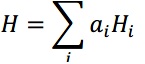
where is the weight of the asset (as measured by the amount/value of the asset in units of currency) in the basket and , the haircut applicable to that asset.
(x) Adjustment for different holding periods:
For some transactions, depending on the nature and frequency of the revaluation and remargining provisions, different holding periods (other than 10 business-days) are appropriate. The framework for collateral haircuts distinguishes between repo-style transactions (i.e. repo/reverse repos and securities lending/borrowing), “other capital-market-driven transactions” (i.e. OTC derivatives transactions and margin lending) and secured lending. In capital-market-driven transactions and repo-style transactions, the documentation contains remargining clauses; in secured lending transactions, it generally does not. In view of different holding periods, in the case of these transactions, the minimum holding period shall be taken as indicated below:
Table 27: Minimum Holding Period
| Transaction type | Minimum holding Period | Condition |
|---|---|---|
| Repo-style transaction | five business days | daily remargining |
| Other capital market transactions |
ten business days | daily remargining |
| Secured lending | twenty business days | daily revaluation |
The haircut for the transactions with other than 10 business-days minimum holding period, as indicated above, shall have to be adjusted by scaling up/down the haircut for 10 business–days indicated in the Table 27 above, as per the formula given in paragraph 37(8)(xii) below.
xi. Adjustment for non-daily mark-to-market or remargining:
In case a transaction has margining frequency different from daily margining assumed, the applicable haircut for the transaction shall also need to be adjusted by using the formula given in paragraph 37(8)(xii) below.
xii. Formula for adjustment for different holding periods and / or non-daily mark- to-market or remargining:
Adjustment for the variation in holding period and margining / mark-to-market, as indicated in paragraphs 37(8)(x) and 37(8)(xi) above shall be done as per the following formula:
H = H10[,J(NR + (TM – 1)
10
Where;
H = haircut
H10= 10-business-day standard supervisory haircut for instrument
NR = actual number of business days between remargining for capital
market transactions or revaluation for secured transactions.
TM = minimum holding period for the type of transaction
38. Credit Risk Mitigation Techniques – On-Balance Sheet Netting
On-balance sheet netting is confined to loans/advances and deposits, where banks have legally enforceable netting arrangements, involving specific lien with proof of documentation. They may calculate capital requirements on the basis of net credit exposures subject to the following conditions:
Where a bank,
i. has a well-founded legal basis for concluding that the netting or offsetting agreement is enforceable in each relevant jurisdiction regardless of whether the counterparty is insolvent or bankrupt;
ii. is able at any time to determine the loans/advances and deposits with the same counterparty that are subject to the netting agreement;
iii. monitors and controls the relevant exposures on a net basis; and
iv. monitors and controls its roll-off risks.
it may use the net exposure of loans/advances and deposits as the basis for its capital adequacy calculation in accordance with the formula in paragraph 37(7). Loans/advances are treated as exposure and deposits as collateral. The haircuts will be zero except when a currency mismatch exists. All the requirements contained in paragraphs 37(7) and 35 will also apply.
39. Credit Risk Mitigation Techniques – Guarantees
1. Where guarantees are direct, explicit, irrevocable and unconditional banks may take account of such credit protection in calculating capital requirements.
2. A range of guarantors are recognised and a substitution approach will be applied. Thus, only guarantees issued by entities with a lower risk weight than the counterparty will lead to reduced capital charges since the protected portion of the counterparty exposure is assigned the risk weight of the guarantor, whereas the uncovered portion retains the risk weight of the underlying counterparty.
3. Detailed operational requirements for guarantees eligible for being treated as a CRM are as under:
4. Operational requirements for Guarantees
i. If conditions set below are met, banks can substitute the risk weight of the counterparty with the risk weight of the guarantor.
ii. A guarantee (counter-guarantee) must represent a direct claim on the protection provider and must be explicitly referenced to specific exposures or a pool of exposures, so that the extent of the cover is clearly defined and incontrovertible. The guarantee must be irrevocable; there must be no clause in the contract that would allow the protection provider to unilaterally cancel the cover or that would increase the effective cost of cover as a result of deteriorating credit quality in the guaranteed exposure. The guarantee must also be unconditional; there should be no clause in the guarantee outside the direct control of the bank that could prevent the protection provider from being obliged to pay out in a timely manner in the event that the original counterparty fails to make the payment(s) due.
iii. In the case of maturity mismatches, the amount of credit protection that is provided must be adjusted in accordance with paragraph 35.
iv. All exposures will be risk weighted after taking into account risk mitigation available in the form of guarantees. When a guaranteed exposure is classified as non-performing, the guarantee will cease to be a credit risk mitigant and no adjustment would be permissible on account of credit risk mitigation in the form of guarantees. The entire outstanding, net of specific provision and net of realisable value of eligible collaterals / credit risk mitigants, will attract the appropriate risk weight.
(v) Additional operational requirements for guarantees
In addition to the legal certainty requirements in paragraph 34 above, in order for a guarantee to be recognised, the following conditions must be satisfied:
a. On the qualifying default/non-payment of the counterparty, the bank is able in a timely manner to pursue the guarantor for any monies outstanding under the documentation governing the transaction. The guarantor shall make one lump sum payment of all monies under such documentation to the bank, or the guarantor shall assume the future payment obligations of the counterparty covered by the guarantee. The bank must have the right to receive any such payments from the guarantor without first having to take legal actions in order to pursue the counterparty for payment.
b. The guarantee is an explicitly documented obligation assumed by the guarantor.
c. Except as noted in the following sentence, the guarantee covers all types of payments the underlying obligor is expected to make under the documentation governing the transaction, for example notional amount, margin payments etc. Where a guarantee covers payment of principal only, interests and other uncovered payments should be treated as an unsecured amount in accordance with paragraph 39(7).
(5) Range of Eligible Guarantors (Counter-Guarantors)
Credit protection given by the following entities will be recognised:
i. Sovereigns, sovereign entities (including BIS, IMF, European Central Bank, the European Union, the European Stability Mechanism and the European Financial Stability Facility as well as those MDBs referred to in paragraph 10, ECGC and CGTMSE, CRGFTLIH, individual schemes under NCGTC which are backed by explicit Central Government Guarantee), banks and primary dealers with a lower risk weight than the counterparty.
ii. Other entities that are externally rated except when credit protection is provided to a securitisation exposure. This would include credit protection provided by parent, subsidiary and affiliate companies when they have a lower risk weight than the obligor.
iii. When credit protection is provided to a securitisation exposure, other entities that currently are externally rated BBB- or better and that were externally rated A- or better at the time the credit protection was provided. This would include credit protection provided by parent, subsidiary and affiliate companies when they have a lower risk weight than the obligor.
iv. In case of securitisation transactions, SPEs cannot be recognised as eligible guarantors.
(6)Risk Weights
i. The protected portion is assigned the risk weight of the protection provider. Exposures covered by State Government guarantees shall attract a risk weight of 20 per cent. The uncovered portion of the exposure is assigned the risk weight of the underlying counterparty.
ii. Materiality thresholds on payments below which the protection provider is exempt from payment in the event of loss are equivalent to retained first-loss positions. The portion of the exposure that is below a materiality threshold shall be subject to full capital deduction by the bank purchasing the credit protection.
iii. Any CRM instrument from which CRM benefits like shifting of exposure/ risk weights etc. are not derived may not be counted as an exposure on the CRM provider. In cases where the exposure is reckoned on the counterparty, risk weight of the counterparty shall apply.
(7) Proportional Cover
Where the amount guaranteed, or against which credit protection is held, is less than the amount of the exposure, and the secured and unsecured portions are of equal seniority, i.e. the bank and the guarantor share losses pari passu on a pro-rata basis capital relief will be afforded on a proportional basis: i.e. the protected portion of the exposure will receive the treatment applicable to eligible guarantees, with the remainder treated as unsecured.
(8) Tranched Cover
Where the bank transfers a portion of the risk of an exposure in one or more tranches to a protection seller or sellers and retains some level of the risk of the loan, and the risk transferred and the risk retained are of different seniority, banks may obtain credit protection for either the senior tranches (eg the second-loss portion) or the junior tranche (eg the first-loss portion). In this case the rules as set out in the securitization standard apply.
(9) Sovereign Guarantees and Counter-Guarantees
A claim may be covered by a guarantee that is indirectly counter-guaranteed by a sovereign. Such a claim shall be treated as covered by a sovereign guarantee provided that:
i. the sovereign counter-guarantee covers all credit risk elements of the claim;
ii. both the original guarantee and the counter-guarantee meet all operational requirements for guarantees, except that the counter-guarantee need not be direct and explicit to the original claim; and
iii. the cover should be robust and no historical evidence suggests that the coverage of the counter-guarantee is less than effectively equivalent to that of a direct sovereign guarantee.
(10) ECGC Guaranteed Exposures:
Under the Export Credit insurance for banks on Whole Turnover Basis, the guarantee/insurance cover given by ECGC for export credit exposures of the banks ranges between 50 per cent and 75 per cent for pre-shipment credit and 50 per cent to 85 per cent in case of post-shipment credit. However, the ECGC’s total liability on account of default by the exporters is capped by an amount specified as Maximum Liability (ML). In this context, it is clarified that risk weight (as given in paragraph 7(5) of these Directions) applicable to the claims on ECGC should be capped to the ML amount specified in the whole turnover policy of the ECGC. The banks are required to proportionately distribute the ECGC maximum liability amount to all individual export credits that are covered by the ECGC Policy. For the covered portion of individual export credits, the banks shall apply the risk weight applicable to claims on ECGC. For the remaining portion of individual export credit, the banks shall apply the risk weight as per the rating of the counter-party. The RWA computation can be mathematically represented as under:
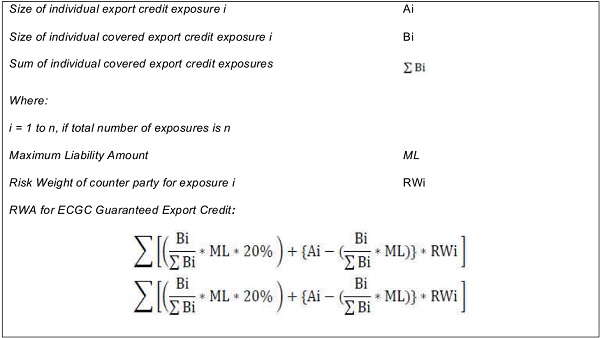
CHAPTER VI – REPEAL
40. Upon coming into effect of these Directions on April 01, 2027, the corresponding provisions in the Reserve Bank of India (Commercial Banks – Prudential Norms on Capital Adequacy) Directions, 2025 shall stand repealed.
Vaibhav Chaturvedi
(Chief General Manager)
Appendix 1
Determination of equity exposure
1. Equity exposures are defined on the basis of the economic substance of the instrument. They include both direct and indirect ownership interests, whether voting or non-voting, in the assets and income of a commercial enterprise or of a financial institution that is not consolidated or deducted. An instrument is considered to be an equity exposure if it meets all of the following requirements:
i. It is irredeemable in the sense that the return of invested funds can be achieved only by the sale of the investment or sale of the rights to the investment or by the liquidation of the issuer;
ii. It does not embody an obligation on the part of the issuer; and
iii. It conveys a residual claim on the assets or income of the issuer.
Explanation: Indirect equity interests include holdings of derivative instruments tied to equity interests, and holdings in corporations, partnerships, limited liability companies or other types of enterprises that issue ownership interests and are engaged principally in the business of investing in equity instruments
2. Additionally any of the following instruments must be categorised as an equity exposure:
i. An instrument with the same structure as those permitted as Tier 1 capital for banking organisations.
ii. An instrument that embodies an obligation on the part of the issuer and meets any of the following conditions:
a. The issuer may defer indefinitely the settlement of the obligation;
b. The obligation requires (or permits at the issuer’s discretion) settlement by issuance of a fixed number of the issuer’s equity shares;
c. The obligation requires (or permits at the issuer’s discretion) settlement by issuance of a variable number of the issuer’s equity shares and (ceteris paribus) any change in the value of the obligation is attributable to, comparable to, and in the same direction as, the change in the value of a fixed number of the issuer’s equity shares; or,
Explanation: For certain obligations that require or permit settlement by issuance of a variable number of the issuer’s equity shares, the change in the monetary value of the obligation is equal to the change in the fair value of a fixed number of equity shares multiplied by a specified factor. Those obligations meet the conditions of item 3 if both the factor and the referenced number of shares are fixed. For example, an issuer may be required to settle an obligation by issuing shares with a value equal to three times the appreciation in the fair value of 1,000 equity shares. That obligation is considered to be the same as an obligation that requires settlement by issuance of shares equal to the appreciation in the fair value of 3,000 equity shares
(d) The holder has the option to require that the obligation be settled in equity shares, unless either (i) in the case of a traded instrument, the supervisor is content that the bank has demonstrated that the instrument trades more like the debt of the issuer than like its equity, or (ii) in the case of non-traded instruments, the supervisor is content that the bank has demonstrated that the instrument should be treated as a debt position. In cases (i) and (ii), the bank may decompose the risks for regulatory purposes, with the consent of the supervisor.
3. Debt obligations and other securities, partnerships, derivatives or other vehicles structured with the intent of conveying the economic substance of equity ownership are considered an equity holding. This includes liabilities from which the return is linked to that of equities. Conversely, equity investments that are structured with the intent of conveying the economic substance of debt holdings or securitisation exposures shall not be considered an equity holding.
Explanation:
(a)Equities that are recorded as a loan but arise from a debt/equity swap made as part of the orderly realisation or restructuring of the debt are included in the definition of equity holdings. However, these instruments may not attract a lower capital charge than would apply if the holdings remained in the debt portfolio.
(b)Supervisors may decide not to require that liabilities from which the return is
linked to that of equities, be included where they are directly hedged by an equity holding, such that the net position does not involve material risk.
(c) RBI can, however, re-characterise debt holdings as equites for regulatory purposes and to otherwise ensure the proper treatment of holdings under Pillar 2.
Appendix 2
1. Calculation of risk-weighted assets using the LTA
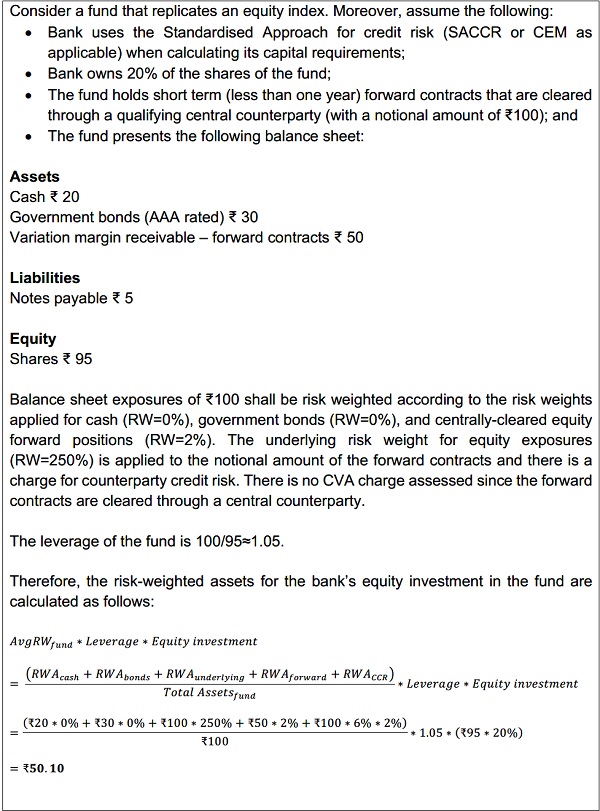
Reserve Bank of India (Commercial Banks – Capital Charge for Credit Risk – Standardised Approach) Directions, 2026
2. Calculation of risk-weighted assets using the MBA
| Consider a fund with assets of ₹100, where it is stated in the mandate that the fund replicates an equity index. In addition to being permitted to invest its assets in either cash or equities, the mandate allows the fund to take long positions in equity index futures up to a maximum nominal amount equivalent to the size of the fund’s balance sheet (₹100). This means that the total on balance sheet and off balance sheet exposures of the fund can reach ₹200. Consider also that a maximum financial leverage of 1.1 applies according to the mandate. The bank holds 20% of the shares of the fund, which represents an investment of ₹18.18.
First, the on-balance sheet exposures of ₹100 shall be risk weighted according to the risk weights applied for equity exposures (RW=250%), ie RWAon-balance = ₹100 * 250% = ₹250. Second, we assume that the fund has exhausted its limit on derivative positions, ie ₹100 notional amount, which would be weighted with the risk weight associated with the underlying of the derivative position, which in this example is 100% for publicly-traded equity holdings. The total risk-weighted assets related to the maximum notional amount underlying the derivative positions are hence RWAunderlying = ₹100 * 250% = ₹250. Third, we would calculate the counterparty credit risk associated with the derivative contract. If we do not know the replacement cost related to the futures contract, we would approximate it by the maximum notional amount, ie ₹100 and also calculate the add-on by applying a 15% conversion factor, resulting in an exposure amount of ₹115. Assuming the futures contract is cleared through a qualifying CCP, a risk weight of 2% applies, so that RWACCR = ₹115 * 2% = ₹2.3. There is no CVA charge assessed since the futures contract is cleared through a central counterparty. The RWA of the fund is hence obtained by adding RWAon-balance, RWAunderlying and RWACCR, ie ₹502.3. Leverage adjustment The RWA (₹502.3) shall be divided by the total assets of the fund (₹100) resulting in an average risk weight of 502.3%. The average risk-weight is then scaled up by a factor of 1.1 to reflect financial leverage = 502.3%*1.1 = 552.53%. Finally, as the bank invested ₹18.18 in the equity of the fund, its total RWAs associated with its equity investment amount to ₹18.18 * 552.53% = ₹100.45 |
3.Calculation of the leverage adjustment
Consider a fund with assets of ₹100 that invests in corporate debt. Assume that the fund is highly levered with equity of ₹5 and debt of ₹95. Such a fund would have financial leverage of 100/5=20.
Consider the following two cases:
Case 1: Fund specialises in low-rated corporate debt
Assets
Cash ₹ 10
A+ to A- bonds ₹ 20
BBB+ to BBB- bonds ₹ 30
Below BBB- bonds ₹ 40
he average risk weight of the fund is (₹10*0% + ₹20*50% + ₹30*100% + ₹40*150%)/₹100 = 100%. The financial leverage of 20 would result in a risk weight of 2000% for the banks’ investment in this highly levered fund, however, this is capped at a conservative risk weight of 1111% (equivalent to full capital deduction).
Case 2: Fund specialises in high-rated corporate debt
Assets
Cash ₹ 5
AAA to AAA- bonds ₹ 75
A+ to A- bonds ₹ 20
The average risk weight of the fund is (₹5*0% + ₹75*20% + ₹20*50%)/₹100 = 25%. The financial leverage of 20 results in a risk weight of 500%. The above example illustrates that the rate at which the 1111% cap is reached depends on the underlying riskiness of the portfolio (as judged by the average risk weight) as captured by Basel II Standardised Approach risk weights or the IRB methods. Therefore, for a “risky” portfolio (100% average risk weight), the 1111% limit is reached fairly quickly with a leverage of 11.1x, while for a “low risk” portfolio (25% average risk weight) this limit is reached at a leverage of 44.44x