From Section 194-IA to Section 393
(A Procedural Evolution in TDS Compliance on Immovable Property Transactions)
1. Introduction:
Tax Deducted at Source (TDS) on transfer of immovable property was introduced by the Finance Act, 2013 and came into effect on June 1, 2013 to bring high-value real estate transactions within the reporting framework and enhance transparency in tax administration.
Section 194-IA of the Income-tax Act, 1961 has, over the years, served this purpose effectively. However, from a practical standpoint, its procedural framework often resulted in operational difficulties, particularly in transactions involving multiple buyers and/or sellers.
With the introduction of Section 393 under the Income-Tax Act, 2025, the legislature has retained the substantive provisions while significantly rationalising procedural compliance. This shift reflects a broader policy objective of simplification, system-driven accuracy, and improved taxpayer experience.
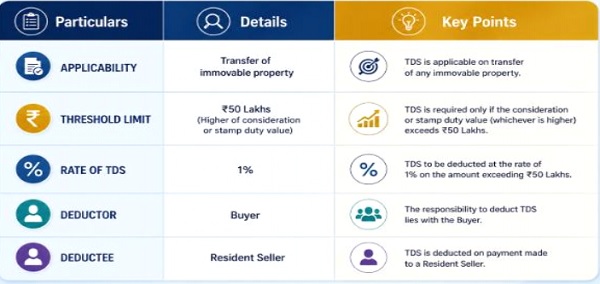
2. Substantive Provisions – No Change in Core Framework
The transition from Section 194-IA to Section 393 does not alter the fundamental tax framework. The reform is procedural rather than substantive in nature.
3. Comparative Overview:
| Particulars | Section 194-IA
(Income-tax Act, 1961) |
Section 393
(Income-tax Act, 2025) |
|---|---|---|
| Compliance Form | Form 26QB | Form 141 |
| Filing Mechanism | Separate Form for Each Seller | Single Consolidated Form by Each Buyer |
| Calculation Of Consideration | Manual Allocation of Consideration Amount |
System-Driven Allocation of Consideration Amount |
| Error Probability | Relatively Higher | Reduced |
| Compliance Burden |
Higher | Streamlined |
| Due Date | 30 days from the end of the month in which the deduction was made |
30 days from the end of the month in which the deduction was made |
4. Key Procedural Reforms
4.1 Introduction of Single Form
Under the earlier framework:
- Separate Form 26QB was required for each seller, even in single-buyer transactions.
- This resulted in duplication, increased compliance burden, and higher probability of errors.
Under the new framework:
- A single Form 141 is required, irrespective of the number of sellers.
- This significantly streamlines compliance and reduces redundancy.
| Particulars | Section 194-IA (Income-tax Act, 1961) |
Section 393 (Income-tax Act, 2025) |
|---|---|---|
| No. Of Buyer | 3 | 3 |
| No. of Seller | 3 | 3 |
| No. of Form Required | 9 | 3 |
4.2 System-Driven Allocation of Consideration
The revised framework captures:
- Percentage share of buyers and sellers
- Enables automatic proportionate allocation of consideration and TDS This reduces manual intervention and enhances accuracy.
4.3 Improved Transparency and Data Integrity
The new system facilitates:
- Better alignment with Value of Consideration / Stamp Duty Value
- Reduced discrepancies in AIS and Form 26AS
4.4 Issue in Reporting of Total Consideration under the Earlier framework
A significant practical challenge under the erstwhile Form 26QB framework related to the reporting of total consideration in cases involving multiple buyers or sellers.
In practice, two alternative approaches were followed:
- Reporting Gross Consideration: Where the entire transaction value was reported in each Form 26QB, it resulted in duplication of transaction value in AIS/TIS, leading to inflated reporting despite TDS being deducted only on the respective share.
- Reporting Proportionate Consideration: To mitigate duplication, professionals adopted reporting of proportionate consideration based on ownership share. However, this approach appeared conceptually inconsistent, as the form required reporting of total consideration.
This resulted in:
- Mismatches in reported transaction values
- Increased scrutiny during assessments
- Additional reconciliation efforts and explanations
4.5 Resolution under Section 393 (Form 141)
The introduction of Form 141 appears to address this inconsistency by:
- Explicitly capturing percentage share of buyers and sellers
- Enabling system-driven proportionate allocation
- Eliminating duplication in AIS/TIS reporting
This represents a structural correction of a long-standing reporting anomaly, improving both logical consistency and data accuracy.
5. Impact on Stakeholders
| For Buyers |
|
| For Sellers
|
|
| For Professionals
|
|
6. Broader Perspective: Ease of Compliance
The transition reflects a policy shift towards:
- Digitisation and automation of compliance
- Reduction in procedural bottlenecks
- Enhanced taxpayer convenience
- Improved quality and reliability of reportable information.
7. Key Takeaways
- No change in tax liability or applicability
- Significant procedural simplification
- Single form filing is a major reform
- System-driven allocation reduces errors and disputes
- Correction of earlier reporting inconsistencies
- Strengthening of transparency and compliance ecosystem
8. Conclusion
The transition from Section 194-IA to Section 393 represents a progressive procedural reform. While the substantive provisions remain unchanged, the compliance experience has been significantly enhanced.
The introduction of a single form mechanism and system-driven allocation not only simplifies compliance but also addresses inherent inconsistencies in the earlier reporting framework.
Such reforms reinforce the principle that effective tax administration depends as much on ease of compliance as on statutory provisions.
*****
Authored by: CA. Bipin Kumar| Email: [email protected]
About the Author: CA. Bipin Kumar is a practicing Chartered Accountant with expertise in direct taxation, compliance, and litigation. He advises clients on tax structuring, assessments, and regulatory matters, and actively engages in resolving practical challenges in tax implementation.
Disclaimer: The views expressed in this article are based on the author’s interpretation of the provisions and practical insights gathered during the course of professional practice and compliance handling. While due care has been taken in presenting the analysis, readers are advised to refer to the relevant statutory provisions, rules, notifications, and official guidance, and to seek professional advice before acting on the basis of this article